
Photograph by
Over the past decade, MTA Education Support Professionals have been on the march across Massachusetts. Contract victories have reset our sense of possibility as poverty pay has given way to significant raises, job security and the respect ESPs deserve. As a proud MTA member and the author of a new book on the history of "paraprofessional" labor in education, I have celebrated these wins, both for what they deliver in the present and for how they renew a fighting tradition among ESPs. Decades ago, the first generation of paraeducators reimagined what administrators called "aide" work, linking their labor to struggles for jobs and freedom in their schools, communities and unions. In doing so, they showed how public education and educator unionism could, and should, promote equality, opportunity and the common good for students, workers and their communities.
With apologies to my professional home in Boston, I recently published a book that is primarily a study of the American Federation of Teachers and its New York City local, the United Federation of Teachers. That said, working in and with our MTA union family helped me to better understand the significance of this history as I was finishing this book. ESPs don’t need a historian to tell them they’ve had to do too much with too little for too long, but conversations with ESPs and organizers have convinced me that this history offers a rich font of context and ideas as we fight for what we deserve in the present and defend public education for the future.
To start, where did these paraprofessional/ESP jobs come from? The answer begins with the baby boom. As the national K-12 student population nearly doubled between 1949 and 1969, administrators scrambled to staff schools. One idea, promoted by the Ford Foundation, was the hiring of "teacher aides," envisioned as local mothers who would work for a pittance doing menial, administrative, care and disciplinary work while credentialed teachers lectured in front of classrooms of 40 students (or more). Crucially for the bosses, the plan was cheaper than hiring more teachers, already unionizing in the late 1950s.
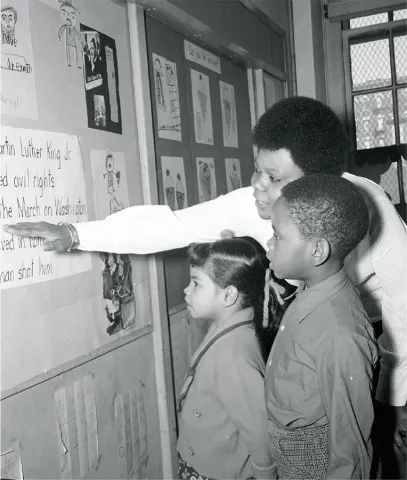
However, the moment the first "aides" went to work, they began to rethink and remake these jobs. Despite being designated "non-professional," their labor was clearly educational, as both they and the teachers they worked with realized immediately. In addition, these aides brought local knowledge into classrooms from communities and carried information from schools back to parents, developing new conduits for learning and communication. Some of them, after a year or two, expressed interest in advancing within the educational workforce as teachers, counselors or social workers.
It was these three overlapping qualities that drew the attention of civil rights organizers in U.S. cities, particularly New York. In Harlem and on the Lower East Side, community organizations advocated for the hiring of "parent aides" in schools, with the express goal of desegregating the educational workforce, creating jobs for Black and Puerto Rican New Yorkers, and making schools more responsive to the communities they served. Their ideas went mainstream with the passage of the Elementary and Secondary Education Act (ESEA) in 1965. Best known for creating the Title I program to support students living in poverty, the ESEA also encouraged the hiring of educators from their communities, to implement the "maximum feasible participation" of poor and working-class people in the systems that governed their lives. Using federal funds, New York City alone hired 10,000 new "paraprofessional" educators between 1967 and 1970. Nationally, nearly half a million of these workers entered schools between 1965 and 1975.

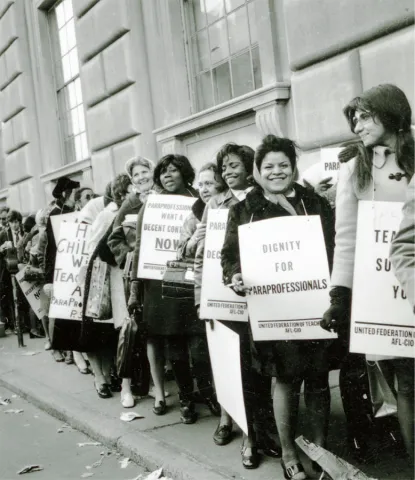
The hiring of "paras" paralleled the rise of teacher militancy (in both the AFT and our own National Education Association) and the rapid growth of collective bargaining for teachers. As locals fought for their early contracts, the presence of new paraeducators in the classroom posed a question: Would these new workers want to join "teacher" unions, and would these unions, which asserted teachers’ professionalism in their campaigns, welcome them? Debates raged, too extensive to recount here, though it should be a point of state pride that one of the first union leaders to argue that paras belonged in "teachers" unions was Lynn’s own Rose Claffey. What I learned in my research, however, is that what mattered most was the everyday solidarity that teachers and ESPs built on the ground once paras started work and teachers got over the shock of having new adults in their classrooms. Shared labor led to mutual recognition and appreciation, and when the time came for ESPs/paras to elect their collective bargaining agents – a process often accompanied by simultaneous votes among teachers as to whether to expand their unions to include these workers – it was this solidarity that overcame fear and distrust, as well as divides of race, class and geography. Tens of thousands of paras joined teacher unions in the 1970s, winning major raises, job security and paths to advancement. Their presence in these unions did not guarantee continued solidarity with teachers, but it did establish a baseline for future organizing.
Ten years ago, I put some of what’s above into a blog post for the Labor and Working-Class History Association, where Jessica Wender-Shubow, then the president of the Brookline Educators Union, found it. Jess wrote to me wondering if this history could help the Brookline School Committee understand "paraprofessionals’ struggles as part of efforts to achieve racial equity and justice." As she explained, the school committee – like many in liberal Massachusetts towns – professed a commitment to these values in general, but they had no idea where ESPs, or their jobs, came from. Brookline was not alone; decades of top-down, market-based "education reform" had not only sidelined ESPs and their history but replaced the broad visions for public education they promoted in the 1960s and 1970s with narrow interventions guided by elite administrators and consultants.
In Brookline, ESPs campaigned for years to change this narrative, and their struggle showed me just how powerful recovering this history could be. At a rally attended by hundreds in June of 2023, BEU paras and teachers shared the stage with Heather McGhee, then promoting her book "The Sum of Us: What Racism Costs Everyone and How We Can Prosper Together." McGhee’s book builds on a general history of the public goods lost when Southern cities shuttered pools and libraries rather than integrate them to argue that we need an expansive definition of the public good, one that rejects the "zero sum" logic of scarcity so long promoted by neoliberal policymakers. Moderating this event, I argued that ESPs and their labor fit squarely into this narrative. Rather than quibbling over miniscule raises, what would it look like if school committees understood the hiring and promotion of working-class educators – more often women of color than in any other school position – as part of an effort to reach and educate all our students, to improve our relationships with their communities, and to create jobs that provide stable careers to individuals and allow them to act as anchors of public service in their towns and cities?
This, I believe, is one key way in which the history is useful: not just for MTA educators who believe in the power of public education, but also for the wider public to whom we appeal as unionized educators. If linking this labor to struggles for racial and economic justice sounds unexpected, it’s worth saying that civil rights leaders – Bayard Rustin, A. Philip Randolph and Coretta Scott King among them – made this case a generation ago. If the raises ESPs seek today of 30 percent or more seem like a lot to school committees, let us recall that New York City’s paras won a 140 percent increase in their first contract in 1970, gains mirrored around the nation in the decade that followed.
Back in December, Holly Currier, a member of the MTA ESP Committee, helped me put together a virtual book launch. Afterward, as we discussed the gains paras have made, she noted that fighting for "living wages" is, of course, essential, but it shouldn’t be the limit of what we seek. The solidarity we’ve seen among educators on picket lines and in contract campaigns across the state need not stop at "raising the floor," but opens the possibility of new collaborations in classrooms, unions and communities. At a time when the entire public sector is under attack in the name of "efficiency," ESPs in Massachusetts are renewing a tradition of advancing equality, for everyone, students and educators alike.
is a member of the Faculty Staff Union at UMass Boston, where he is an assistant professor of history and labor studies and the associate director of the Labor Resource Center. He is the author of "Para Power: How Paraprofessional Labor Changed Education." (University of Illinois Press, 2024)