
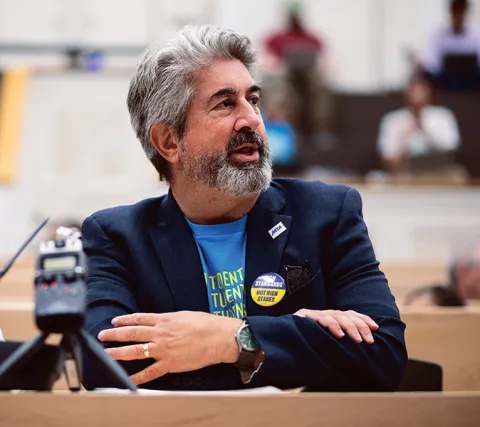
Our President
Max Page, president of the 117,000-member Massachusetts Teachers Association, is a longtime public education activist who believes that the quality of life in our communities depends on having public schools and colleges that meet the needs of every student and family.
Page was elected president of the MTA in May 2022 and again in April 2024. Prior to that, he served two terms as vice president. He is on leave from UMass Amherst, where he has been a professor of architecture since 2001. He also has served as the director of the Master of Design in Historic Preservation Program. As an MTA leader, Page helped organize members to ensure passage of the Student Opportunity Act. As president, he is continuing to fight for similar legislation to increase funding for public higher education, with the goal of making it debt-free for students.
Page has long championed progressive tax policies for Massachusetts, including the Fair Share Amendment, which is generating billions of dollars for public education and transportation by requiring the very rich to pay an additional 4 percent on income over $1 million a year.
Page maintains the MTA’s focus on ways to create a more diverse educator workforce, from prekindergarten through higher education. Under Page’s leadership, the MTA will also continue to oppose the use of high-stakes standardized tests such as the MCAS exams. He is also dedicated to promoting “Green New Deal” policies and practices at schools and on college campuses to combat climate change.
Page believes strongly in the power of coalitions, both within the MTA and between our union and partners across the state. Page is a member of the Steering Committee of Raise Up Massachusetts and has devoted efforts to creating regional bargaining councils and action networks among MTA locals.
Page notes that MTA members across the state are making their locals more powerful and winning the working conditions that educators deserve and the learning conditions that students need to succeed and thrive. He vows that as the state’s largest labor union, the MTA is poised to fight for the common good and defend public institutions from right-wing assaults.
Page was president of his local association, the Massachusetts Society of Professors, from 2006 to 2009. Before becoming MTA vice president, he served on the MTA Executive Committee and Board of Directors and as vice chair of the Government Relations Committee. Page is a resident of Amherst. He lives in his childhood home with his wife, Eve Weinbaum, an associate professor at UMass Amherst, who is the current president of the MSP. They have three children.
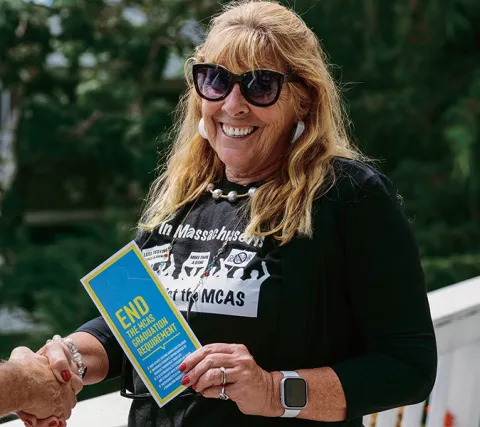
Our Vice President
Deb McCarthy, vice president of the 117,000-member Massachusetts Teachers Association, is a public education activist who has long worked to strengthen alliances that build strong communities.
McCarthy, a fifth-grade teacher at the Lillian M. Jacobs Elementary School, was elected to serve as MTA vice president in May of 2022 and again in April of 2024. She has taught in the Hull Public Schools for 25 years.
Over more than two decades, McCarthy has taken on a variety of elected leadership roles in her local union, the Hull Teachers Association, including president and vice president. She also has served on the MTA Board of Directors, as chair of the MTA Government Relations Committee, as an MTA Political Action Leader, and as a Massachusetts NEA Director.
McCarthy’s roots in activism are deep. As HTA president for 12 years, she brought open bargaining — a transparent approach to winning contract campaigns that encourages rank-and-file member participation at every step — to her local.
“It was transformational and a model of inclusivity and democracy. Everyone feels like they have a seat at the table,” she said. “Rather than members asking what the union can do for them, our members understand that they are the union and they work as a collective for the learning conditions that our students and community deserve. Educators’ working conditions are our students’ learning conditions.”
McCarthy was brought to union activism because of her commitment to public education. She is passionate about fighting austerity budgets and the ongoing attempts to privatize public education.
As a unionist, she remains focused on working with parents and students in the fight against high-stakes standardized testing, as she has done for a decade. McCarthy was a “conscientious objector,” refusing to administer the MCAS tests for two years.
McCarthy also played a key role in forming the South Shore Education Justice Alliance — a coalition of educators, parents and community members that seeks to address issues ranging from school infrastructure to smaller class sizes. The coalition — a table that is part of the Massachusetts Education Justice Alliance — played a crucial role in helping to defeat the Question 2 charter school expansion initiative, in advocating for passage of the Student Opportunity Act, and in building support for the Fair Share Amendment.
As MTA vice president, McCarthy will continue to fight for fully funding public schools and colleges, for wraparound services, for teaching the whole child, for a living wage for Education Support Professionals and adjunct faculty members, for the right to strike for public employees, and for educators’ professional autonomy.
McCarthy is a resident of Hull. All of McCarthy’s four children and three of her seven grandchildren have attended or currently attend the Hull Public Schools. And she comes from a family of educators. Her mother was also a Hull educator. Currently, McCarthy’s sister, daughter and daughter-in-law are educators.