The surge in COVID-19 cases sparked by the virus’ delta variant has made the fall semester at public colleges and universities more precarious — and unions have taken the lead on addressing elevated health and safety concerns.
Several higher education chapters and locals have voiced support for vaccine requirements for students. In some cases, they also have successfully bargained vaccine requirements for staff and faculty, ensuring that workers’ rights are protected.
In addition to health and safety, staffing levels and the lingering effects of job cuts and furloughs that campus executives imposed early in the pandemic remain a problem for many union members. Often there’s a confluence of both issues. Maintenance and Trades Union members at UMass Lowell, for example, were not properly protected as they worked on campus throughout the pandemic and were subjected to furloughs and staff reductions that paved the way for campus administrators to try to privatize some bargaining unit work.
"Our higher ed unions have been relentless in fighting for students, workers and communities," said MTA President Merrie Najimy. "Across the public higher education system, MTA members have been leaders in the areas of health and safety and student support.
"Without both financial support for students and programming to aid first-generation and nontraditional students, our public colleges and universities fail in their mission," Najimy continued. "And we know this failure is most harmful to students of color, who have left public colleges at an alarming rate over the past year."
Campus activists, with statewide support from the MTA, have been advocating for the use of federal pandemic relief funds to restore cut positions and programs as well as address health and safety concerns such as ensuring that buildings have adequate and up-to-date ventilation systems.
"The federal government has provided hundreds of millions of dollars to public colleges and universities," said MTA Vice President Max Page. "We know how this money should be spent: Some of it must be used to bring back all of the faculty and staff positions that were egregiously cut throughout the pandemic. The state must also step up and use federal money it received to address the disparity in pay and benefits between full-time faculty and adjunct faculty and put an end to the exploitation of part-time faculty."
"In addition, Massachusetts has to address the crushing student debt problem and finally make public higher education debt-free for all of our working-class students," Page added. "We also need the state to use these funds to make our public higher education campuses healthy, safe, and green. We have never had greater urgency to address these fundamental weaknesses of our public higher education system. Let’s not miss the chance."
Even given the availability of federal support and state funding that was not reduced from the previous year, many union members are voicing concerns over the plans laid out for the fall semester.
Trevor Kearns, president of the Massachusetts Community College Council chapter at Greenfield Community College, said it was disheartening to see the presidents of community colleges across the state refuse to require COVID-19 vaccines for students — something that is happening at state universities and in the UMass system, as well as at most of the state’s private colleges.
"Them not doing what every other college is doing reinforces a marginalized status for community colleges, and that is frustrating," Kearns said.
Kearns also pointed to a disconnect between campus-level discussions and statewide administrative decisions.
Prior to the abrupt departure of GCC’s president, the union and management had been working out a policy concerning vaccines. But the unexpected leadership change scuttled much of the reopening planning for the campus.
A similar unwillingness to address the rapidly changing landscape presented by the delta variant can be seen on the UMass Boston campus, according to Steve Striffler, president of the Faculty Staff Union.
Striffler said that even though agreements have been reached on requiring vaccines and the use of masks, the pandemic’s surge demands more. The FSU has been pushing for the university to reduce student density and to establish a routine coronavirus testing program.
Packed shuttle buses and other areas where there is little or no physical distancing seem unsafe, and there has not been an effort on the part of campus executives to explore the use of some remote learning to lessen population density at UMB, he said. Faculty members also want a more effective and comprehensive contact-tracing procedure — one that informs instructors when someone in their class has tested positive for COVID-19.
Steve Striffler, president of the Faculty Staff Union at UMass Boston, said that even though agreements have been reached on requiring vaccines and the use of masks, the pandemic’s surge demands more.
"We can’t understand why the campus is so committed to the idea of being full capacity when our economic model isn’t relying on it the way other campuses do," Striffler said.
Union members note that it is not unusual for management to ignore frontline workers’ concerns about the pandemic and its health and economic impacts.
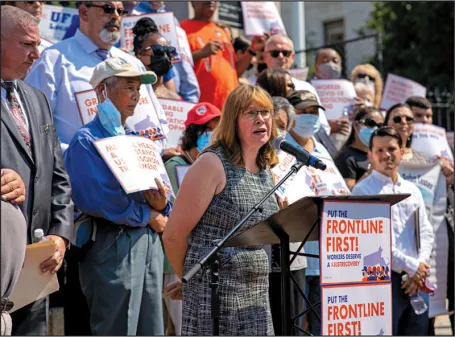
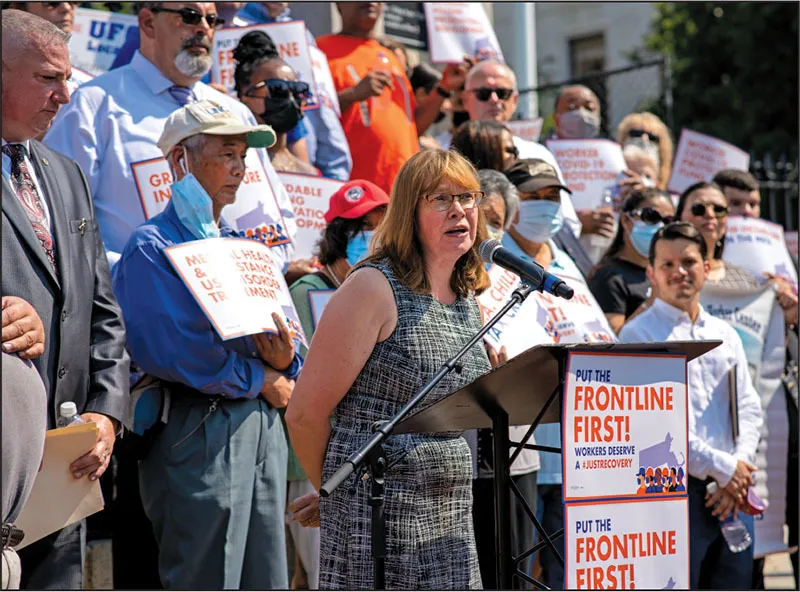
In July, the Greater Boston Labor Council held a rally near the State House, calling on legislators to use federal American Rescue Plan Act money to address the financial and health needs of workers affected by the pandemic.
Joanna Gonsalves, a member of the Massachusetts State College Association chapter at Salem State University, addressed the crowd, advocating for financial support for students, better working conditions for adjunct faculty and safer campus buildings.
Long before the pandemic began, colleges and universities such as Salem State were suffering from decades of underfunding that led to buildings being poorly maintained and a mounting financial burden on students who were forced to shoulder campus debt with ever-growing tuition and fees.
"Having students pay capital debt is unacceptable," Gonsalves said.
"And the pandemic has taught us how many college and university buildings are just not healthy."
Gonsalves also raised the important issue of how part-time and adjunct faculty members are exploited — often paid much less than their full-time counterparts and denied access to health care benefits.
"The federal funds can allow Massachusetts to fix what is broken in public higher education and lay the foundation for long-term solutions," Gonsalves said.
"The federal funds can allow Massachusetts to fix what is broken in public higher education and lay the foundation for long-term solutions."
— MSCA member Joanna Gonsalves

Call 800.392.6175, Ext. 8265 or visit massteacher.org/masschild

To view available job opportunities, please visit massteacher.org/jobs.
The MTA is an Equal Opportunity Employer. We value our diverse workforce and welcome applications from minorities, women and persons with disabilities.