For the past two years, Massachusetts educators have constantly had to deal with the unknown, often finding themselves exhausted and overwhelmed. Today, amid the continuing sense of upheaval resulting from the COVID-19 pandemic, people are worn out. Infections, illness and absences spiked once again early in January as schools and campuses reopened for the second semester and the omicron variant hit with full force.
State officials promised needed supplies, including protective masks and rapid tests, for educators working in person in classrooms, labs and offices. Then they failed to deliver in a consistent way.
That problem followed a line of other issues that educators — working as part of their locals and the MTA as a whole — have had to fight to resolve.
Starting in 2021, after a unionwide "We’re Ready to Roll Up Our Sleeves" campaign on social media, educators from prekindergarten through college were able to obtain vaccinations.
Many students also have been inoculated, helping make Massachusetts one of the most highly vaccinated states in the nation. But the progress has remained uneven, with hard-hit communities of color and others still needing more extensive safety and health efforts on the part of the state and the administration of Governor Charlie Baker.
"We are tired of Band-Aid approaches from Governor Baker and Commissioner Jeffrey Riley when it comes to facing the biggest public health threat of our time," MTA President Merrie Najimy said in late December, noting that the state has repeatedly failed to seek input from educators and their unions. "As always, key decisions will be most effective when made in concert with educators, locally elected officials and other community members.
"Proactive planning for the difficult months ahead is imperative," Najimy added.
Despite widespread progress and currently falling coronavirus rates, the series of ups and downs has contributed to a continuing sense of unease.
Omicron, for example, was able to sidestep available protections and led to a major wave of infection and illness.
Through the worst public health crisis of their lifetime, educators at public schools, colleges and universities have kept their focus on supporting students as they taught classes, drove buses, prepared food, and provided nursing and counseling, amid other services.
Teachers, college professors, Education Support Professionals and fellow staff members often turned to each other, finding strength in numbers and their union identities. They remained resilient even through the most difficult weeks. And they are working to stay strong for the rest of the year.
Some towns and cities generally got it right, following vital protocols and winning substantial buy-in from local families and their education communities.
In Arlington, classroom educators and school nurses worked closely with the town’s Board of Health on testing and in-school vaccination programs.
The schools, working with the nurses and other members of the Arlington Education Association, maintained a successful "test-to-return" program that allowed students to go back to class after a five-day quarantine if they showed no symptoms and produced a negative COVID-19 test. And the inoculation program has resulted in Arlington having a 97 percent pediatric vaccination rate — among the highest in the state.
"We’ve developed a culture of cooperation here," said Julianna Keyes, president of the AEA.
At UMass Amherst, the testing operation likewise was comprehensive, providing access to testing for students, staff and faculty regardless of vaccination status.
Participants have regularly deposited completed tests into drop-off kiosks on campus, using existing lab equipment and heeding the advice of faculty members and other staff.
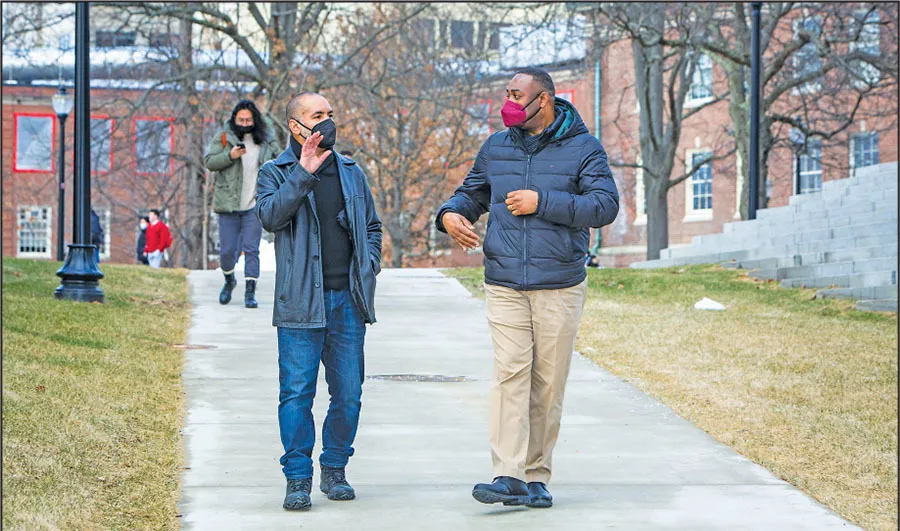
"It took everybody talking to make it happen," said Wilmore Webley, an associate professor of microbiology and a member of the MTA’s highly active Environmental Health and Safety Committee.
But these successes weren’t uniformly replicated across public higher education campuses and preK-12 schools. Far from it.
Dean Robinson, an associate professor of political science at UMass and, like Webley, a member of the union’s EHS Committee, noted that the university system has had the institutional resources to provide a consistent level of support.
"We need programs like this to be in place from preK through graduate school," Robinson said. "The entire UMass system has a role it can play in keeping communities safe because we have the expertise throughout the system."
Educators find support in one another and the union
MTA leaders responded to the lack of a comprehensive state plan to keep schools and campuses open for in-person learning by applying strong pressure on state officials — to live up to their promises to provide effective masks, accessible vaccinations, a comprehensive and efficient testing response, upgrades to ventilation systems, and assistance in dealing with understaffing.
Many schools experienced educator shortages due to illness, which resulted in classes being combined and paraprofessionals having to fill in for colleagues. The lack of foresight and planning from state education officials made the situation worse, as Najimy repeatedly said in media interviews and public statements.
For many educators, one somewhat reassuring result of the pandemic has been a feeling of greater connection with others working in their schools and colleges. Collaboration was a constant as they went online for instruction in 2020 and has remained so since they have returned to in-person education.
Realistically, the pandemic won’t be over soon. Omicron may have relinquished its chokehold on communities, but the slow rollout of vaccines worldwide means more variants with the potential to spread widely are likely, according to Webley.
"That’s the tricky part with an ongoing pandemic like this, with a virus that’s so contagious," Webley said. "If I had to look at past experience, I would have to say absolutely we will have another variant. It’s just a matter of when."
Foreseeing an ending to the pandemic is problematic, Webley said, adding: "People expect it will be wiped out, but it will not be."
What the state needed to do to support educators was to provide a robust, comprehensive testing and reporting system.
"Once it became clear that people were resistant to vaccination, then everyone should have pivoted to having a system in place where over break, they should have gone in and improved the ventilation in every school," Webley said. "There should have been allocations immediately, a surge of workforce, to get that done."
But that scenario did not play out. And for the time being, educators will have to keep turning to each other and following the proven methods of protection — wearing high-quality masks, getting vaccinated, and practicing good hand hygiene — as they try to keep their students, themselves and their communities as safe as possible.
For updated information, visit massteacher.org.