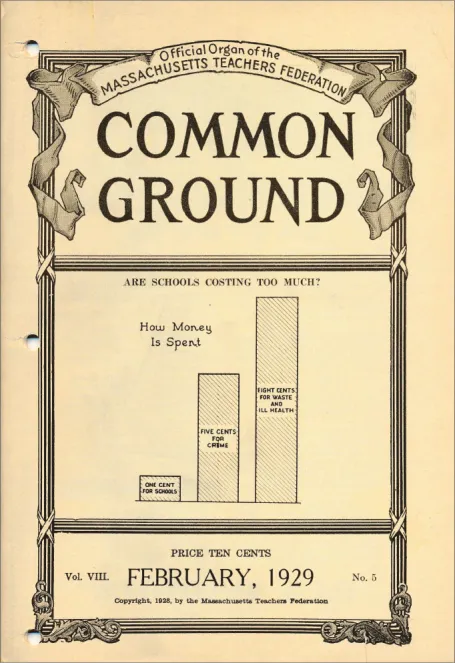
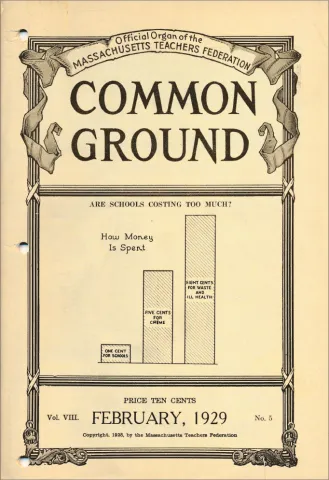
This November, the MTA celebrates the 175th anniversary of the association’s founding. The Spring edition of MTA Today featured highlights of the MTA’s first 50 years. In this issue, we explore the period from 1900 to the early 1930s, when the organization went through several transformations and there was a heightened focus on wages, benefits and working conditions. All quotations in italics are from The Faces and Voices of the Massachusetts Teachers Association: Celebrating 150 Years of History, written in 1995 by now-retired MTA Communications Specialist Jerry Spindel. Other information is from Common Ground, the association’s periodical during the early 1900s.
By the turn of the century, MTA was a firmly entrenched member of the education establishment. Its members included such world famous scholars as the naturalist Louis Agassiz and psychologist G. Stanley Hall. Its conferences were attended by such notables as educator and author Booker T. Washington, and Harvard University President Charles W. Eliot.
But membership in the establishment came at a price. Many felt MTA had ceased to focus on the problems and concerns of rank-and-file educators. Thus, on February 8, 1911, Ernest McKechnie, of Somerville, gathered with fellow educators from Attleboro, Leominster, Lowell, Lynn, Malden, New Bedford and Newburyport, and founded the Massachusetts Teachers Federation (MTF).
Eight years later, in 1919, the MTF merged with the MTA. This revitalized MTA now organized its members by local associations, and encouraged its members to be active not only in the educational arena, but in the political arena as well.
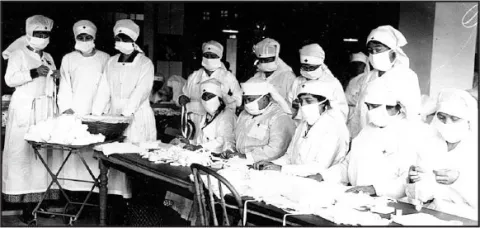
Many issues addressed in the early 20th century have parallels today, including coping with a pandemic. The influenza pandemic of 1918 and 1919 — known as the Spanish flu — hit Massachusetts hard. Fort Devens, in the towns of Ayer, Shirley and Harvard, was a major source of the outbreak in the U.S., with one 1918 report noting, "On Sept. 1, its barracks were jammed with 45,000 soldiers waiting to be shipped to France. By the end of that month, Fort Devens was a charnel house filled with the dead and dying."
By the time the pandemic was over, the virus had killed at least 50 million people worldwide — 675,000 of them Americans.
Most urban schools across the country closed after the second wave hit in 1919, according to the journal Health Affairs, including those in Boston, Fall River, Lowell and Brookline. There is one big difference within the association in the chronicling of the crises then and now.
Despite the magnitude of the problem, there appears to have been only passing reference to the earlier pandemic in the MTA’s publications from those years. Issues of merit pay, whether "child-centered" education was the right approach, and the routine activities of local associations — many of which were called "clubs" — are described at length. The war in Europe, which was still going on when the first wave hit, was discussed in several essays. But the lack of any mention of the pandemic or school closures in the MTA’s publications is in sharp contrast to today’s intense focus on COVID-19. Media coverage of the pandemic was also minimal by today’s standards.
What Common Ground did focus on during those years was a robust platform of improving teaching conditions. In the April 1918 publication, that platform included support for:
- Equitable salaries for teachers.
- The enactment of a retirement law.
- The enactment of a tenure law.
- More democratic control of schools in —
- making rules for the conduct of the schools.
- choosing the textbooks.
- arranging the courses of study.
- Vocational education.
- The appointment of a teacher as a member of the State Board of Education.
The last item in the 12-point platform was support for the 18th Amendment to the Constitution, prohibiting the manufacture, transportation or sale of alcohol. Prohibition was ratified in January 1919.
By the 1920s, MTA had scored some impressive victories:
- A retirement law that offered educators pensions for the first time;
- A tenure law that offered some minimal job security;
- A minimum salary law that put a floor under teacher earnings; and
- A state aid law that diverted a portion of state income taxes to poorer schools to equalize educational opportunity. …
On equalizing educational opportunity, the principles described in Common Ground are nearly identical to the requirements for public school funding laid out in the 1993 McDuffy case and codified in the Massachusetts Education Reform Act of that year. Paul R. Mort, the 1931 author of "The Financing of American-Level Schools," wrote:
"The principle of equalization of educational opportunity demands that the state shall define a satisfactory program of education below which no community in the state shall be permitted to go." In today’s terms, that’s the foundation budget.
"It then follows that the state must provide a system of financing this program of education, either from state sources or from a combination of state and local sources so devised that the burden of the minimum program shall fall upon the people in all localities according to their taxpaying ability. In this principle will be noted both the promise of adequate educational opportunities for boys and girls and the trend toward equity in taxation."
Women continued to be second-class citizens in education, as in society as a whole. They were routinely paid less than men. For example, in 1918 — two years before women won the right to vote — the maximum annual salary for a female high school teacher in Saugus was $750, while for a man it was $900. Top salaries for elementary school teachers, disproportionately female, were even lower: $650. In addition, the state Supreme Judicial Court codified discrimination against married female teachers.
An MTA survey of 1926 found that almost 30 percent of cities and towns did not permit married women to teach. In Chicopee, the School Committee summarily fired all married women teachers, except those protected by tenure. And when the Hopedale School Committee’s dismissal of a married female teacher was challenged, the Massachusetts Supreme Judicial Court came down against the teacher. Its ruling stated:
"The School Committee acted in good faith, without animosity, and for what it considered to be in the best interests of the schools."
Financial concerns were paramount after the stock market crashed on Oct. 29, 1929. In the ensuing years, teacher pay was reduced by anywhere from 5 percent to 20 percent, and many educators lost their jobs.
Despite the hardships that teachers were facing, the association supported the greater good during the Great Depression. Hugh Nixon, the MTA’s first full-time executive secretary, wrote:
"We must not allow the present economic depression to lead to an educational depression. Let us help mitigate the sufferings of those less fortunate than ourselves, especially the children for whom we are responsible because we are teachers."
Then as now, the MTA was willing to take on monied interests to make sure public schools were properly funded. When critics complained that the MTA was applying too much pressure in support of members’ interests, the association responded: "We should not be frightened off by the tactics of vested interests who fulminate about the ‘selfish lobbies’ of teachers. When tax-dodgers begin to call us names, it is a sign that our programs are getting results."
In future issues of MTA Today, we will write about highlights from the periods following the one covered here and leading up to the present day.

Everyone belongs in our circle.
At KinderCare, we’re committed to building warm, welcoming, safe and supportive classrooms for children of all abilities, backgrounds and experiences.
MTA member families save 10 percent at participating KinderCare Learning Centers.
To arrange for a tour of a KinderCare Learning Center near you, go to www.kindercare.com/mta or call 888.525.2780.