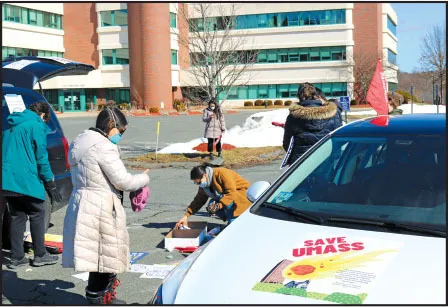
The chaos unleashed by the coronavirus pandemic on college and university campuses more than a year ago was met with a wave of cooperation from staff and faculty unions. Many made painful decisions, juggling the needs of workers, students and communities amid financial uncertainty.
For the sake of saving workers’ jobs for the long haul and preventing any long-term damage to campus programs, union members agreed to reduced hours and furloughs and to drastically different working conditions.
Yet as a clearer picture emerges of the true financial impact of the pandemic on public higher education, unions are stepping up their demand that campus executives pull back on austerity measures. In some cases, they say, administrators are exploiting the crisis to make unwarranted budget cuts.
The state is providing level funding for public higher education through June, and three packages of federal stimulus funds have provided significant revenues to public colleges and universities.
The most recent, the American Rescue Plan Act, is expected to deliver more than $438 million to public colleges and universities in Massachusetts. The funds are in addition to the $378 million allocated in two previous stimulus packages.
Many workers who were laid off or furloughed across the public higher education system during the early days of the pandemic, however, remain out of work or are still subjected to reduced hours.
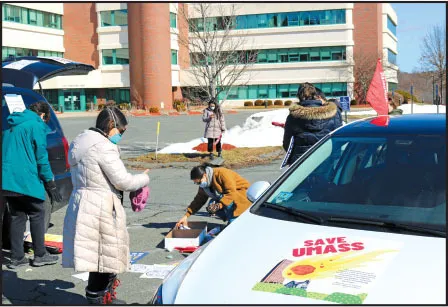
The University Staff Association at UMass Amherst, for example, is fighting campus executives on two fronts — one to bring back staff members who remain on furlough and one to halt the increasing use of temporary employees to do bargaining unit work.
At Salem State University, the administration moved forward with furloughs for faculty and librarians despite the infusions of federal aid. The university is set to receive more than $19 million under the most recent bill. The two previous stimulus measures allocated roughly $17 million.
At Quinsigamond Community College, union members who taught at the Children’s School remain out of work, and the award-winning early education center remains closed. The Massachusetts Community College Council has been fighting the closure and reports that the college has provided no evidence of financial or health and safety problems that would support the action.
In March, Children’s School teacher Erin Roache spoke before the Board of Higher Education, explaining that the center serves the community, including students attending the college, and trains educators. Why is it, she asked, that other early education centers around the state could remain open — and benefit from federal stimulus money — while the one at Quinsigamond remained closed.
"Providing affordable, high-quality early education and care is essential to removing barriers to equity within the Commonwealth," Roache told the board. "A major barrier to education for community college students is the lack of child care.
"Finding quality care on campus removes that barrier," she continued. "Pairing higher education and early education programs helps parents improve their life opportunities while also supporting the developmental needs of their children — both essential to ending intergenerational poverty."
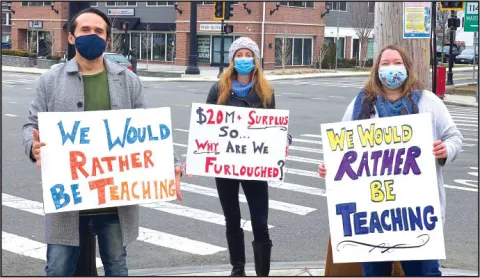
MCCC members at Greenfield Community College remain concerned that the school is without a library director, and administrators there are not moving to fill the position. Instead, they have folded those important duties into another job.
"It’s troubling to see campus executives and trustees exploit the pandemic to make and sustain damaging cuts to our public colleges and universities," said MTA President Merrie Najimy.
But unions on community college, state university and UMass campuses have been fighting the cuts and have won some important battles. Union jobs in various student support services at Bristol Community College that were cut in 2020, at the beginning of the pandemic, are being restored.
UMass Lowell executives tried to effectively close the Labor Studies Center there by keeping its director — a member of SEIU 888 — on indefinite furlough. In return, members of the UMass Unions United coalition and its allies organized a campaign that resulted in not only bringing the director back from furlough, but adding a staff member to the center.
MCCC members at Springfield Technical Community College waged a high-profile campaign when the school cut seven popular career-path programs last spring. The college’s Board of Trustees ultimately restored five of the programs and is still reviewing the fate of the other two.
Activists have also concentrated on health and safety concerns. While Governor Charlie Baker refused to prioritize higher education workers for access to COVID-19 vaccines, there were some campus-level victories in terms of securing personal protective equipment for workers whose jobs require them to be in person. A coalition of unions at UMass Lowell also formed a Health and Safety Committee, which now meets regularly with administrators to assess what is happening on campus.
"We have seen many instances throughout the pandemic where campus management and trustees have not acted in the best interests of students, workers and our communities," said MTA Vice President Max Page. "The good news is that our members have remained energized and are working across unions and across campuses to protect the quality and mission of public higher education."

Paid Advertisement
Offering 100% Online
Graduate Programs in Education
Programs Include
- Graduate Certificate in Designing Learning Experiences (NEW)
- Graduate Certificate in Teaching Online (NEW)
- Master of Science in Education (MSEd)
- Master of Science in Education: Reading Specialist (MSEd-RS)
- Certificate of Advanced Graduate Study (CAGS)
- Certificate of Advanced Graduate Study: Advanced Educational Leadership (CAGS AEL)
- Post-Master’s Certificate (PMC)
- Doctor of Education (Ed.D)
Why UNE Online?
- Learn on your schedule in a flexible study format
- No GRE required
- Dynamic faculty of practitioners, researchers and educators
- Designated student support specialists
- Complete in one to three years
LEARN MORE TODAY
800.994.2804 | education@une.edu | online.une.edu