Educators work hard for their students and their families, but when it comes to investing, many are losing money unnecessarily because of high fees and other charges in their 403(b) plans.
Many educators say they have been led astray by smooth pitches from sales agents who have access to teachers’ lounges and classrooms, or who are featured at district orientation events.
Burned by their experiences, MTA members in several locals throughout the state are trying to help educate their colleagues about low-fee options for 403(b) plans and a 457(b) alternative – both of which are defined-contribution retirement plans educators can use to supplement traditional pensions. Educators are encouraging their districts to take a stronger role in making sure educators have good plan choices.
Unlike private-sector 401(k) plans, plans available to employees in public education and nonprofits do not have to comply with the federal ERISA law, which sets minimum standards for retirement plans, and requires administrators who manage retirement savings plans to act as fiduciaries – in the best interest of the investor.
"Hey, are you new here?"
Eddie Boynton, a member of the Braintree Education Association, said understanding the impact of high fees, surrender charges and other aspects of bad 403(b) plans is critically important for the personal savings of educators. Over a long career in education, someone who invests in a highfee plan can lose hundreds of thousands of dollars.
As a first-year teacher, he stumbled into a bad one himself. A sales representative popped her head into his classroom one afternoon, after students had left the building, and said: "Hey, are you new here?" That was the beginning of a pitch for a 403(b) plan that Boynton, a math teacher, selected. It would be eight years before he understood he had better, low-fee options. He vowed to help other educators avoid making his mistake.
"At that point, I naively assumed that people like that, who have access to the school building, have been vetted by the school district," Boynton said. "I did not know there was a list of multiple other vendors, especially vendors that do not have sales agents such as this, who offer another option for a 403(b)."
Once he unearthed the fees on his original plan, Boynton learned he was paying more than 2 percent in administrative fees. Lowcost plans often have fees of less than half a percent, according to financial media.

Boynton became active in his local on a mission to educate his coworkers about 403(b) and 457(b) plans and is now a union vice president. At his urging, the Braintree district added low-cost defined contribution options to its offerings. The Braintree local routinely offers educational sessions for new hires and its new contract includes language that prevents sales agents from accessing schools.
Locals are strengthening contracts
Throughout the state, several other locals have made improving their retirement plan options a priority. Both the LABBB Collaborative Education Association and the Dover-Sherborn Education Association in their respective contracts added a Roth (after-tax) option in 403(b) plans for educators, and also ensured access to the low-cost Massachusetts Deferred Compensation 457(b) SMART Plan, a retirement savings plan overseen by the state treasurer.
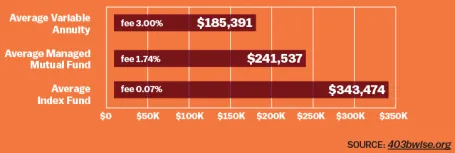
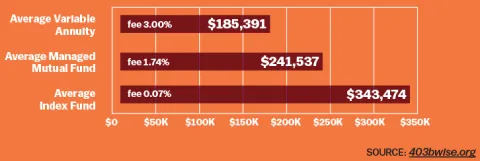
BY THE NUMBERS
Total value of investment after 35 years, assuming $250 contributed monthly with a 6% average annual return.
Active MTA members on this issue have formed an Activists Network to consider advocacy, education and legislative solutions. The group, the 403(b) Action Network, welcomes new participants and is willing to speak to local members and colleagues about this topic.
Like Boynton, Annie Murphy, a Spanish teacher at Dedham Middle School, was approached by a 403(b) vendor in her school, in her case, the educator lunchroom.
She learned later how "terrible" her plan was, after she started getting more educated on personal finance. Most educators don’t need insurance company annuities, which are often found in 403(b) plans, "because we have our pensions," Murphy said. "They prey on teachers who they know are known to be conservative with their money."
Boynton and other educators who are trying to improve education around 403(b) and 457(b) plans have corresponded closely with the founders of 403bwise.org, a nonprofit website that evaluates plans throughout the country, and provides "grades" for the vendors in each state. As of late June, the nonprofit had evaluated about 256 public school districts in Massachusetts. Most earned a "C" on the 403bwise grading system, which means the district offers at least one good option, according to Dan Otter, a 403bwise founder.
Low-fee, national brokerages such as T. Rowe Price, Fidelity Investments and Vanguard Investments are among the companies that have received a "green" rating in Massachusetts from the nonprofit. In addition, the state’s 457(b) SMART Plan offers great ultra-low fee options. But they aren’t on the vendor list in every district.
More choices in plans doesn’t guarantee low costs
Otter, a former elementary school teacher in California, said educators often are unaware of the pitfalls of investing with insurance companies. Employees fall for high-cost vendors because they’re the ones sending sales agents into the schools, he said.
"Not enough teachers have access to a good, low-cost plan, or it’s a multivendor (district), which we see a lot of in Massachusetts," Otter said. "Ten or 20 vendors, and the majority of them are terrible."
What does Boynton think educators should do?
For starters, be wary if someone introduces themselves as a "financial professional" or a "financial advisor." Only a fiduciary is required to make recommendations that are in an investor’s best interests. Many financial services representatives are paid through commission.
And educators should understand that many companies with the best options will not send sales representatives into schools. Educators should examine all the choices available to them. Public-sector employees in the state, for example, can participate in the state’s 457(b) SMART Plan if their district adds it.
Ideally, school districts would weed out the companies offering high fees. But in Massachusetts, districts steer clear of getting involved. Instead, they use a third-party administrator who selects the companies that can offer plans to educators.
Educators nationwide must educate themselves, Boynton said: "The 403(b) space is like the Wild West, where anyone will sell you snake oil."
If you or your local association would like to have someone from the MTA’s 403(b) Action Network speak to your executive board, or your membership about this topic, please contact MTA Bargaining Specialist Phil Katz at PKatz@massteacher.org.