The massacre of 19 fourth-grade students and two teachers on May 24 at the Robb Elementary School in Uvalde, Texas, by an 18-year-old with an assault rifle shocked and angered educators throughout the nation.
Within days, educators, students, parents and other community members were meeting to plan actions to express their outrage.
"There are no excuses — and no ‘inalienable rights’ — that can justify the deaths of 19 children who were in their fourth-grade classroom …," the MTA said in a statement immediately after the murders. "Our nation needs to take bold and immediate action to control the flow of firearms in our society."
To amplify that message, MTA members staged days of Mourning, Rage and Action — "MRA" events — to combat the influence of the NRA.
Local associations held ceremonies honoring the students and educators killed in Uvalde, as well as demanding tougher national gun laws. Many of the actions took place on June 1, ranging from a somber vigil in Milton — where educators wore black and struck a triangle 21 times to commemorate those killed in Uvalde — to a standout in Middleborough, where educators wore white as a symbol for peace. Members of the Springfield Education Association set up empty chairs in their city to symbolize the lives lost to gun violence.
The MTA was joined by the Massachusetts Nurses Association, the Massachusetts School Nurse Organization and the American Federation of Teachers – Massachusetts in calling gun violence a national public health crisis and demanding stricter gun-control laws. The joint statement drew attention not only to deadly school shootings but also to killings at health care centers, places of worship, and other everyday destinations, including grocery stores.
"Students and families deserve the right to go about their lives without fear of being murdered at random — just as they should be able to access public schools and colleges without unnecessary fear of contracting or spreading COVID-19," the unions said. "We support sensible national laws that expand background checks and close loopholes allowing easy access to firearms. We support national bans on the high-powered assault weapons that turn schools and other places into combat zones that police themselves fear to enter."
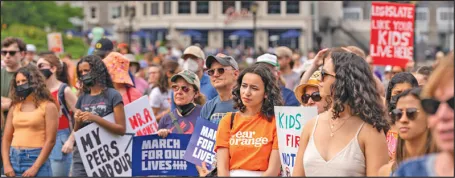
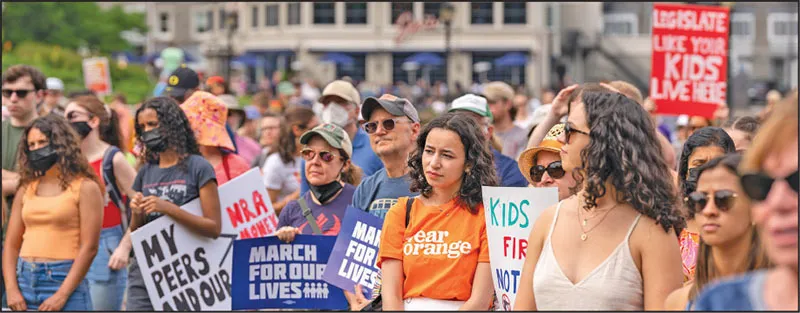
Local activists connected to March For Our Lives, a national gun-control group, invited then-MTA President Merrie Najimy to be a featured speaker at a June 11 rally in Boston. Numerous area educators joined more than 1,000 other protesters gathered at a waterfront park to demand action on gun violence. Similar events featuring educators were held elsewhere in the state.
Rachel Keegan-McGlinn was among more than a dozen members of the Brookline Educators Union who attended the event in the North End.
"It’s really important that we’re visible and that we’re sending a clear message," Keegan-McGlinn said. She said gun laws need to be the focus of change — "not arming teachers or putting the burden of change on teachers and children."
Some of the educators who attended said they decided to come to the rally in Boston as soon as they heard about it.
"I just couldn’t sleep after this thing in Texas," said Matt McKeon, a teacher at Peabody Veterans Memorial High School. As an educator, McKeon already had taken part in active-shooter drills. "Seriously, we need to ban assault weapons," McKeon said.
Najimy drew loud cheers when she told the crowd that educators would reject proposals to arm themselves or increase the presence of police at schools.
"Our vision is one where public preK-12 schools — and public colleges as well — are the heart of their communities: places of joy and learning, open to all and full of ways to enrich our lives," Najimy said. "Yet many of our schools have become fortresses, locked down and under 24-hour surveillance.
"We want to stop normalizing active-shooter drills," she continued. "All of these only perpetuate the culture of firearms and violence that we are trying to break. And such measures create merely an illusion of safety."