Educators from across the Cape and Islands region came out in force to support their colleagues in the Falmouth Educators’ Association as the local union withstood a sustained attack on protected activity arising from contentious bargaining over the conditions of in-person learning last spring.
The conflict came to a head over the summer when the district placed FEA President Lori Andrade on leave and then terminated the veteran educator, both without cause.
MTA leadership and surrounding local associations — along with other labor unions in the region — saw these actions as bold attempts at union busting. Many parents and community members were likewise upset with the way educators were being treated and spoke out at School Committee meetings, defending educators and the FEA.
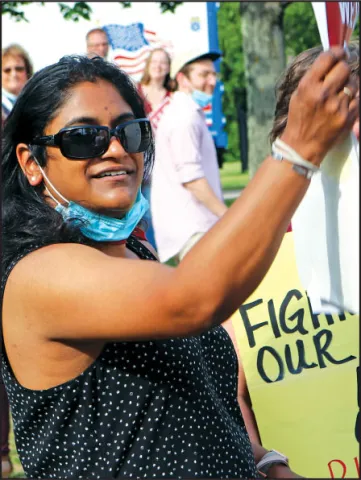
The FEA’s organizing extended to a series of standouts and public demonstrations outside of School Committee meetings. It became a common sight in the spring and summer to see streets lined with hundreds of educators and their supporters, many holding signs emblazoned with slogans such as "Union Busting Is Disgusting" and "No Guff," a jab at the district’s own anti-bullying messaging.
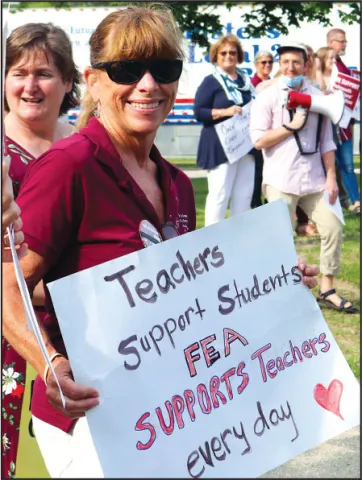
Monomoy educator Cheri Armstrong is chair of the Cape and Islands Area Massachusetts Educator Kristina Woods, left, and Celeste Cruise were among the members supporting the Falmouth Educators’ Association’s fight for fairness at high-visibility events in the spring and summer.
Keeping the pressure on proved to be successful, as Andrade was returned to the staff and outstanding issues with the district have been resolved.
MTA President Merrie Najimy praised the Cape and Islands regional associations for forming a tight network of mutual support.
"This took shape three years ago," Najimy said at a May rally that drew active and retired educators from 15 local associations. "Locals were working without contracts — and you all started showing up for each other.
"This is what it means to be in the MTA," she continued. "We stand in solidarity in our buildings, across our district, across our regions and across the state."
Action Network. The collective, she said, will continue its work to strengthen all of the region’s local associations.
"Locals across the Cape and Islands continue in solidarity to address local, regional, and state issues important to our members," Armstrong said. "Together, we stand for positive, affirming school environments."
But the Falmouth fight proved especially threatening as it forced educators to consider the impact of retaliation for participating in normal union activities.
Michelle Dunn, president of the Dennis-Yarmouth Educators Association, described the Falmouth situation as having the potential for both a chilling effect and a ripple effect.
"Going after a local president is a scare tactic, something to stop union activity," she said. "I encouraged my members to support the FEA because if Falmouth was successful, it would encourage other superintendents and districts to try the same tactics."
Open advertisement in lightbox