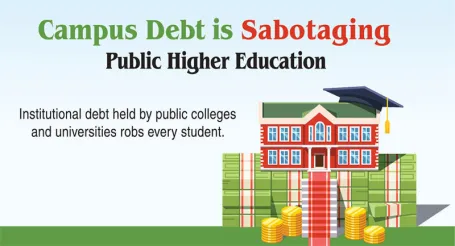
As the federal government finally takes steps to erase some student debt, MTA activists continue to draw attention to another borrowing practice that escalates the cost of attending a public college or university.
"Campus Debt Reveal 2022: Massachusetts Public Colleges and Universities" is a report prepared by Salem State University faculty members Joanna Gonsalves and Rich Levy, UMass Lowell student Gayathri Raja, and Framingham State University student Tyler Risteen. The project on which the study is based examined the impact of declining state investment in public higher education, which includes a shift in how colleges and universities fund constructing and maintaining buildings.
"The campus debt problem is a symptom of the larger problem of austerity and neoliberal economics over the past generation," said MTA President Max Page. "When state funding is cut for public colleges and universities, then those institutions too often are forced to embrace destructive strategies just to survive."
Over the past 20 years, campuses have had to absorb a far greater share of the cost to build and maintain dorms, academic buildings and other campus facilities. While the state in the early 2000s covered from 75 percent to 100 percent of campus construction projects, a recent initiative by Governor Charlie Baker’s administration committed the state to only half of the cost of building new STEM facilities.
As a result, campuses have been forced to borrow billions of dollars. The increase in borrowing has led to rising student fees — largely without oversight. While the Legislature must approve any tuition hikes, campuses can set their own fees.
The new report includes a "Debt Audit Toolkit" that instructs users on what data to gather from colleges and how to analyze the findings. The toolkit makes it possible to determine the portion of student fees that are covering campus payments.
For example, the report shows that Bridgewater State University pays nearly $18.5 million annually in debt service, which claims about $2,122 of the $10,145 in annual fees paid by its students.
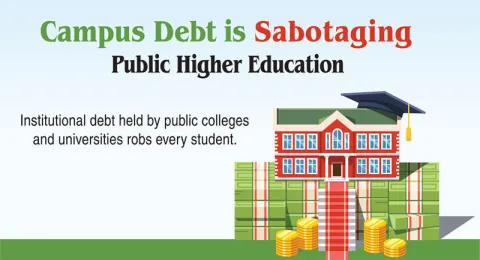
The report also looks at the deeper implications of saddling campuses with capital expenses.
The student debt crisis could be dramatically lessened if campus debt were not driving up student costs. The report found that UMass Amherst students could reduce their typical individual average loan burden by more than $16,000 if the state covered the university’s capital expenses.
The report also examined the impact of capital debt on faculty. If Salem State University was not paying nearly $18 million annually to cover its debt, for instance, it could hire up to 132 additional full-time faculty members.
"In every meeting or conversation during this campus debt reveal, our students, alumni, and faculty were quick to share horror stories of overfilled classrooms and diminishing course offerings," the report stated. "Without a doubt, many other scenarios could be imagined for freed up monies if there were no campus debt. Campuses would possess the means to do a combination of things."
When public colleges and universities are forced to prioritize debt repayment, they inevitably cut support services for students and diminish the quality of working conditions for staff and faculty, the report found.
The Massachusetts Campus Debt Reveal Project is working to empower educators, students and community activists who are committed to providing high-quality public higher education without leaving students in debt.
Levy, a co-leader of the project, said the movement is national in scope. So far, he and his colleagues have been in touch with public higher education staff and faculty in Oregon, New York, Indiana and Florida.
"We are building a movement to fight campus debt that is linked to the movement to cancel student loan debt," he said. "Canceling campus debt would reduce future student debt for all students and increase spending on core educational needs."
For more information on the Campus Debt Reveal Project, please visit massteacher.org/campusdebtreveal.
MTA on the Web