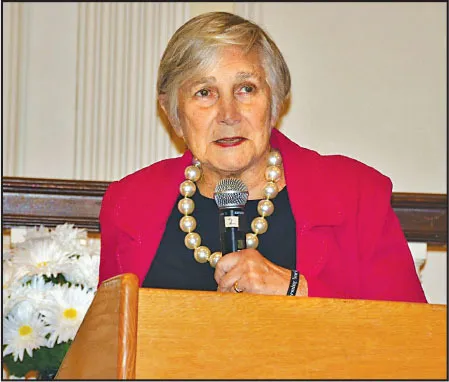
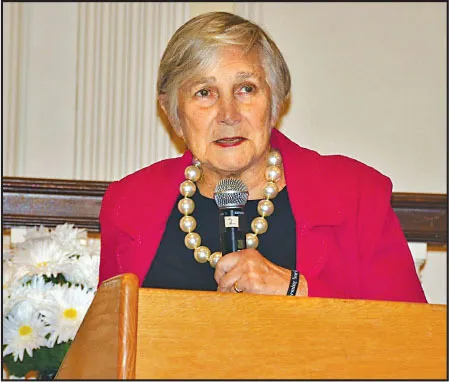
My message is: Resistance is not futile — resistance is powerful." So said Diane Ravitch, education historian, author and activist, during a recent Citizens for Public Schools event.
Ravitch was in the area to promote her newest book, Slaying Goliath, and to recognize two Massachusetts activists it features: former MTA President Barbara Madeloni, honored for leading the successful 2016 fight against lifting the cap on charter schools, and UMass Boston Associate Professor of Political Science Maurice Cunningham, whom Ravitch praised for shining a light on the dark money that poured into the "Yes" campaign. The MTA was a co-sponsor of the event.
In her talk on Feb. 26 at First Parish in Cambridge, Ravitch recounted the fight against Question 2, as the ballot initiative seeking the cap lift was called, reminding the audience that the "Yes" side was ahead by a wide margin in early polling. She said that so-called education reformers, whom she calls education "disrupters," set their sights on Massachusetts in the belief that if they could win in the "bluest of blue states," they could win anywhere.
The "Yes on 2" campaign won support from Governor Charlie Baker, several business associations, Democrats for Education Reform and The Boston Globe. It brought in money from very wealthy donors, many of them from out of state. The campaign ultimately raised close to $29 million, outspending the "No" campaign by $14 million.
Backers of the question also filed a lawsuit claiming that the state’s cap on charter schools was unconstitutional. Their public face was a group of parents who were featured in rallies and ads but who did not finance or control the campaign’s spending.
Despite their resources, Ravitch told the Cambridge audience, backers were up against a formidable foe in Madeloni, who said, in essence, "We will not let this happen." Madeloni and other members of the "No on 2" coalition — including many MTA and AFT Massachusetts members, along with allies across the state — refused to cut a deal in the Legislature to allow a partial lift of the cap to avoid a costly ballot campaign.
The gamble paid off. In the end, Question 2 was defeated by a vote of 62 percent to 38 percent. Of the state’s 351 cities and towns, the "Yes" campaign won in fewer than 20 affluent communities — communities not threatened by the expansion of charter schools.
Ravitch attributed the "No on 2" win to four main factors. The campaign had a clear message about how charter schools drain money from public schools while failing to serve the same population of students. It had a better ground game, including educators across the state who spread the message to friends, family members and neighbors. It offered a potent critique of who was behind the "Yes" campaign — billionaires and out-of-state donors who had no connection to public schools in Massachusetts. Lastly, the "No" campaign was endorsed by more than 200 school committees, respected local officials, the Massachusetts Democratic State Committee and longtime public school advocates.
Madeloni, for her part, credited the large coalition of education, labor, parent, community and civil rights groups represented in the Save Our Public Schools campaign with being a truly grassroots effort.
"Power is not in the State House," she said. "We have the power. We have to stop giving it to them." Madeloni added that support from African Americans was critical, reminding the audience that then-Boston City Councilor Tito Jackson became one of the most forceful spokespeople for the "No" campaign.
Madeloni said that beating the education "reformers" was more than just about winning on a single ballot question. "Thank you for writing a book that reminds us we are part of something bigger," she said to Ravitch. "This is all about union busting and stifling the voice and power of workers."
Cunningham described the endless power of monied interests as "perilous for democracy."
Cunningham, who did extensive research on the dark money behind the "Yes" campaign, said that there are three reasons corporate interests support non-unionized charter schools over unionized public schools: "Taxes. Taxes. Taxes." Unions such as the MTA advocate for progressive taxation to pay for quality public services and to fund fair wages, hours and working conditions for public employees.
In Slaying Goliath, Ravitch details how Cunningham ferreted out who funneled money to the "Yes" campaign through the New York-based organization Families for Excellent Schools — Advocacy. The strategy was for this group to receive the money, concealing the names of donors, and then to contribute the bundled funds to the political action committee running the campaign.
It didn’t work. Cunningham scrutinized campaign finance documents and highlighted big names behind the "Yes" campaign, including billionaire hedge fund manager Seth Klarman, who in 2014 had backed Republican Karl Rove’s American Crossroads super PAC; Jim and Alice Walton, heirs to the Walmart fortune; Jonathan Sackler, heir to the Purdue Pharmaceutical fortune; billionaire former New York City Mayor Michael Bloomberg; and venture capitalist Paul Sagan, Baker’s appointed chair of the Board of Elementary and Secondary Education.
Cunningham encouraged the state’s Office of Campaign and Political Finance to investigate the money trail. The OCPF did — and fined FESA $426,000 for concealing the names of the donors. The fine cleaned out the group’s bank account and led to its closure.
"I’m no hero," Cunningham said. "Barbara and Diane are heroes."
Cunningham said he spends time following the money trail on important issues because "people have the right to know" who is funding political campaigns. He described the endless power of monied interests as "perilous for democracy."
He said he hasn’t made many friends doing such work, but he doesn’t intend to stop. His message to those seeking to unfairly manipulate the system is this: "When you stop screwing with democracy, I’ll stop messing with you."