The Statewide ALANA (African, Latino, Asian and Native American) Network and the MTA Environmental Health and Safety Committee have undertaken a collaborative effort to better understand the impact of race-related stress on educators of color. The research will better prepare local unions to address this important issue within our school districts and colleges, support recruitment and retention of educators of color, and foster discussion and shared language within our workplaces. The group’s initial findings are summarized here by Dr. Audrey Murph-Brown, MTA’s director of training and professional learning; Dr. Scott Fulmer, a project manager at UMass Lowell and chair of the EH&S Committee; and Khafayat Kadiri, a research assistant in epidemiology at UMass Lowell. Kadiri’s work was funded by a grant from the UMass Lowell Center for the Promotion of Health in the New England Workplace.
Self-reported educators of color, or EOC, represent between 6 percent and 7 percent of the membership of the MTA, making them a particularly vulnerable workplace population. In addition to job duties, educators of color play a huge role in supporting students of color as they navigate racial and social injustices. As much as students of color improve working conditions for educators of color,1 research shows that there is an improvement in the outcomes for students of color due to the presence of educators of color.2,3
Educators in general are leaving the field for a variety of reasons. They cite a lack of instructional resources and classroom materials, a reliance on high-stakes testing, and professional disrespect as some of the greatest sources of stress.4 For educators of color, racism is a social determinant of health that contributes to elevated stress within the educational environment.5
At the 2019 MTA Summer Conference, ALANA members conducted focus group discussions in which educators of color described their experiences with race-related stress in the workplace. One goal was to use the collected data to organize bargaining for the common good — providing a way for local associations to make transparent, and to disrupt, the racist structures that negatively impact educators of color.
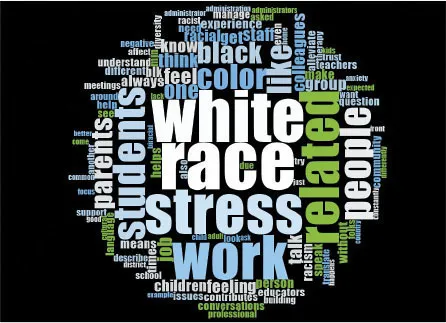
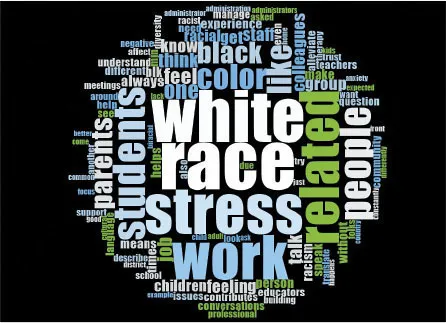
The facilitators used five prompts to guide the discussions. Qualitative data analysis of the focus group results was conducted with NVivo software, including a word frequency analysis whose results are pictured with this article. The findings reaffirmed similar studies that have focused on challenges for educators of color.3,6
#1: Describe what race-related stress means to you.
The following quotes are taken from participants’ responses:
"In my home country, it feels different, not stressful. Here, it feels like you have to work double to be even."
"White people. They believe the color of the skin is an issue" and "White entitlement."
"Having to do all the roles to support students of color because nobody else steps up."
"Checking up on or excluded from work meetings."
#2: What contributes to race-related stress at work?
"Power is based on favoritism and nepotism within the local, so power shifts between and among white members."
Even in racially diverse communities, one participant noted, white parents hold more socioeconomic power: "White students and parents have greater socioeconomic influence. Whites question grades, books."
As shown in prior studies, having to tacitly support policies they disagreed with was stressful. (See the footnoted references to Kohli (2016), Partee (2014), Jackson, I., and Knight-Manuel, M. (2018).)
"Having to uphold the policies that you know are racist."
#3: How does race-related stress you experience at work affect you?
"Depression. Weekly therapy. Vomiting every day. Crying, insomnia, Sunday anxiety about Monday. I only want to do a good job."
"Children see how their white parents act toward people of color. The same conversations occur from generation to generation."
#4: What helps you to manage your race-related stress at work?
Participants responded:
"We have weekly conversations around race. In those conversations, we look at systems of racism."
"There is a group of Black women at work that I can huddle with."
"The bonds with students help me manage."
#5: What would alleviate race-related stress at work?
Participants responded:
"A common language so I can use the words ‘white supremacy’ and ‘microaggression’ without dealing with white fragility. If only the white people around me and all of us had a shared common language."
"Monthly meetings, diversity dialogues. It’s slow going, and there’s a lot of work to do."
"Holding administrators accountable. Having a chance to confront and raise the realities, rather than them just transferring me out. Being able to speak up."
Seeking out mentors, identified in previous studies, 2,3,7 was also mentioned:
"Finding mentors outside of my own college. Could the union help to identify mentors so you can talk to others when you are the only person of color in your role?"
The initial findings of this study show that many educators of color encounter workplace race-related stress and its adverse effects. These outcomes contribute to higher turnover for educators of color. It is also important to note that existing workplace policies affect race-related stress. Participants discussed how local associations should be able to move forward on policies that address work-related racial stress. With proper management and implementation, these suggestions have the potential to improve EOC experiences in the workplace and reduce turnover.
References
1. Jackson, I., and Knight-Manuel, M. (2018). "Color Does Not Equal Consciousness."
2. Barnum, M. (2020). "Black teachers leave schools at higher rates — but why?"
3. Partee, G. (2014). "Retaining Teachers of Color in Our Public Schools."
4. Carver-Thomas, D. & Darling-Hammond, L. (2017). "The trouble with teacher turnover: How teacher attrition affects students and schools."
5. Jee-Lyn García, J., & Sharif, M. (2015). "Black Lives Matter: A Commentary on Racism and Public Health."
6. Simon, N., Johnson, S., & Reinhorn, S. (2015). "The Challenge of Recruiting and Hiring Teachers of Color: Lessons From Six High-Performing, High-Poverty, Urban Schools."
7. Kohli, R. (2016). "Behind School Doors: The Impact of Hostile Racial Climates on Urban Teachers of Color."