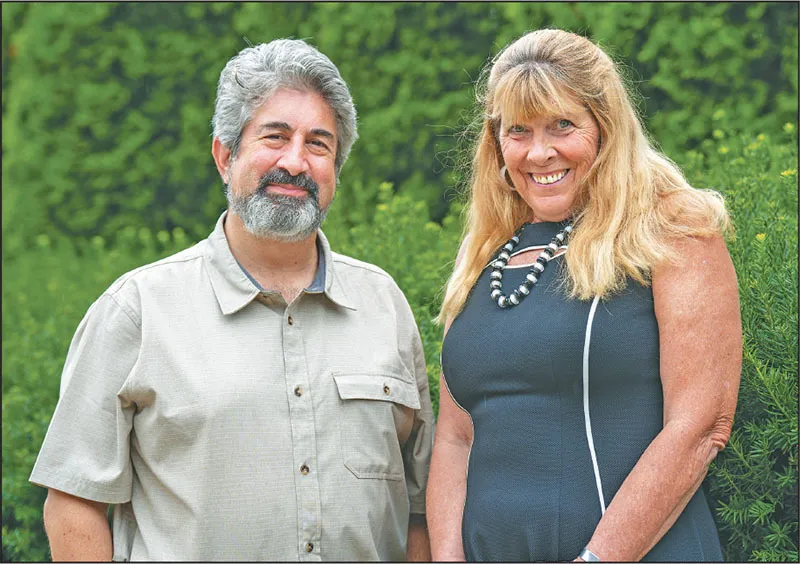
MTA President Max Page and Vice President Deb McCarthy took office on July 15 following their election at the Annual Meeting of Delegates in May. Page previously served two terms as the association’s vice president and is a former president of the Massachusetts Society of Professors. He has been a professor of architecture at UMass Amherst since 2001 and is also a former director of its Master of Design in Historic Preservation program. Before her election, McCarthy worked for 25 years as a fifth-grade teacher in Hull. She has served in a variety of leadership roles in her local union, the Hull Teachers Association, as well as on the MTA Board and as an NEA Director. Both Page and McCarthy were raised in families that were active in public advocacy and education unions, and both say their early experiences helped inspire their own activism. They were interviewed by MTA Editor/Writer Mary MacDonald.
Q: What inspired you to become active in your local union?
Page: My father was one of the founding members of the Massachusetts Society of Professors, which is the faculty and librarian union — my union at UMass Amherst. I grew up around this idea of unions and higher education. My mother also was a teacher and then a public school principal. After college, I worked for two years in New York City’s homeless shelter system and got a closer view of the city’s stark inequalities. After graduate school, I taught in Georgia and was involved in the American Association of University Professors, which is not a union but was the closest thing we had in Georgia. My wife, Eve Weinbaum, is a union organizer, and she teaches in the Labor Center at UMass Amherst. In coming to UMass, which is the largest unionized worksite in New England, I was a member of the MSP. Within a year or so, I was asked to join the board. All of us have activist energies and a desire to make change. The MSP seemed like a great place to do that, partly because there were great union activists who really wanted to transform that local to be an advocate for public higher education and to fight for the rights of adjunct faculty, who were increasingly exploited.
McCarthy: My first day on the job as a fifthgrade teacher, the Hull Teachers Association was demonstrating before the start of the school year. The members were working without a contract. They were having a standout at the entrance to the town, with signs saying "Support the HTA — Settle our Contract Now," and I joined them. That night at the dinner table, my husband questioned whether participating in that action was in my best interest. And I remember the conversation like it was yesterday: that it would be in my best interest to stand for my values and for what I thought was right. That if I was going to be the educator my students deserved, I needed to stand up and speak up when it’s the right thing to do. And then I participated in several other job actions over the next couple of months. I’m not saying I was without fear. But I needed to push through my fear because of my students. These were the educators who had taught me. They had been my own children’s educators. My mother, who was a Hull teacher, was on the line. There was this feeling of camaraderie and unity that felt special. The following year I was asked to be a building representative. And I’ve been an elected union leader in some capacity ever since.
Q: What do you consider the greatest opportunity for the MTA in the next few years?
Page: I feel like we have built momentum in the past number of years to truly take on that role as the voice of public education and fight for the kind of public education system our communities deserve — and our students deserve and our members deserve. I see great opportunity starting with a victory around the Fair Share Amendment. We have a chance to really upend the austerity narrative. By winning this and gaining a significant fund dedicated forever to public education and transportation, we start to upend that notion that we don’t have the money to do the things we want, like pay living wages to Education Support Professionals, to pay adjuncts fairly and provide health care and pension benefits, to have enough counselors and mental health staff and educators in classes — all of the things that we’re told we can’t do in one of the wealthiest states in one of the wealthiest nations in the world.
McCarthy: I think the greatest opportunity for our union is as a collective to grow the power of our rank-and-file members through open bargaining, through shared governance and leadership models, and through shared solidarity. We must fight back against the false austerity narrative that has underfunded and undermined the true potential of our public schools and colleges. We have to fight against those who would try to eliminate educator autonomy, diminish educator professionalism, and deny our right to withhold our labor. We must maximize our opportunities for direct actions that create the schools all students deserve.
Q: Describe some successes you had as a union leader. What contributed to them?
Page: Probably the most significant was the passage of the Student Opportunity Act. We worked on it for close to two years. It was the most significant reinvestment in public education in Massachusetts and the most progressive, helping those districts that had the least. Communities like Fall River, New Bedford, Worcester and Springfield are getting the lion’s share, as they deserve. That’s rolling out over seven years. It was a powerful grassroots movement where we talked to members in 35 community forums. The Legislature had punted it year after year. And by the MTA’s involvement, we were able to get it done.
McCarthy: The biggest successes were the two cycles of open bargaining and the bylaw change that brought about a shared-governance plan into the leadership model of the Hull Teachers Association. Under open bargaining, every member is invited to attend and participate in the conversations between the union and management. The conversations happen in the open, versus behind closed doors. The shared-governance bylaw change means there will be a co-president from the elementary building and a co-president from the middle school — and the third co-president will be from the high school. This allows the members in all buildings to feel like they have a voice and are invested in the governance of our union.
Q: What are some of your goals for the next two years?
Page: We have an opportunity with the Fair Share funds to finally achieve the major reinvestment in public higher education that has been long delayed. Some of the needs are lifting up adjuncts in pay and benefits and lifting up working conditions and pay for our faculty and staff in community colleges and throughout the higher education system. It’s about achieving debt-free public higher education for our students. For preK-12, there is often a justification: "Well, we can’t pay our ESPs a living wage. We don’t have the money." Well, Fair Share should also make sure that every educator earns a living wage. That should be a baseline. The MCAS — the high-stakes testing regime — is another focus. Getting rid of the MCAS and the high-stakes nature of MCAS is starting to get back at reclaiming the classrooms and the schools — being able to have educators be the experts that they are in educating the whole child. If we don’t have educator autonomy and have educators educating the whole child, then we’re not succeeding.
McCarthy: Once we win the Fair Share Amendment, a major focus of mine will be to dismantle the racist high-stakes accountability system that supports and maintains an elitist opportunity gap. At the elementary school in which I taught, what I experienced under the punitive MCAS regime was the elimination of the position for the school librarian, the band program and the buses for an after-school enrichment program. Educator autonomy has been denied. The professional right to educate the whole child no longer exists. Instead, the mandates of high-stakes testing have districts, like the one I taught in, purchasing online testing software. The students’ day becomes a series of test-and-drill curricula that has removed the joy from the classroom. Last year alone, the students in my fifth-grade classroom participated in 18 days of simulated MCAS testing, which, when combined with the actual six days of MCAS testing, resulted in 24 days of high-stakes testing at the elementary school level.

WE’RE HIRING!
To view available job opportunities, please visit massteacher.org/jobs.
The MTA is an Equal Opportunity Employer. We value our diverse workforce and welcome applications from minorities, women and persons with disabilities.