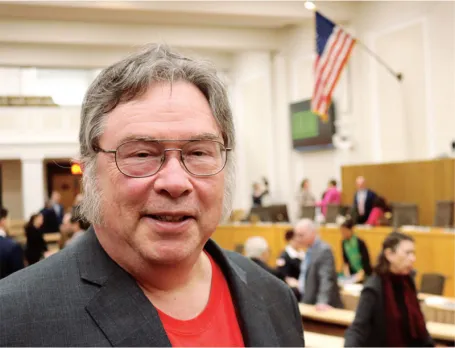
It does not surprise Joe Nardoni that Middlesex Community College, where he teaches, has generated a long trail of failed searches for full-time faculty and staff over the past three years.
Nardoni points out that the calculated cost of living for a single-parent, single-child household in Middlesex County is $124,000. Faculty salaries at Middlesex Community College are $74,000 on average, about $50,000 below what is needed to live in that area.
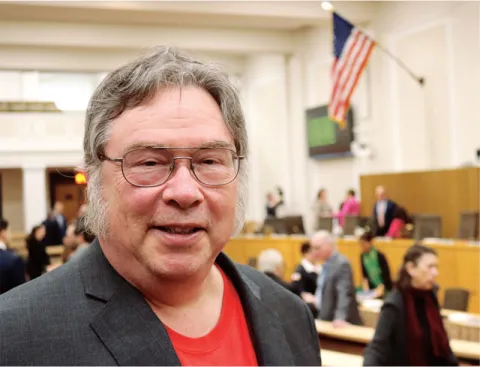
"No one can afford to come here to work," Nardoni said. "We can’t attract good candidates from other states once they see the salary and the cost of living." Nardoni reflected on the recruitment challenge as he waited to testify at a hearing on the Fiscal Year 2025 state budget, before the Legislature’s Joint Committee on Ways and Means.
Nardoni told the lawmakers that salaries for faculty and staff at community colleges should immediately be raised by $15,000 using funds from the Fair Share Amendment. This would be a step toward addressing staffing problems at community colleges as they anticipate rising enrollments, given efforts to expand free community college beyond the current MassReconnect program. State Senate President Karen Spilka and other supportive legislators have said they want to expand MassReconnect, which now allows residents age 25 and older to attend community college at no cost.
The issue of low wages is not unique to community colleges.
A salary study conducted by ASA Research, on behalf of the Massachusetts Teachers Association, shows how wages are significantly lower for faculty in the Commonwealth’s public higher education system in comparison to peers working at public colleges and universities in nearby and similar states. Wages for Massachusetts faculty and staff are also far lower than those paid to faculty and staff working at comparable private colleges and universities in the state. In some cases, the wage gap exceeds $30,000 a year.
Non-instructional staff at public colleges and universities likewise earned well below what is considered to be a living wage, as calculated by the Massachusetts Institute of Technology. The study showed that, in some cases, public higher education staff earn as much as $43,000 below what is considered necessary to support a single parent with a child.
The study factored in the cost of living here and elsewhere when determining the salary comparisons. It showed that not only are salaries lower in Massachusetts, but also that salaries of public higher education employees have grown at a slower rate compared to those of faculty and staff working at public colleges and universities in other states.
In a recent message to MTA members, President Max Page and Vice President Deb McCarthy stated: "As wages fall below what is needed to meet this state’s high cost of living, this not only harms those of us working in public higher education, but also harms the very institutions themselves as it becomes increasingly difficult to fill vacancies and attract the best-qualified job applicants. Consequently, student supports and academic programs are put at risk."
Paying faculty and staff fair wages that meet cost-of-living standards in Massachusetts is one of the four main components of the proposed Cherish Act, which is supported by the MTA and its partners in the Higher Ed For All coalition. The bill also calls for an equity and wage study to examine workloads and use of part-time employees. Cherish also seeks equitable wages and access to benefits for adjunct faculty.
HEFA’s other priorities under the Cherish Act are the creation of debt-free public higher education; expansion of existing programs that support students; and the elimination of campus-based debt for construction and building maintenance by returning those responsibilities to the state, especially as colleges and universities transition to more environmentally friendly buildings.
As the proposed bill sits in committee, HEFA advocates are addressing the pillars of Cherish through the budget process. In addition to Nardoni, who is vice president of the Massachusetts Community College Council, representatives from the American Federation of Teachers Massachusetts, the Coalition for Social Justice Education Fund, Progressive Mass, Massachusetts Education Justice Alliance and the Public Higher Education Network of Massachusetts testified at the Ways and Means hearing. Speakers pointed out the hazards of privatizing services at public colleges and universities and the need to lower and eliminate the debt burden for students enrolled in public higher education.
Nardoni said he considered himself lucky, having worked in public higher ed during the last significant wage hike nearly 25 years ago.
"When you can’t live on a full salary, it’s a pretty good bet you’re never going to be able to retire either," Nardoni said.