Many people believe a strike is a powerful tool for a union that is trying to reach contract terms with management that is stalling or refusing to reach an agreement.
But for nearly a century, a sharp division has existed between the rights of most public and private unionized employees regarding the legal authority to strike. Private-sector union members can legally strike; public-sector union members often cannot.
Why are they treated differently? To some extent, it’s because public-sector workers, in working for the local, state or federal governments, are paid by taxpayers on behalf of the public. Under this thinking, a strike against the government is a strike against the interests of the people, said Erik Loomis, a professor of labor history at the University of Rhode Island.
"Are public employees actually workers? Very early public employee strikes – Boston police in 1919 – really raised that question to a new level," Loomis said. "There is a general hostility about thinking about government workers as workers, period. They’re viewed as government servants."
Deb Gesualdo, president of the Malden Education Association, said disparate treatment of public and private employee unions as it relates to striking may owe more to the fact that educator unions – by far the largest public unions – are predominantly female. "We are the largest public-sector unions, and we are a feminized workforce. I think it’s just another means by which to oppress a mostly female workforce."

Early labor laws tended to extend rights to specific groups of workers, and not provide broad protection, Loomis said. This also is why railroad and airline workers have their own labor law, existing outside the National Labor Relations Act of 1935.
The Act, approved under President Franklin Roosevelt, first granted the right to form a union and collectively bargain to some private employees. It excluded public unions from those rights, as well as the right to strike. Roosevelt was vehement about this, calling it "unthinkable and intolerable" for government employees to strike, according to a passage in "Beaten Down, Worked Up: The Past, Present, and Future of American Labor," a book on the history and future of the labor movement by Steven Greenhouse.
"Should a particular kind of worker have the right to strike? There is actually a long debate about this in America," Loomis said.
Unionists and others who support the right often describe it as a human right. The MTA, in legislation seeking a right to strike for educators in Massachusetts, supports this change if bargaining has extended for more than six months. Gesualdo, whose 740-member union had a one-day strike in October 2022, said she views it as a human right. "I don’t think there should be any difference in the type of rights that people have, based on whether they’re public-sector or privatesector workers. To limit people’s ability to take an action, or even speak about actions based on what type of job they work, is just fundamentally wrong."
Matt Bach, president of the Andover Education Association, which had a five-day strike in 2023, said that action came after months of stalled bargaining. The action ended with a significant gain in pay and benefits for members, particularly for the union’s Instructional Assistants. Bach, a history teacher, said federal prohibitions on striking often trickled down to the states. By the early 1960s, the Massachusetts political establishment reached an agreement that extended collective bargaining rights to public unions here – but not the right to strike.
Bach supports the MTA’s legislative effort for the right to strike but has mixed feelings about the bureaucratic process that might create. He saw the power that developed among Andover members when they took that action. Allowing a legal right to strike for educator unions likely will lead to fewer strikes, he said.
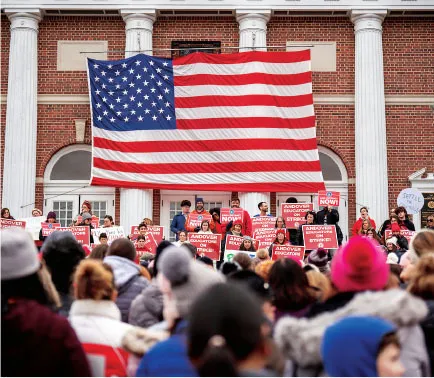
"They’re very impractical in not allowing at least teachers to strike," Bach said. "What you would likely see is the threat of that reality bringing management to a quicker solution through collective bargaining."
In recent years, statewide and local educator unions have become a focus in public-sector strikes, many of them in states where striking is illegal. West Virginia started the "Red for Ed" wave in 2018, striking for improved pay and benefits, quickly followed by educators in Oklahoma and Arizona. These strikes inspired educators throughout the country to follow suit.
The power that the educator unions hold, in part, is that their numbers are so great they cannot be easily replaced, Loomis said. Educators also are professionals with credentials; someone can’t just walk into a school and start working. "Who is going to move to West Virginia, with qualifications, to work in a dilapidated school for $30,000 a year? No one," he said. "They hold all the cards."