Photographs by
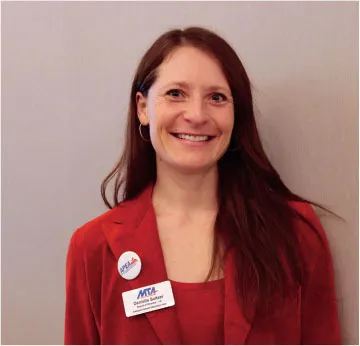
On Nov. 6, Danielle Seltzer’s first-period English class at Amherst-Pelham Regional High School was buzzing about the results of the presidential election.
One student finally asked, "Hey, what happened with the MCAS thing?"
"I said it passed, MCAS is no longer a graduation requirement," Seltzer recalled recently. "They all cheered."
That particular class, Seltzer noted, was for students with special education plans. She said the students are all capable of passing grade-level work, but doing so requires extra effort.
"One young woman — a ninth-grade student — said, ‘I’m so glad I don’t have to worry about MCAS anymore because I can actually focus on school,’ " Seltzer said. "What I didn’t fully realize until that moment, was that at age 14 because of the MCAS and because of who these students were, they already came into high school thinking that they didn’t have a chance. I am so inspired and reinvigorated by the fact that they now have that chance."
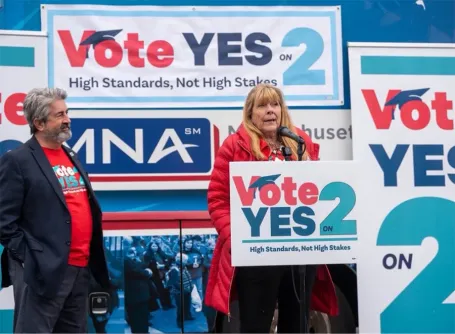
Voters decisively passed Question 2 in November, ending the use of the 10thgrade MCAS exams as a state-mandated high school graduation requirement. Supporters of the ballot initiative driven by MTA members successfully argued that the high stakes of the MCAS exam narrowed learning and unfairly penalized students who just don’t perform well on standardized tests. In passing Question 2, Massachusetts joined the vast majority of states that have abandoned standardized tests as high school graduation requirements. Just six states continue to use standardized tests for graduation requirements, down from 27 states in 2012.
Massachusetts school districts must now certify that students have successfully completed coursework aligned with the state’s academic standards. And while opponents of Question 2 have been lobbying the state Legislature to delay implementation of the new law, Governor Maura Healey instead filed an executive order calling for the establishment of a Graduation Council tasked with making recommendations for statewide high school graduation requirements.
The MTA — as well as the American Federation of Teachers Massachusetts and the Boston Teachers Union — will have a seat on the council. It is expected to deliver a report to the governor in 18 months.
MTA President Max Page and Vice President Deb McCarthy urged Healey to seek a wealth of public input and noted that a goal of Question 2 was to open a statewide conversation about educating the state’s young people to become future citizens, neighbors, parents and workers.
"During the ballot campaign, we heard valuable insights from across the state about what residents want from our schools and how to best resource schools and evaluate their success, Page and McCarthy said, in a joint statement. "We look forward to participating in a council that intends to take seriously public involvement. With students and educators freed from the constraints of a high-stakes standardized test, now is the time to ensure that every student is able to have a rich and rewarding high school experience grounded in our state’s high academic standards." In moving away from the use of high-stakes standardized tests, education advocates need to envision — in McCarthy’s words — a "portrait of a graduate in the 21st century."
"Now is the time to transition toward an approach that addresses the depth and breadth of the individualized educational choices and career interests of our students," McCarthy said. "I imagine graduation pathways that maintain our academic rigor, that expand high-quality learning experiences and internships, and that make the high school experience more learner-centric and invigorating."

As part of its legislative priorities, the MTA is recommending making MassCore a required program of study for high school students.
Cynthia Roy, who teaches science at Bristol-Plymouth Regional Technical School and is active in the New Bedford Coalition to Save Our Schools, vigorously campaigned for passage of Question 2. With the MCAS graduation requirement gone, districts are beginning to discuss grading policies and to look at assessment tools that acknowledge the limitations of standardized tests.
"Fortunately, deeper conversations are now emerging about the value of multiple assessment methods and the shortcomings of tools like multiple-choice tests," she said.
Roy, however, does caution against districts embracing pre-packaged curriculum which can in some cases be as undermining of educator autonomy as high-stakes testing.
"As an experienced educator, I can attest that some curricula labeled as ‘high quality’ do not meet the needs of students as effectively as materials developed by my colleagues," she said. "In many cases, educators create superior curriculum resources aligned with state standards that are more rigorous, relevant and engaging. Professional educators must always adapt any curriculum to best serve their students’ unique needs."
Another benefit of passing Question 2 is that it prompted the state Department of Elementary and Secondary Education to direct districts to provide a diploma to anyone who was denied one solely on the basis of their MCAS scores.
"I’m so grateful for the work of our union and work of our students and work of parents and community members all across the commonwealth," Seltzer, of Amherst-Pelham, said. "Passing Question 2 allows students to earn a diploma the way it should be earned — through enriching, relevant, deep learning that is so much more than a test score."
Urge state legislators to support MTA-backed legislation, which builds on our Question 2 victory, by expanding access to the rigorous MassCore program of study, and more. Please visit massteacher.org/testing.