Photographs by
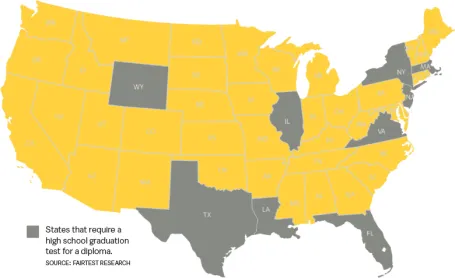
Massachusetts likes to brag that it has an exceptional national reputation for public education, but in one aspect, it’s a straggling outlier. The state requires a high school graduation test for a diploma, one of just eight that continue to do so.
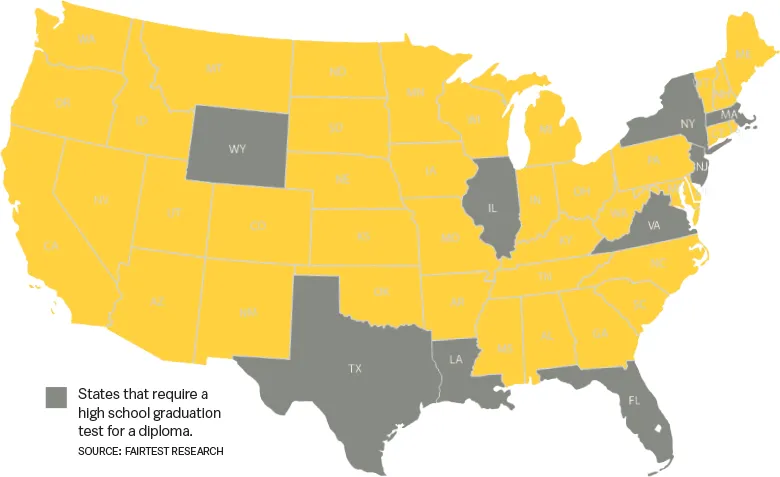
Massachusetts, which administers the MCAS-based graduation test in the 10th grade, is joined by Florida, Illinois, Louisiana, New York, Texas, Virginia and Wyoming.
This number doesn’t include New Jersey, which deferred the test in the pandemic, and now has legislation to remove it, although it has yet to act.
More than a dozen states have dropped the high-stakes approach over the past decade. During the peak of "accountability testing," in the federal No Child Left Behind era of the early 2000s, the high school graduation test was the norm in 27 states, according to FairTest, the National Center for Fair and Open Testing.
In that era, the federal government required that all states test students, and make yearly progress on goals. But there has never been a mandate for a graduation test. And research has found that graduation tests do not lead to higher academic achievement.
Over the past decade, a majority of states that once had it have reached the conclusion that they don’t need a high-stakes measure to determine whether students have learned enough to graduate.
Some moved to more flexible methods to determine whether students had learned essential skills, including a combination of grades, projects and exams. Some officials said the graduation tests, or exit exams, no longer aligned with their curriculum.
Other states expressed concern about the students failing them repeatedly and being blocked from career paths, said Harry Feder, executive director of FairTest.
"That is one reason," Feder said. "The other is the idea of what is this really doing for us. Not only is it harming kids, but … passing a test is not really the measure of whether a kid is college-ready or ready for the workforce. We have to think about other competencies."
California temporarily dropped the requirement in 2015 and then abolished it two years later. Its state officials said at that time that the test no longer reflected its needs. The state said as many as 30,000 students would qualify for retroactively issued diplomas, according to the magazine EdSource.
Ohio in 2022 adopted a new system that uses student scores on end-of-course exams and made these exams available to former students as well.
Georgia, which like Massachusetts had a high school graduation test that predated the No Child Left Behind Act, stopped the practice in 2011. Its governor in 2015 signed a law recalling the multi-section exam, clearing the way for as many as 9,000 former students who had failed it to obtain high school diplomas, according to Education Week.
New York, whose Regents exams have been required for graduation since the mid-1990s, is examining whether to replace them with alternative measures. The commission reviewing the exams is expected to report back to state education officials in 2024. Meanwhile, the state education board is introducing a pilot program that would offer other measures of student achievement, the Times Union of Albany reported, such as portfolios, presentations, projects and internships.
Angelique Johnson-Dingle, deputy commissioner for P-12 Instructional Support, told the Times Union in April: "The idea is all students are provided the opportunity to demonstrate their skills and knowledge in the best way that suits them."
And then there’s Massachusetts. The state waived the graduation test during the pandemic. But it has more recently doubled down on the exam, which it introduced in 1993.
The state Board of Elementary and Secondary Education this year voted to raise the cut scores, the threshold for passing the exam, beginning with the class of 2026. In a report called "Lessons Learned," which evaluated the impact of the graduation test, the nonprofit Citizens for Public Schools warned that this action would likely reverse gains in graduation rates:
"This will likely result in even more students not passing MCAS tests, and even more students not graduating. And it is the student groups with the fastest growing enrollment in Massachusetts public schools … who are being most harmed by the MCAS graduation requirement, including Latinx, English learners and low-income students."
Governor Maura Healey has been noncommittal when asked about the MCAS-aligned high school exam. She told GBH in September she had assigned staff to evaluate the MCAS and whether it’s measuring what the state intends. "MCAS is an assessment tool," Healey told Boston Public Radio. "… We need to identify who is not succeeding in the current rubric and what we need to do along with any changes to the existing test."

The MTA, supported by local educators and parents, is pursuing two tracks to change the damaging status quo. It is collecting signatures from registered voters for a ballot initiative that would remove the high school graduation test, while creating alternative measures that take a more holistic approach to education. And the union is seeking legislative action through the Thrive Act, which would end the high school graduation test, end state takeovers of districts and schools, and allow parents, educators and communities to have a stronger voice in how schools are run.
Educators and union members who have seen firsthand how the MCAS and the graduation test impact student learning, and the teaching profession, have urged the state to change.
MTA Vice President Deb McCarthy, an elementary school teacher for almost 30 years, reminded legislators at a Thrive Act hearing on Oct. 4 that data from MCAS testing doesn’t arrive for educators to consider until the next year – too late to have any influence on instruction.
The high school test does not reflect what students have learned, she said.
"I have met and worked with many students, particularly those with special education needs or who are English learners, who struggle with standardized tests, yet are still very good students. It is unfair and unjust to attach such high stakes to a single test and deny a high school diploma to any student who is otherwise qualified to receive one."

Betsy Preval, a Cambridge Education Association member, speaking at the same hearing, said the graduation exam and the MCAS in general are not a valid measure of academic skills.
"Collaboration, cooperation, investigation, empathy, patience, analysis, reflection, revision, critical thinking, differentiation – these are the values educators across the Commonwealth work tirelessly to uphold in our schools. That there are multiple ways to demonstrate knowledge."