Education Support Professionals are badly underpaid in most Massachusetts school districts, and an increasing number are fighting back with the support of their unions.
In Somerville and Greenfield the fight is currently focused on demanding a living wage for one group of ESPs: paraprofessionals, who are sometimes called instructional aides, teaching assistants or paraeducators. In Athol, the local is advocating for a fair contract for all — teachers and ESPs alike. Underlying it all is a demand for more respect for roles that are critically important to students but too often underappreciated.
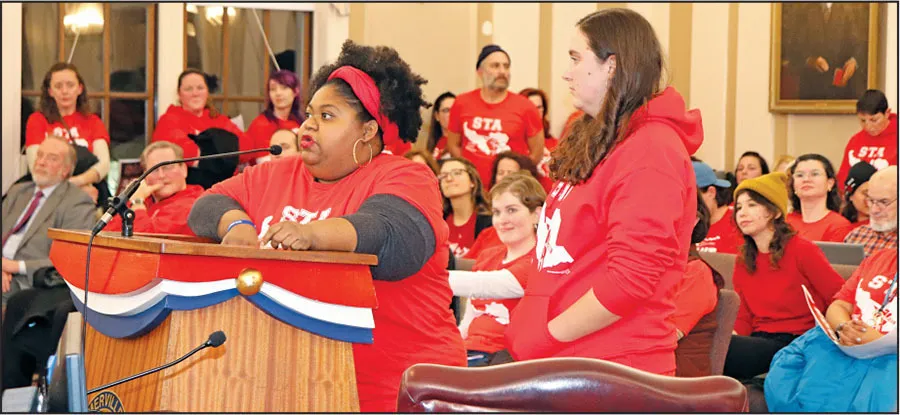
On Jan. 13, more than 200 Somerville educators, parents, union supporters and other community residents rallied outside City Hall and then marched into a School Committee meeting, chanting "20K is not OK! We deserve a higher pay!"
They were angry that the starting salary for paraprofessionals in the district is about $20,000 a year, which is significantly lower than the federal poverty level for a family of two. They are seeking to boost that to $25,000, which is still far too little to afford to live on in Somerville, a high-cost and increasingly affluent city.
Margaret Whittier-Ferguson, a para in a prekindergarten classroom, is head of the Somerville Teachers Association contract action team. She threw herself into the effort to support her colleagues in the short term and build the union’s strength in the long term.
"We’ve come to the breaking point," she said. "We can’t keep subsisting on what are basically poverty wages. We are fighting for a better contract that is fair and provides us with dignity and meets basic needs for housing and transportation. The STA is actively working on building our union’s power through this issue."
Whittier-Ferguson’s goal is to become a teacher. She is stuck in a vicious cycle because she can’t save enough on her salary to enroll in a master’s degree program, which would enhance her job prospects. Her plight underscores the need to both advocate for members in our public schools and attack the public higher education affordability problem.
"We’re only going to win a strong contract if every teacher, every para and the entire community get involved," she said.
Although few paraprofessionals could speak at the School Committee meeting because testimony was limited to Somerville residents, an exception was made for Daphnee Balan, a para at the West Somerville Neighborhood School.
"I pray that my daughter doesn’t get sick, because I don’t know if I’d be able to afford [to get help] for her," she said, fighting back tears. "Every day when I get up to go to work, I pray that my car starts because I don’t know if I can afford to deal with issues with my vehicle.
"I have heard people say that we get kicked, we get hit and we get punched," Balan continued, referring to earlier testimony about challenges facing paras, who often work with students who have behavioral problems. "But we also get hugged every day by the very ones that do that to us. That’s because we greet them with a smile every day.
They’re happy to see me because they value me. "The question is," she asked members of the School Committee, "do you?"
Although the School Committee has filed for mediation, the STA is continuing to push the district to address the para crisis head-on by agreeing to a fair contract without delay.
In Greenfield, the paraprofessionals have a different problem. With a starting salary of only $11.75 an hour, they are among the lowest-paid in a state that has just increased the minimum wage for private-sector and state employees to $12.75 an hour and is heading toward $15 an hour in 2023. The MTA is backing a bill that would require the same minimum wage requirements for municipalities. That bill will have to be approved by a two-thirds vote in both branches of the Legislature to become law.
During negotiations, the Greenfield School Committee offered the paras a $3 raise at each step. The local accepted the offer and both sides ratified the agreement. But no raises have been given because the city says there isn’t enough money to honor its agreement.
Susan Voss, a paraprofessional in Greenfield, said local members have picketed and spoken out at School Committee and City Council meetings.
Putting their students first, however, members pushed back when the former mayor proposed taking funds out of the school budget — including money for special education services — to finance the raises.
Now that there is a new mayor and the expectation of new funding under the Student Opportunity Act, the Greenfield Education Association will regroup and push for the raises that the members are owed, Voss said.
The Athol Teachers Association is fighting for all educators — including ESPs — through unified bargaining, meaning the more powerful teachers’ unit is standing with members in the smaller units. Mary Grutchfield, an elementary school special education teacher and the new president of the ATA, said that winning comparable raises for all of the units is only fair. Yet the district has proposed giving teachers a bigger cost-of-living increase than paraprofessionals and other staff.
Members signed a petition protesting the disparate treatment and delivered it to the School Committee. Regarding the raises, the petition states, "Whether you are a custodian or a paraprofessional or a teacher, your milk costs the same. We all deserve raises to meet the rising cost of living."
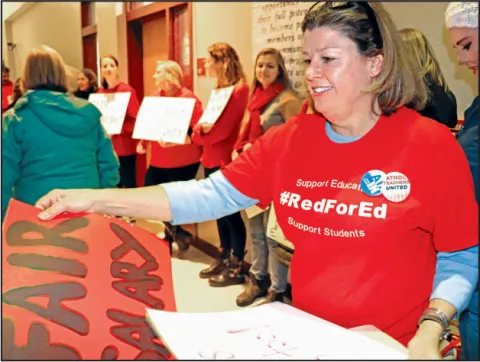
At that session, ATA members held up signs in the hallway and during the meeting to show their solidarity. This was a new kind of activism for a local that traditionally has been quiet. One member with a button-making machine made buttons reflecting the union’s newfound solidarity: Athol Teachers United.
Rami Bridge, president of the Somerville Teachers Association, summed up why locals like his should be fighting so hard for paraprofessionals. In an op-ed for the local newspaper, Bridge wrote, "No educator in a class by themselves can give all their students the support they need. It takes a team of dedicated professionals. Paraprofessionals are the glue that holds the team together. Our schools would not function without them."