Photographs by
The purpose and significance of Indigenous Tribal Land and Waterways Acknowledgments (TLA) have evolved over the nine years I’ve been ensuring they take place at MTA meetings and educational gatherings.
Initially, I incorporated them into my introductions. Over time, I began reaching out to conference organizers, before sessions began and during mingling periods, to ask if someone was prepared to deliver the TLA. If no one was, I would volunteer to do it myself.
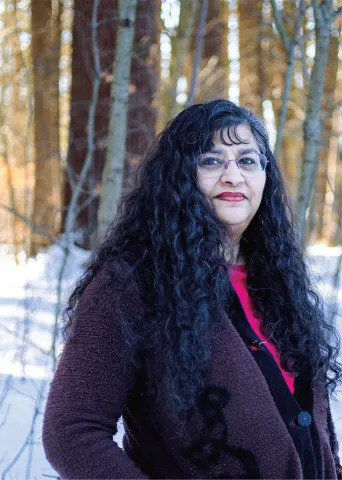
I begin by introducing myself and sharing my ancestral lineage on both my biological mother’s and father’s sides, which reflects my multiracial identity and includes my first language, German, as well as my Indigenous affiliations.
As someone who is three generations removed from my Caribbean ancestors, a first-generation German, and not Indigenous to the lands where I live and work, I view TLAs as a meaningful way to be a "good relative," ally and activist who supports Indigenous communities generally, and local nations specifically. Acknowledgments are an important step in making visible the Indigenous nations that colonization has sought to erase. TLAs honor the Indigenous peoples who have been stewards of these lands for thousands of years and who continue to maintain their deep connections to the land, waterways, plants and animals of these territories.
I am a retired special education teacher and have worked with educators for over 30 years through the Massachusetts Association of School Superintendents and Initiatives for Developing Equity & Achievement for Students (IDEAS). As part of any self-introduction, I believe we should not only share our names and pronouns but also acknowledge the tribal lands where we live or work. For me, this means recognizing that I reside and work on Pawtucket, Agawam, and Massachusett lands in what is now called the MetroWest area of Boston.
TLAs provide an opportunity to publicly express gratitude to Indigenous nations. For those of us who are not Indigenous to this land, even if we are Indigenous to other lands, it is important to recognize that we have benefited from colonial violence that displaced Indigenous peoples, exploited both them and their land, and continues to disregard political agreements, such as treaties, among other injustices. Acknowledging the land we are on must go beyond simply "checking a box." To make TLAs meaningful, we need to share our personal learning journeys, provide accurate information about Indigenous nations, and commit to accountability and action.
Most of us were never taught about treaties, including their names or the year when they happened. The Fort Laramie Treaty of 1868, for example, is one of the most significant. Briefly, it established the Great Sioux Reservation, including the Black Hills, and guaranteed the Sioux Nation exclusive use of this land in exchange for their agreement to live on a reservation and refrain from attacking settlers. Today, this area is where Mount Rushmore is carved, a stark reminder of the continued disregard for these agreements and the erasure of Indigenous sovereignty.
We stand on the ancestral homelands and traditional territories of Indigenous peoples who continue to fight for human rights, tribal sovereignty, and access to the resources needed to build self-sustaining communities. The name "Massachusetts" originates from the Algonquin word Massa-adchu-es-et, meaning "large hill place" or "at the great hill," specifically referring to the Great Blue Hill. This hill is part of a landscape shaped by an ancient volcano that was last active over 400 million years ago. Much of the Massachusetts Bay area lies within the ancestral homeland of the Massachusett and also the Nipmuc, who are Indigenous to central and western Massachusetts, as well as parts of Connecticut and Rhode Island. The Wampanoag span the areas of Rhode Island and Cape Cod, including Martha’s Vineyard and Nantucket.
"Wampanoag" means "People of the First Light." In the 1600s, the Wampanoag Nation numbered as many as 40,000 people across 67 villages. Today, there are about 5,000 enrolled members, although many more identify as Wampanoag. Historically, the Wampanoag Nation comprised several tribes or clans that formed a larger confederacy. Some of the principal groups within today’s Wampanoag Nation include Sakonnet (along the eastern shore of Rhode Island), Aquinnah, Assawompset, Herring Pond, Mashpee and Pokanoket.
The Pokanoket were the Wampanoag group who greeted the Pilgrims in 1620. Their sachem, Massasoit, led the nation in forming a peace treaty with the new settlers. The Mashpee Wampanoag gained federal recognition in 2007 after more than 30 years of effort. In November 2024, Governor Healey signed an executive order granting state recognition to the Herring Pond Wampanoag. It is important to note that state and federal recognition are colonial constructs imposed on sovereign nations that have governed and cared for this land for thousands of years. Indigenous peoples know who they are. Colonization, however, has worked to erase their history and identities, making recognition processes necessary in the eyes of settler governments.
One of the region’s key waterways was originally known as Quinobequin, meaning "meandering" in reference to its winding path. In 1614, English explorer John Smith renamed it the Charles River after Prince Charles, who later became King Charles I of England, even though the prince had never seen it. Another relevant memorable moment happened when John Smith (of "Pocahontas" fame) left Thomas Hunt in charge of further "exploration" in New England, but let's back up a moment. In 1605, Capt. George Weymouth captured Tisquantum, a Patuxet Wampanoag man, and took him to Europe.
In 1614, Thomas Hunt brought the captured Tisquantum back to Maine as an interpreter. Tisquantum eventually escaped enslavement in Europe with the help of Franciscan monks and returned to New England 14 years after his initial capture. Fluent in multiple European languages, he is better known by the English name "Squanto," under which he famously encountered the Pilgrims in 1620.
A Tribal Land and Waterways Acknowledgment is an opportunity to express our commitment to accountability. As daily classes, conferences, and workshops unfold, it is important to reflect on the intersectionality of Indigenous nations within discussions about racial discrimination, ongoing colonial violence, and oppression on the lands they have always inhabited.
Unlike other groups, Native people never migrated to another part of the world in large numbers. These are their only homelands, and it is essential to ensure their stories are told. Efforts must focus on making them visible, rather than invisible, while engaging with these issues on their ancestral and current lands.
This commentary was written by Claudia Fox Tree, Ph.D., a Retired member who taught special education for 37 years. She is a member of the MTA Ethnically Marginalized Affairs Committee. For more information on tribal land acknowledgments and EMAC, please visit massteacher.org/EMAC.