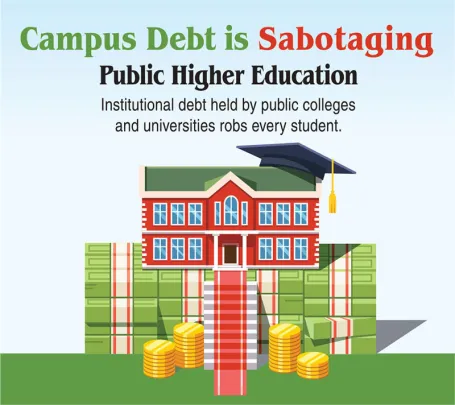
While the problem of student debt related to the cost of higher education is widely known and is the source of policy debates unfolding at the state and national levels, there is a related issue that too often remains hidden.
Campus debt.
To highlight the problem of public colleges and universities accumulating excessive debt for capital improvements, MTA members have used a grant from the union to launch the Massachusetts Campus Debt Reveal project, a follow-up to a national version of the effort that was held last April.
The loan obligations held by the colleges and universities — which run into the billions of dollars across the Massachusetts public higher education system — ultimately rob all students of opportunities and contribute to the student debt crisis by inflating the cost of obtaining a degree.
Prior to 2000, the state paid for most of the major building costs on public college and university campuses. A return to that approach would produce numerous benefits, advocates note.
Joanna Gonsalves, a professor at Salem State University, is a member of a coalition of faculty, staff and students that is fighting not only for greater state investment in public higher education, but also for going back to policies that made the state responsible for campus capital projects.
"While the problem of student debt is well understood, the impact that campus debt has on public higher education is not treated with the same urgency," said Gonsalves, who is one of the organizers of the debt-reveal project. "This institutional debt is a significant force driving students into debt as their costs rise to pay for campus loan obligations."
The multi-campus coalition drew more than 100 students and higher education union members to an online event on April 14 that also was attended by legislators.
"Before I was involved with this project, I had been completely unaware that campus debt even existed and of the impact it has on students, faculty, resources and the quality of our education," said Gayathri Raja, a sophomore at UMass Lowell. "Diving into the financials of our state colleges and speaking to many of the parties involved have opened my eyes to the danger of this immense amount of debt and how it is largely concealed from the public. The changes in public higher education and its funding that this project is fighting for attack the problems at the source."
The coalition is pushing the Legislature to adopt the Cherish Act, which would restore funding to address decades of budget cuts to public higher education and freeze tuition and fees at public colleges and universities for five years.
In addition, the activists are working in support of passage of the Fair Share Amendment in November. The proposed constitutional amendment would apply a 4 percent tax on annual income above $1 million and is expected to raise approximately $2 billion each year for public education and transportation.
"Diving into the financials of our state colleges and speaking to many of the parties involved have opened my eyes to the danger of this immense amount of debt and how it is largely concealed from the public," said Gayathri Raja, a sophomore at UMass Lowell. "The changes in public higher education and its funding that this project is fighting for attack the problems at the source."
The coalition has identified more than $3 billion in capital debt held by UMass campuses and $1.2 billion in capital debt on campuses within the broader state higher education system. To press its case, the coalition notes that excessive debt held by public colleges and universities sabotages education in two ways.
First, it leads to the prioritization of fiscal decisions over educational decisions. Increasingly, public college and university trustees and board members are coming from professional backgrounds in the financial services sector rather than from education or public service.
Second, campus debt influences the betterknown problem of student debt and leads to cuts in staff and programs to shift spending to debt repayment.
These cuts, coupled with increasing costs and the need for student borrowing, create barriers for entry to public colleges and universities — especially for nontraditional students, students who are the first in their families to go on to higher education, and students of color.
The coalition is active in the campaign to cancel student debt. It supports the initiative by U.S. Senators Bernie Sanders and Elizabeth Warren — and the national Debt Collective — to have the Biden administration strongly address the problem of student debt.
The Campus Debt Reveal Project is planning to participate in a May 16 Debt-Free Future rally that PHENOM, the Public Higher Education Network of Massachusetts, plans to hold at the Massachusetts State House.