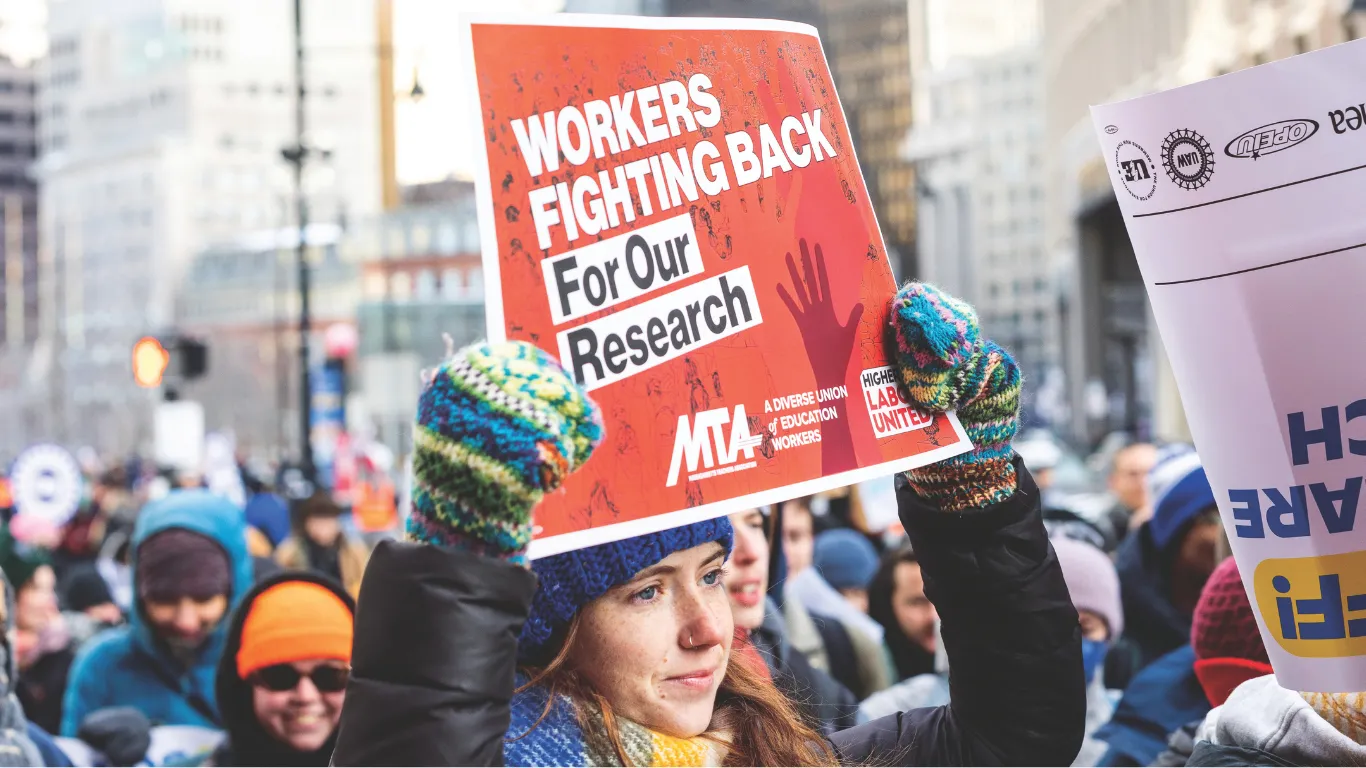
Unions representing workers at UMass campuses, state universities and community colleges are organizing campaigns to address the fundamental changes bearing down on higher education through policy and funding initiatives of the Trump administration.
Various federal funding sources for colleges and universities remain in flux as the White House uses fiscal coercion to end diversity, equity and inclusion programs and tries to stanch other grants flowing to university research and work. The Trump administration’s aggressive crackdown on immigration has left foreign students, faculty and staff uncertain about their ability to continue studying and working in this country. And most recently, the Trump administration has threatened students and colleges with harsh reprisals ranging from arrest, deportation and defunding for allowing legal protests related to the U.S.’s support for Israel in its war against Hamas that is devasting Gaza.
The MTA also is concerned about the fate of Pell Grants and other funding available to low- and middle-income students who hope to attend college. An executive order signed by President Trump on March 20 seeks to dismantle the U.S. Department of Education, which oversees Pell Grants and other forms of financial aid, including the federal student loan and work study programs.
In a press conference after he signed the executive order, Trump stated that funding for programs such as Pell Grants and Title I aid to preK-12 schools would be "preserved," but his order emphasized that the Department of Education is not equipped to act as a bank. Trump later said the Small Business Administration could administer student loans.
Closing the Department of Education would require action by Congress.
The executive order states that any allocation of federal education funds is going to be contingent on a requirement that programs terminate "illegal discrimination obscured under the label ‘diversity, equity and inclusion’ or that address ‘gender ideology’."
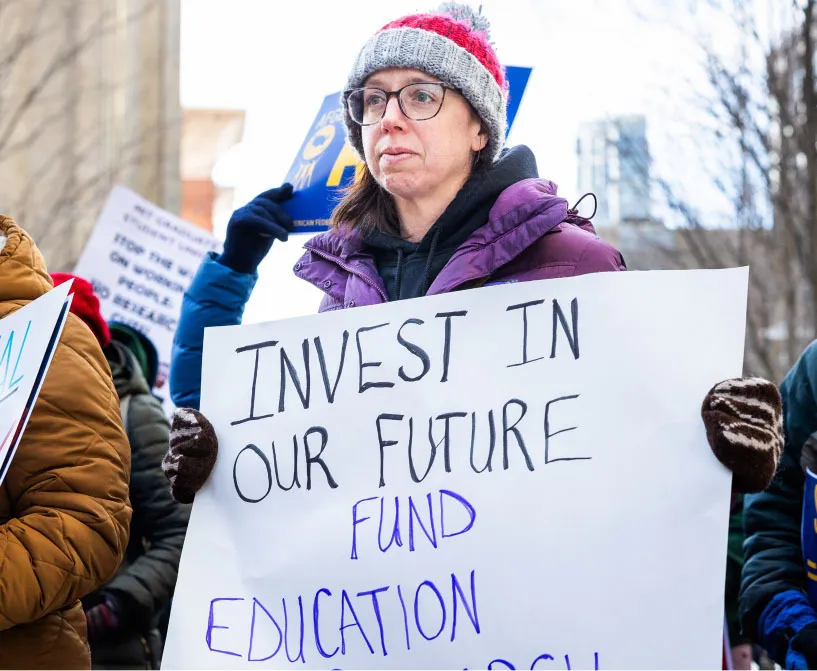
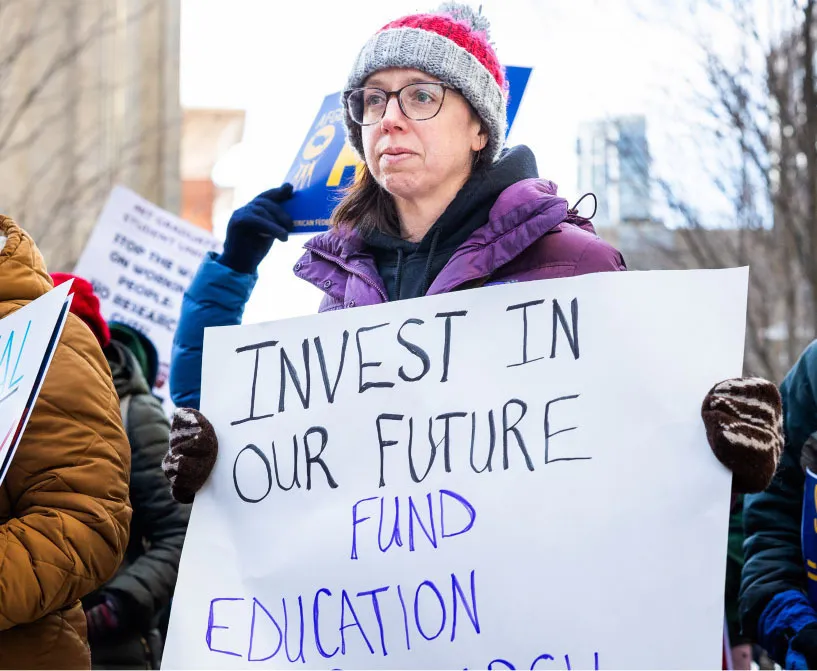
Responding to threats to higher education funding or mission, a coalition of MTA and AFT Massachusetts higher education affiliates is meeting weekly to develop plans for protecting public higher education in this state. Union members also have engaged in campus-based and statewide actions to advocate for the funding to support students, maintain the integrity of academic work and uphold the values of the public higher education mission.
In seeking protection from any federal harm, higher ed unions are using contract bargaining, as well as advocacy around approval of the FY 2026 state budget and the beginning of a new legislative session.
"Education nurtures democracy and provides students with economic opportunities," MTA President Max Page and Vice President Deb McCarthy said in a recent statement. "The Commonwealth’s five-campus UMass system, nine state universities and 15 community colleges act together as an engine of civic and economic strength, one that drives the quality of life in our state.
"This is only possible as long as our colleges and universities stay true to a shared mission of welcoming inquiry, research and study from a broad array of perspectives, and ensuring that the views of individuals and communities that have been marginalized and oppressed are included in academic pursuits. Likewise, our campuses must be open to all individuals who are ready to pursue higher education."
Members from several MTA higher education unions participated in a Boston rally on Feb. 19 with union members from private colleges and universities, all focused on protecting academic freedom as well as worker and student rights.
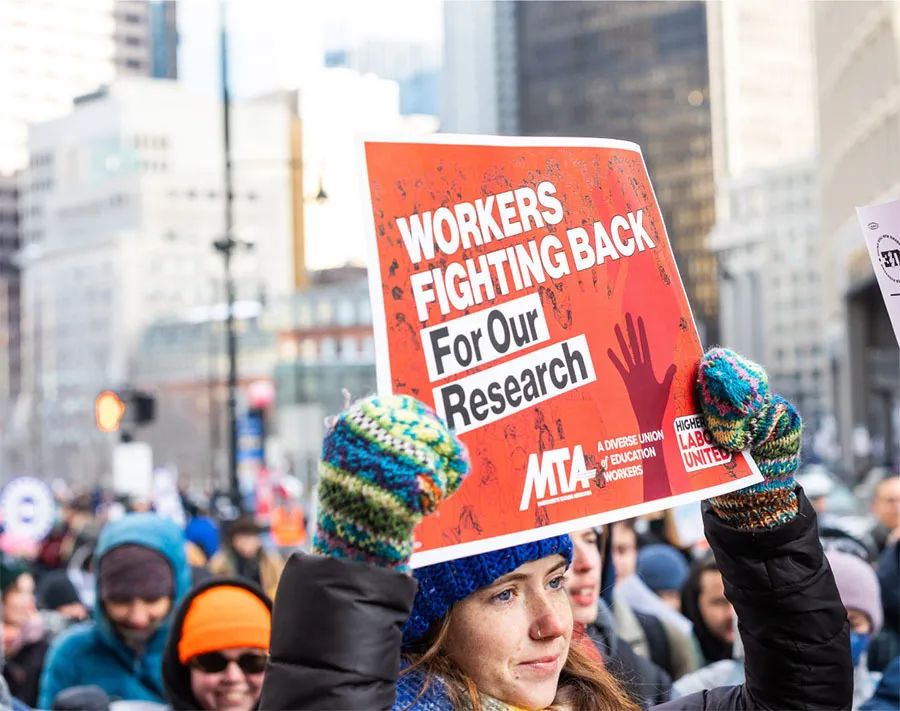
Bianca Ortiz-Wythe, a policy analyst at UMass Boston’s Gastón Institute for Latino Community Development and Public Policy, and a member of the Professional Staff Union, said at the rally that UMass administrators told the institute "to whitewash" any references to diversity, equity and inclusion from its work after the federal Environmental Protection Agency grant that funds her project came under federal scrutiny.
Ortiz-Wythe and her team are working to improve environmental and health conditions in East Boston.
"The project was intended to support work like providing training on participatory budgeting and environmental justice to build local capacity and strengthen community efficacy around environmental justice advocacy," she said. "This work isn’t frivolous — it’s essential. Without it, issues like flooding and poor air quality continue to disproportionately harm working-class communities, and residents are left without the tools to fight back. But then we learned our grant was in jeopardy — because of Trump’s executive order on DEI. For three weeks our grant was in limbo. Recently, we were told we could start work, without any of the funds to actually do it.
"Additionally, we’ve been told to whitewash any mention of DEI, environmental justice, and the very principles that the grant was meant to uphold — erasing the reality of racial and social inequities in order to meet fascist, political demands. By dismantling the very infrastructure meant to address systemic injustice, they are ensuring that inequality is maintained and deepened."
Tom Estabrook, president of the union representing employees funded by grants and contracts at UMass Lowell, has worked for nearly 30 years for the New England Consortium, which provides health and safety training to businesses, communities and industries. The National Institutes of Health has provided much of the funding for the consortium’s work. The Trump administration’s efforts to freeze NIH funding is jeopardizing the health and safety training.
Estabrook debunked the argument that the consortium’s work qualifies as "wasteful government spending," which Trump and Elon Musk, the billionaire CEO who has led efforts to dismantle federal programs, have cited as they slash federal programs and the federal workforce.
"Every dollar spent on safety can yield a $6 return on investment," Estabrook said. "Our work is effective and well worth the federal support. But my critical work and the work and livelihoods of many of the 140 members of my union local are at risk from the actions by the Trump administration. These attacks on federal funding are an attack on me, my coworkers and working people broadly. At UMass Lowell, the Trump administration’s actions against federal research funding agencies have halted important studies of transnational human trafficking in Global South countries and of HIV prevention among Black and transgender women. This is an outright attack on vital research to protect the health and well-being of underserved communities."
In addition to targeting funding, the Trump administration has also gone after students attending colleges and universities. International students at campuses across Massachusetts – including UMass Boston, UMass Amherst, UMass Lowell, UMass Dartmouth and Bridgewater State University – have had their student visas cancelled and student status revoked, which means they must return to their home countries.
"It's beyond reprehensible that the Trump administration revoked visas for foreign students and terminated their student status – all carried out without any contact with university officials," Page said. "This disgusting subterfuge follows the illegal abductions and detention of Tufts University graduate student Rümeysa Öztürk and Columbia University graduate student Mahmoud Khalil, and threats to many others.
"The Trump administration is combining the targeting of foreign students with threats of withdrawing federal funds for lifesaving research and academic work in order to attack colleges and universities, which the president views as obstacles to his agenda. Yet our colleges and universities – especially our public colleges and universities – are engines of opportunity for countless families. Higher education is a cornerstone of our democracy, our economy and our quality of life. Imagine where we would be without the benefits of research conducated at universities and colleges around the country."
MTA unions are demanding their respective campus administrations join workers in speaking out against the Trump administration’s tactics that are threatening to undermine higher education.
So far, the nine presidents of the state universities have signed a letter supporting state Secretary of Education Patrick Tutwiler’s commitment to making public colleges and universities inclusive and accessible to all, and to support traditionally marginalized students.
Protecting public higher education also will require action by state elected officials.
The MTA has requested that legislators use $200 million from the Fair Share revenue surplus fund to establish a reserve fund that can be used to fill any voids left by cuts in federal funding.
This is in addition to several bills aimed at reducing the cost to attend public colleges and universities and to pay competitive wages for faculty and staff.
"Our outstanding public higher education system is vital to the overall health of our communities and state economy," Page said. "We must protect it at all costs."