The MTA’s higher education members have been fighting hard against draconian staff and program cuts at public colleges and universities since the start of the coronavirus pandemic — and they aren’t letting up now.
"We have been confronted by an array of outrageous actions — from the laying off and furloughing of thousands of workers to the elimination of career programs and support services that students rely on to the shuttering of child care centers that provide affordable options for students and workers, as well as practical experience for students," said MTA Vice President Max Page. "Given the federal aid coming into public colleges and universities plus the state’s level funding of public higher education through June, none of these cuts are necessary.
"They are doing damage to our members, our campuses and our communities," Page added. "These executives are using the pandemic as an excuse to get rid of workers."
Higher education staff and faculty have also been placed at risk of contracting COVID-19 in their workplaces. Workers on various campuses report insufficient access to personal protective equipment and a lack of practical safety measures, such as adequate ventilation in buildings.
Making the situation worse is the fact that under the state’s current schedule, higher education workers will receive COVID-19 vaccinations during Phase 3 of the rollout, behind their colleagues in preK-12 schools. MTA members have been lobbying Governor Charlie Baker’s administration to move higher education workers into the second phase.
While MTA members have been relentless in demanding fair and just treatment, responses have run the gamut; at one point, UMass Trustee Michael O’Brien declared that the university system’s substantial reserves could only be tapped for a crisis on the order of a giant asteroid striking Earth.
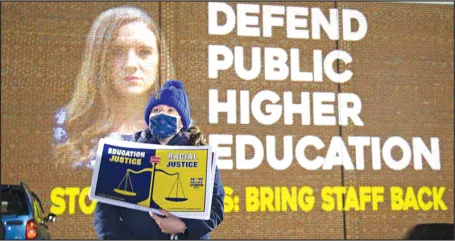
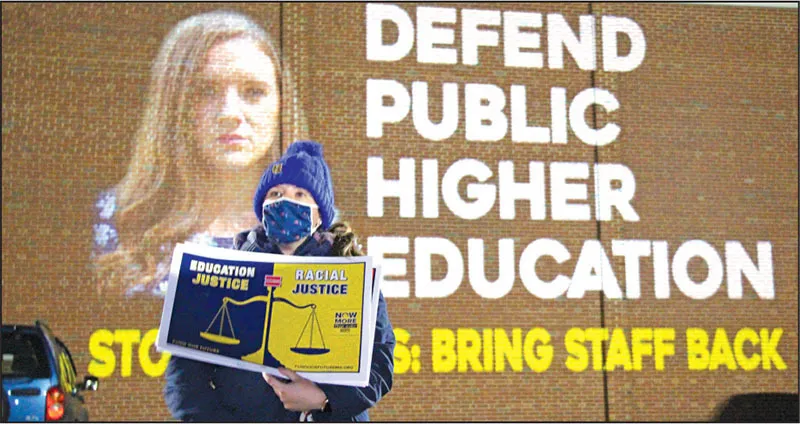
Several campus demonstrations in the fall led to a coordinated statewide action with the arts-activist group The Illuminator. The group worked with MTA members in November, visiting community college and university campuses as well as key locations in downtown Springfield and Boston. During their travels, the activists projected pro-education messages on numerous buildings.
Renae Gorman, president of the Massachusetts Community College Council chapter at Springfield Technical Community College, used the group’s tour as part of her union’s campaign to prevent the college from cutting seven popular career-path programs.
The MCCC chapter brought its fight to the college’s Board of Trustees and to the public. Members demonstrated that the college had the funding to maintain the programs and that the students were benefiting greatly from them.
"These programs allowed students to go out and get good jobs with a two-year degree," Gorman said. "These programs were valuable for Springfield."
In mid-January, the trustees overturned the administration’s decision and restored five of the targeted programs. Gorman said that the union will keep fighting to win back the other two.
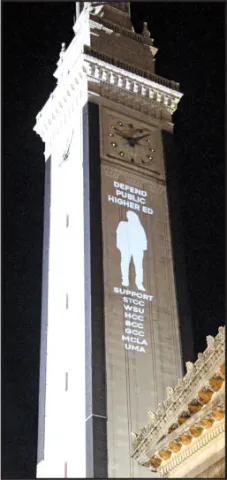
Salem State University, where union members have been in a pitched battle with President John Keenan, was another Illuminator site. Students, staff and faculty circulated petitions, reached out to state legislators, and wrote columns for local newspapers to emphasize the damage that Keenan’s austerity plan — which included furloughs and other personnel reductions for all campus staff — was doing.
Massachusetts State College Association chapter President Tiffany Chenault decried the cuts as harmful to students and demoralizing to faculty and staff. Perhaps worst of all, she said, is that they are completely unnecessary.
Chenault pointed out that Keenan did not pull back from his austerity measures even after the Legislature provided level funding to the university in the current year’s state budget and the campus received $10.7 million in federal COVID-19 stimulus aid.
University of Massachusetts campuses are facing similar challenges. Hundreds of workers are still on furlough even though the system received more than $74 million in the most recent round of stimulus aid and enrollment figures did not plunge, as campus executives had predicted.
Several unions representing UMass staff and faculty are working together on a "Bring Them Back" campaign. Bolstering the coalition’s argument that there is plenty of work to do, even with fewer students on campus, is the fact that UMass has retained and added to the number of non-unionized, unbenefited temporary employees at the same time that it is keeping full-time workers out of their jobs. "The university is exploiting low-paid workers and harming hundreds of families whose livelihoods have been connected to the campus," said Leslie Marsland, president of the University Staff Association.
UMass union members are also organizing around health and safety issues. Many workers who are on the campuses report a lack of access to personal protective equipment and up-to-date information on COVID-19 infections at their job sites.
The MTA is spearheading the Massachusetts Agrees campaign, an effort to raise public awareness about the harmful impacts on students and communities being unleashed by the unnecessary budget cuts. For more information about the campaign, visit massachusettsagrees.org.