The consequences of underfunding public higher education in Massachusetts reach well beyond the students, staff and faculty members grappling with austerity budgets at public colleges and universities.
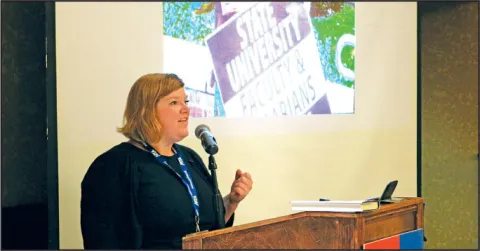
At the recent MTA Higher Education Conference, UMass Boston professor Erin O’Brien presented startling research describing how rising student debt correlates with shrinking participation in politics and the democratic process.
Author and professor Caitlin Zaloom followed up with accounts from Indebted: How Families Make College Work at Any Cost, in which she describes how the cost of higher education creates far-ranging problems for whole families.
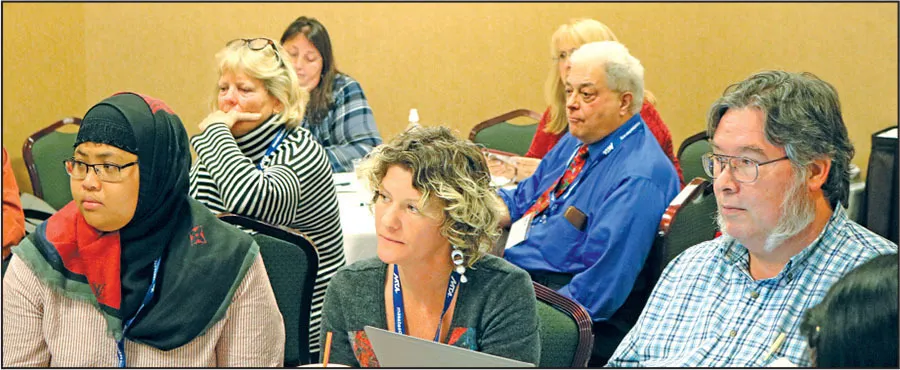
MTA higher ed members were joined by allies from other unions, student groups and some preK-12 locals at the conference, which was held on Jan. 10 at the Sheraton Springfield Monarch Place Hotel. The fight to win passage of the Cherish Act — as well as secure immediate increases in public higher education funding — formed the framework of the event.
This winter and spring, MTA members and their allies want to keep up the momentum created during the successful fight for the historic Student Opportunity Act, which was signed into law in November. The measure will increase spending on preK-12 public schools by $2 billion over seven years.
"It’s time to do the same for public higher ed," said Rep. Paul Mark (D-Peru), one of the lead sponsors of the Cherish Act (S.741/H.1214). Mark shared his experiences of working as an adjunct professor and relying on public colleges and universities — and a union-negotiated tuition benefit — to advance his own education and professional training.

Offering 100% Customizable Graduate Programs in Education
Program Includes
- Master of Science in Education (30 Credit Hours)
- Certificate of Advanced Graduate Study (30 Credit Hours)
- Post Master’s Certificate (15 Credit Hours)
- Individual Non-Matriculated Course Offerings
With Customized Focus Areas in
- Curriculum & Instruction Strategies
- Literacy (K-12)
- Education Leadership
- Inclusion Education
- Adult Education
LEARN MORE TODAY
800.994.2804 | education@une.edu | online.une.edu
With every MTA higher ed local getting ready to head into contract negotiations this year, the conference created opportunities for members to strategize about ways to link bargaining campaigns to the legislative push behind the Cherish Act. Several ideas emerged on ways to share information at all levels, in preK-12 locals as well as the higher education community.
Ashanta Smith, a member of the Springfield Education Association, participated in workshop sessions during the conference and said she came away with a better understanding of how funding issues affecting public colleges and universities have an impact on the students she educates. Smith said it’s important for leaders of preK-12 locals to have a full understanding of the problems that Continued from Page 14 the Cherish Act will address and to be willing to join the campaign to get the bill passed.
While many observations surfaced about student debt and economic injustice, Massachusetts College of Art and Design librarian Katie Riel pointed out an immediate problem in her workplace that the Cherish Act could help solve. "Our building is in disrepair," she said. "Our windows leak, and this is in a library."
UMass professor O’Brien and Zaloom, who teaches at New York University, delivered keynote speeches that took on the broader and deeper implications of poorly funded public higher education. "There are democratic costs of student debt," O’Brien said after presenting data that showed how students who amass loans, especially those who never finish their degrees, tend to withdraw from the political process.
The corrective, she said, is to make public higher education more affordable. As things stand, she noted, Massachusetts ranks near the bottom nationally in terms of state investment in public colleges and universities.
"These are policy choices," O’Brien said. "We’re here to change these trends."
Zaloom interviewed 80 students and 80 family members for Indebted. What she found were families entering into untenable financial situations.
"I saw moral conflict and moral tension. Parents felt this moral responsibility to their children, but we also live in a culture of fiscal prudence," Zaloom said. "College sets a trap for parents and young adults."
Like O’Brien, Zaloom said it will take a lot of organizing and political will to solve the dilemma of college affordability.
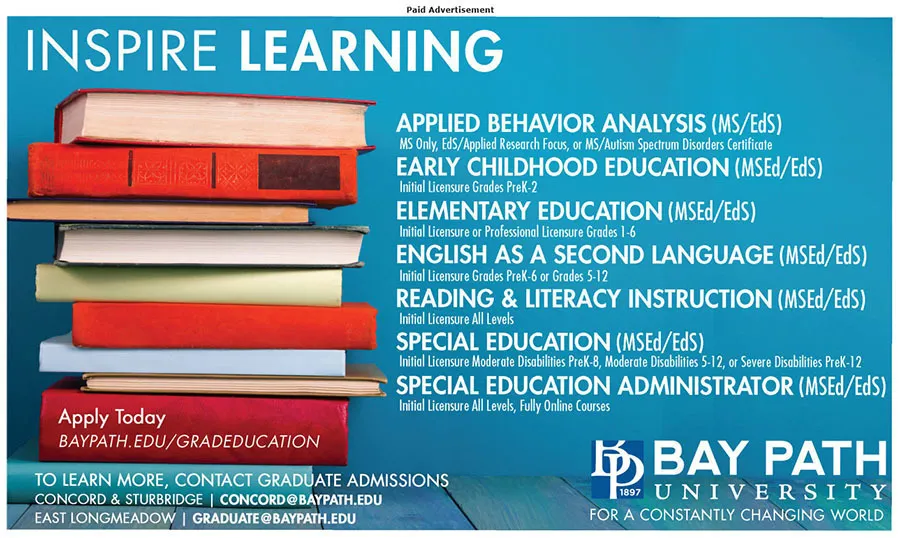
INSPIRE LEARNING
APPLIED BEHAVIOR ANALYSIS (MS/EdS)
MS Only, EdS/Applied Research Focus, or MS/Autism Spectrum Disorders Certificate
EARLY CHILDHOOD EDUCATION (MSEd/EdS)
Initial Licensure Grades PreK-2
ELEMENTARY EDUCATION (MSEd/EdS)
Initial Licensure or Professional Licensure Grades 1-6
ENGLISH AS A SECOND LANGUAGE (MSEd/EdS)
Initial Licensure Grades PreK-6 or Grades 5-12
READING & LITERACY INSTRUCTION (MSEd/EdS)
Initial Licensure All Levels
SPECIAL EDUCATION (MSEd/EdS)
Initial Licensure Moderate Disabilities PreK-8, Moderate Disabilities 5-12, or Severe Disabilities PreK-12
SPECIAL EDUCATION ADMINISTRATOR (MSEd/EdS)
Initial Licensure All Levels, Fully Online Courses
Apply Today
TO LEARN MORE, CONTACT GRADUATE ADMISSIONS
CONCORD & STURBRIDGE | CONCORD@BAYPATH.EDU
EAST LONGMEADOW | GRADUATE@BAYPATH.EDU
FOR A CONSTANTLY CHANGING WORLD