

This November, the MTA celebrates the 175th anniversary of the association’s founding. The Spring and Summer editions of MTA Today featured the history of our first 90 years. In this issue, we explore the period from 1938 through 1965, the year Massachusetts teachers won collective bargaining rights. All quotations in italics are from The Faces and Voices of the Massachusetts Teachers Association: Celebrating 150 Years of History, written in 1995 by now-retired MTA Communications Specialist Jerry Spindel. Other information is from The Massachusetts Teacher, the association’s periodical during this time.
The Great Depression created hardships for many in public education, as teacher salaries were cut and schools were closed. Women paid the highest price. They were paid less than men in the first place — and they were often fired once they married. That practice was upheld by the courts in 1938 in a case involving a Somerville teacher.
When young men left the classroom in large numbers to fight in World War II, women teachers found they had some leverage. The MTA commented, "Some communities will soon be calling back the married women who were so unceremoniously dropped when other people wanted their positions."
The war was a frequent topic in MTA publications. Students were encouraged to bring in nickels, dimes and quarters to buy savings stamps to help finance the war effort. Patriotism was expected. In a 1943 article, teachers were exhorted to pledge: "We will foster the physical and mental health of children and youth, and see that remediable defects are promptly corrected, remembering that the duties and strains of war require strong bodies and healthy minds."
As the war drew to a close, women’s rights took a step forward.
In 1945, after years of lobbying by the MTA, Massachusetts passed the Equal Pay Law for men and women who do comparable work. However, the Legislature left adoption of the law up to each individual city and town. Almost 20 years later, a number of Massachusetts school systems still maintained two separate pay scales.
Today, of course, that would be illegal. But the changes don’t mean women are treated equitably in hiring and promotion practices. Although there are now about three times as many female teachers as male teachers in Massachusetts, male superintendents outnumber females 201 to 132, according to recent data.
The postwar years saw an unprecedented boom in salaries — except among educators. In a 1946 MTA article titled "Shall I Return to Teaching?," a sailor who had taught in Brockton asked, "Wouldn’t I be better off staying in the Navy? The pay is much better in the Navy, and now that the actual struggle between life and death has been removed, it is a much more leisurely life."
The sailor continued, "I actually dreaded meeting my first class after three years in the naval service."
His attitude changed when his 35 students arrived. "I felt there still were children in the world who could laugh, talk, and giggle," he wrote. "I felt at home with them, as if I hadn’t left them at all." He concluded that teaching was his life’s work after all.
The salary was a continual problem, however, and some rural districts paid so poorly that they had a hard time retaining staff. In 1950, average annual salaries listed for selected trades showed classroom teachers at the bottom:
- $4,675: Steam-railroad crews
- $4,233: Heavy construction
- $4,142: Newspaper
- $4,034: Plumbing
- $3,457: Carpenters
- $3,350: Classroom teachers
The MTA frequently called for more state funding to increase spending and better equalize resources across districts. In a 1945 article titled "Cherishing the Public Schools," the MTA’s director of research cited the same constitutional provision relied on in later lawsuits to make the case for more funding. "The differences in financial ability among the cities and towns in Massachusetts are very great," the author wrote. "Newton is three times as able as Fall River or Taunton to support an educational program."
It was the same argument that would be made decades later — in the 1993 McDuffy case, which led to increased state aid to low-income districts, and again in the legislative battle last year for the Student Opportunity Act.
Pay was one issue. Respect, autonomy and the rights of educators were others. Teachers were among the professionals targeted by McCarthyism, which flourished from 1950 to 1954.
By 1950, anyone entering public service in Massachusetts had to take an oath vowing that he or she was not a communist. The Cold War had begun.
MTA fought to eliminate loyalty oaths and other forms of McCarthyism:
"The schools are already doing more than all other agencies combined to teach love of country through the study and appreciation of our national government, history, music and literature. Also, the daily salute to the flag and Pledge of Allegiance ought to satisfy any doubters."
The Cold War left its mark in another way.
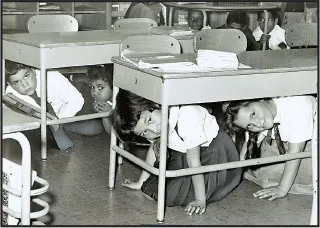
Where we now have active-shooter drills in our schools, in the 1950s and 1960s students were taught to "duck and cover" in case of a nuclear attack.
But not all of the association’s efforts were on such a large scale. In 1951, the MTA won passage of Chapter 219, a law "prohibiting the manufacture and sale of bean blowers." It also banned slingshots, bludgeons and "metallic knuckles."
The rights of women teachers and the efforts to raise professional standards gained ground in the postwar period.
In 1953, Governor Christian A. Herter signed a law forbidding the dismissal of married women teachers. One year later, Massachusetts required that all new teachers in the public schools be certified. It was a law MTA had advocated for a century. And the fact that Massachusetts was the last state in the country to adopt certification did not make the victory any less sweet.
The Civil Rights movement had a lasting impact on schools and on the MTA. In 1954, one of the most important decisions ever handed down by the U.S. Supreme Court — in Brown v. Board of Education — struck down the "separate but equal" doctrine and ordered desegregation of the public schools.
The decades since have seen uneven progress, though. Desegregation efforts were resisted in the North as well as the South, and Boston was a center of the fight against "forced busing." Recent Black Lives Matter protests show how much still needs to be done. As reported in The New York Times last year, "Racial segregation in public education has been illegal for 65 years in the United States. Yet American public schools remain largely separate and unequal — with profound consequences for students, especially students of color."
The 1950s also saw a shift in focus, from schools fostering "strong bodies and healthy minds" to aid in the military effort to a major focus on science and technology.
By the end of the decade, the Soviet Union launched Sputnik, and Washington responded with the National Defense Education Act, pumping $1 billion into the schools and beginning a period of unprecedented growth.
There was plenty of room for improvement. According to statistics for 1960: "Of every 10 students in fifth grade, only six will finish high school. … Of every three students who enter high school, only two will finish. … Only one elementary school in five has a library. … And chances are nine in 10 that an elementary student will be taught by a non-college graduate."
Education became a focus of President Lyndon Johnson’s Great Society programs in 1964-1965, with new laws designed to attack poverty and racial injustice. The Elementary and Secondary Education Act, signed into law on April 11, 1965, provided new federal funding for public education, mainly through the Title I program targeted to assisting low-income students.
That year brought another big change. Until 1965, the only way MTA members could win better wages and working conditions was to make their case to local school committees. The committees were under no obligation to negotiate with them.
A new generation was no longer willing to go begging. While private-sector employees had won collective bargaining rights in the 1920s and 1930s, the public sector had been left behind. Finally, the MTA’s fight for collective bargaining rights succeeded.
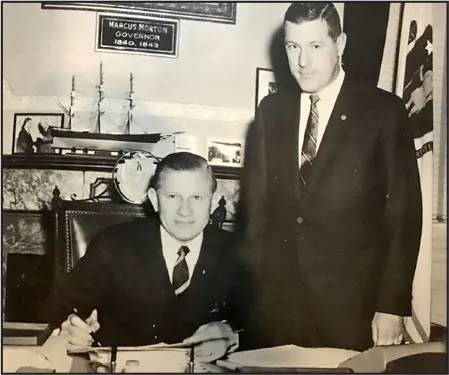
On Nov. 17, 1965, with newly installed MTA Executive Secretary William H. Hebert at his side, Governor John Volpe signed Chapter 763, granting collective bargaining rights to Massachusetts teachers.
In a column for The Boston Herald, Hebert commented:
"For many years, teachers have argued with justification that they are unappreciated as professional people. Their salaries in respect to their education and responsibilities are evidence of this injustice. Now they have a chance to right this wrong."
Within two years of its implementation, more than 200 teachers’ contracts were signed across Massachusetts. Within five years of its implementation, $1 billion was added to teachers’ salaries in the state.
The MTA was now both a professional association and a labor union, a dual role that continues until this day.
In future issues of MTA Today, we will write about highlights from the periods following the one covered here and leading up to the present day.