Gaps in state funding, combined with changing economic conditions, are dramatically impacting many public school districts in Massachusetts. A resulting fiscal crisis is unfolding in myriad ways, in schools that are struggling to cover soaring transportation costs, in districts that are losing needed funds when students go to charter schools and in communities where the per-pupil funding isn’t keeping pace with inflation.
Federal cuts threatened by the Trump administration could make the situation even worse, removing needed support for student programs. The budget squeeze faced by districts has led to an increase over the past year in override campaigns, including debt exclusions, where voters are being asked to increase local funding for schools through higher property taxes, beyond the limits of Proposition 2½.
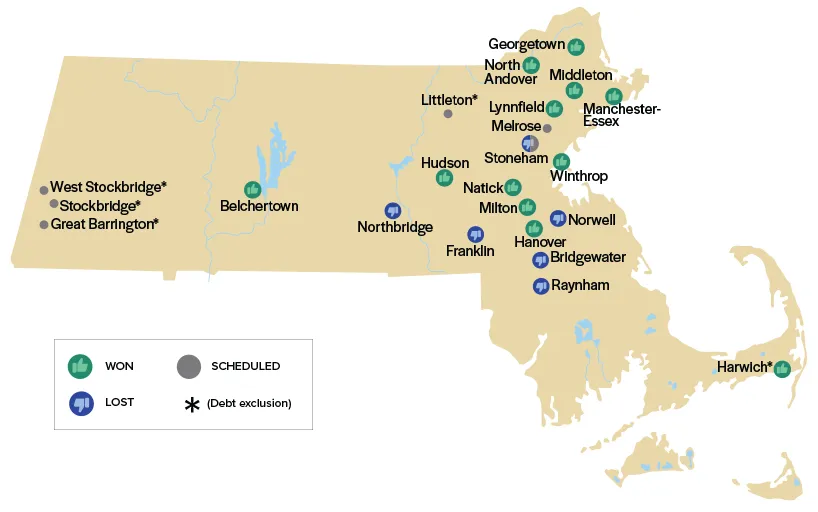
Most of the MTA-supported overrides have been passed successfully – 15 of 21 through Nov. 10. But the greater focus for MTA members is seeking comprehensive state relief through legislation that would ensure all students, no matter where they live, have access to a complete education.
That requires sufficient funding. To effect change, among other strategies, the MTA has organized Fiscal Crisis Action Teams, turned out large numbers of students and educators for a State House budget hearing and gathered signatures for a letter aimed at Gov. Maura Healey and the Legislature.
Charter 70 Inflation CAP
Under current law, Chapter 70 state funding increases for local districts are capped for inflation at 4.5 percent, no matter how high inflation runs in a given year. The MTA supports legislation that would ensure the percentage keeps pace with inflation.
This would help relieve pressure on school systems that are fighting to keep pace with soaring expenses. In Belchertown, an override election narrowly was approved in May, producing $3 million more for public schools. Approved in 2019, the Student Opportunity Act directed more funding to districts with low-income students, but has not resulted in additional funding for Belchertown, explained Fran Frederick, president of the Belchertown Education Association.
After years of escalating costs, and facing the closure of a school and the loss of 30 positions, townspeople approved the override by a mere 20 votes. Most people expected it would be that close, Frederick said. The state has to change the Chapter 70 formula to reflect current conditions, Frederick said. "It’s Chapter 70. We’re just not funding schools the way we need to fund schools. We’re operating with outdated metrics and outdated numbers."
MTA-Supported Override Elections
Charter School Reimbursements
When students leave a public school in their district to attend a charter school, the state provides partial reimbursement for the loss of that per-pupil funding. As MTA Today went to press, state funding for charter school reimbursements had just been decided.
The Legislature voted to override Gov. Maura Healey’s veto of a line item in the state budget that would have provided $19.9 million more in the fiscal 2026 state budget for districts impacted by charter school enrollment. Legislation sought by the MTA to change the reimbursement formula would add a fourth year to the existing, three-year sliding scale for charter reimbursements and increase reimbursements in the second year.
Charter schools can have a dramatic financial impact on large districts, including Springfield, Worcester, Brockton and Fall River, but they also affect many rural schools because each child that leaves for a charter school means more money is lost to the public district than regained through reimbursement. In a small school with declining enrollment, this can have an outsized impact.
Cara Berg Powers, a resident of Worcester and an adjunct faculty member at Worcester State University, testified at the State House to support charter school reimbursement reform. By adding another year to the transitional reimbursement, the legislation will add more stability to public districts, she said. "It makes them 100 percent whole in the first year, and then steps that down gradually."
Regional Transportation
Regional school districts, typically rural, that run buses over a large geographic area are particularly harmed by high inflation that is driving up transportation costs. Regional school districts are supposed to be reimbursed for a significant portion of these costs, but it historically has been underfunded.

Legislation sought by the MTA would provide full reimbursement for regional transportation costs. Bill Brown, the Gateway Education Association vice president, noted that his district covers a large area. State reimbursements vary, and it is difficult for the district to control transportation costs because competition is limited among the private bus companies doing business in rural communities.
Districts are being hit by declining enrollment, which reduces state funding for the local schools, but the costs are escalating. "The buses are still on the routes, whether they pick up 20 kids or 15 kids," Brown said. "It’s the same amount for gas and the same cost for transportation." The impact has been cumulative.
Gateway, for example, no longer has after-school buses for activities. The district is trying to fight back, including by taking students to Beacon Hill to testify for regional district support. "This district in particular has been active in pushing back, which decreases the discouragement to some degree," Brown said.
Special Education
‘Circuit Breaker’ Program
State-mandated special education services are carrying increasingly expensive costs, stretching local school system budgets. The state, through the "Special Education Circuit Breaker Program," reimburses school districts at 75 percent for instructional and transportation costs above a per-pupil level of about $50,000, but this has become inadequate.
Legislation sought by the MTA will raise the reimbursement level to 90 percent, lower the threshold at which costs become eligible for reimbursement, and create a commission to look at additional reforms.
Rural School Aid
Rural districts in Massachusetts face particular challenges. Because they lack efficiencies of scale, they cost more per pupil to educate children than the state average. Rural schools also often have declining enrollment, due to jobs being located outside rural areas, a lack of new housing and other impacts, such as families moving to seek out larger districts with more options, said Jessica Corwin, a School Committee member in Sunderland.
Corwin also is co-chair of the Rural Schools Committee, a group of school leaders fighting for more state funding. The MTA is supporting legislation that would increase state support for rural school districts, including through full funding for their unique challenges, such as an aid fund that would receive $60 million annually for direct support.

Citing her own district, Corwin explained why it is so much more expensive to educate a child in rural Massachusetts. "It costs us about 23 percent more per student to provide a basic education," she said. "If you are going to have a public school, you need to hire a superintendent and a business manager and a director of special education, a principal, a school nurse, a school custodian and a school secretary, whether your school serves 100 students or 1,000 students. We can’t cut some of those essential things."
The Chapter 70 formula doesn’t account for sparsity, and it needs to, she said. "We get the minimum per-pupil increase. When the minimum per-pupil increase is big it’s a good year. This year it was $150 (per student) and people really celebrated that. If you only have 100 kids in your school, that increase doesn’t cover anything substantial in the budget."
For information about the school fiscal crisis and MTA efforts to address it through comprehensive legislation, please visit massteacher.org/fiscalcrisis.