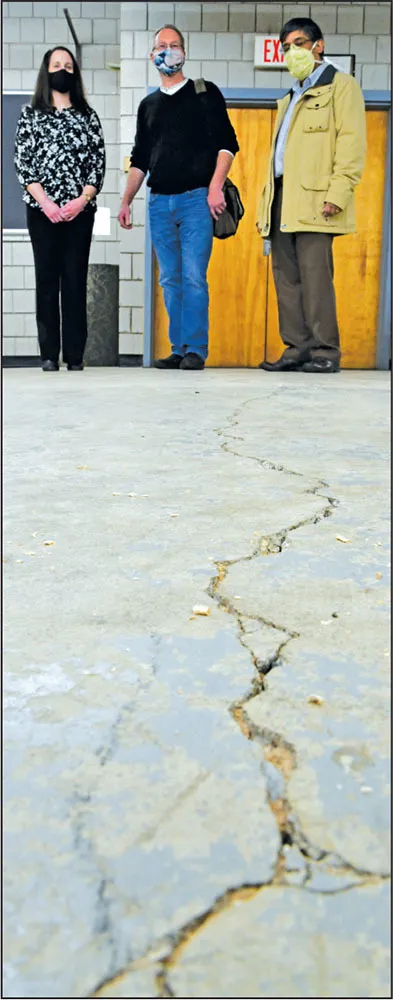
The lower level of Conlon Hall at Fitchburg State University houses a number of excellent programs in film and video production and theater arts. It is also home to other humanities offerings and to engineering classes.
But the official campus tour is unlikely to include a lower Conlon stop for prospective students.
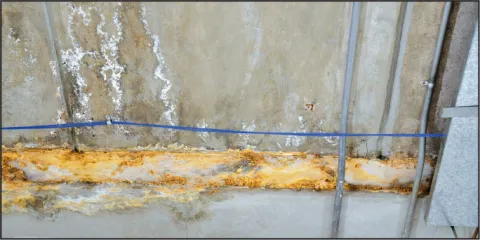
Massachusetts State College Association members, however, are eager to bring visitors to the building, where they point out severely cracked walls and floors, splotches of black tar that seep down from a courtyard after a heavy rain, and water-damaged ceilings that are flaking off dusty debris.
Guides on the MSCA "tour" stop in to assistant professor J.J. Sylvia’s communications classroom, a stuffy, subterranean space where he runs a portable HEPA air purifier to improve health and safety conditions for his 20 students.
"We called the MTA Health and Safety Committee to have air quality tests done down here," noted Rala Diakité, president of the MSCA chapter at Fitchburg State. "Twelve rooms were tested and only four passed."
The poor conditions visible in Conlon Hall offer just one glimpse of the roughly $30 million in needs resulting from deferred maintenance on the state university campus.
"It’s shameful and criminal to make students attend classes in buildings that are not safe," Diakité said.
Across the Commonwealth, students attending public schools and colleges are spending their days in classrooms, studios, libraries and other learning spaces in buildings in dire need of repairs and upgrades. When asked to submit photos documenting problems in their buildings, MTA members who work at preK-12 schools, colleges and universities responded with a flood of images depicting mold, water damage and structural deficiencies that rob students of everything from adequate gymnasium space to usable classrooms.
The photos are part of an MTA effort to persuade the Legislature to allot a portion of the $5 billion that the state has received under the federal American Rescue Plan Act to address critical health and safety needs in public schools and on public college and university campuses.
As MTA Today went to press, the Legislature had not crafted a compromise bill that aligned ARPA spending between the versions passed by the House and Senate.
MTA members have outlined three key educational priorities for the state’s ARPA funds.
The first is to provide resources to address urgent health and safety needs in school and college buildings.
Another advocacy point is to increase financial aid for students attending public colleges and universities and provide debt relief for graduates of state colleges and universities who want to become public school educators.
The MTA is also calling on the Legislature to use ARPA funds to establish pay equity and access to health insurance for adjunct faculty members working in public higher education.
MTA President Merrie Najimy said the state has ample federal funds to address the needs.
"The many inequities within our public education system — from preK through higher ed — that existed before the pandemic became all the more glaring once we grappled with schools and colleges closing because of COVID-19 and then working on ways to safely reopen them," Najimy said. "It is completely unjust to have schools where the air is unsafe to breathe and the books are covered in mold.
"The underfunded schools in our state, the schools most likely to be in communities with mostly Black and brown students, are putting children at risk of illness and injury. The state must step up and address this immediately."
The same responsibility exists for the needs of public higher education, Najimy said.
The Columbus Park Preparatory Academy, a public elementary school in Worcester, illustrates her point.
The preK-through-sixth-grade school has 370 students, a majority of whom are Latinx, according to state data. The structure has visible evidence of disrepair.
Pieces of exterior molding routinely fall off the façade of the building, which is more than 100 years old. The concrete steps leading to the main entrance are riven with wide cracks.
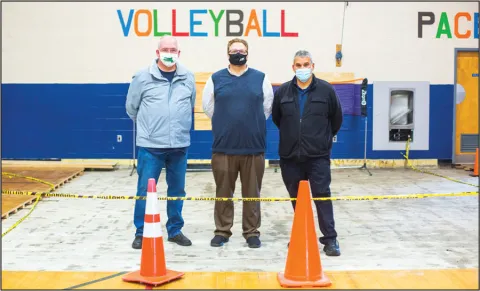
"And this is after they have been repaired," said Roger Nugent, president of the Educational Association of Worcester, who joined members of the local’s Health and Safety Committee on a visit to the school on a recent afternoon.
While exterior damage at the school is unsightly and could lead to a child getting hurt, the interior conditions of the building are particularly worrisome to educators at Columbus Park.
There are several classrooms in the building’s basement, which educators say was never designed to be used for student instruction. The few windows have narrow panes located high on walls, requiring the staff to use special sticks if they want to open them to allow fresh air into the musty rooms.
In a strange twist, educators report that air quality actually became worse in the building after a renovation project was completed that involved replacing some windows and doors.
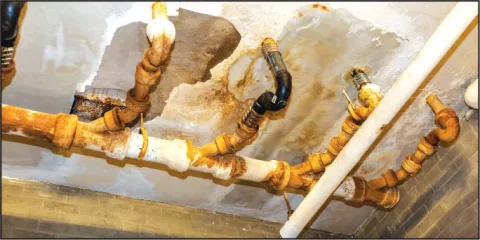
Educators Rachel S. Henry and Jennifer Cote, who serve on the local’s Health and Safety Committee, said that "buttoning up" the building but not addressing the poor quality of the school’s HVAC system has created more problems.
Lead and asbestos particulate are present in the building, EAW Health and Safety Committee members say, and water damage is visible on the walls and ceilings in several rooms.
Henry said she worries that conditions can lead to or exacerbate respiratory illnesses for both students and staff.
As school districts strategize to maintain inperson learning amid the persistent presence of COVID-19 infections among students and educators, they can be undermined by the problem of poor indoor air quality.
"There are a lot of respiratory issues here," remarked Rigo Sanchez, a sixth-grade teacher at Elm Park Community School, which is also in Worcester. "Once the winter hits and we close the windows, we see a lot of allergic reactions."
A tour of the school revealed cracked skylight windows, taped doorknobs — to prevent anyone from becoming locked inside rooms — and stained and damaged ceiling tiles.
But that level of disrepair paled in comparison to the condition of the gym.
Only a small section of the wooden floor is usable because a persistent water leak has destroyed the floor. The boards are in disarray, and a large section is cordoned off as educators continue to wait for repairs.
"Kids shouldn’t have to experience this," Nugent said. "The money is available and we need to get this work done immediately."
MTA members continue to tell their state legislators about the need to use ARPA funds to address immediate health and safety needs in the places where they work and where their students learn.
In her testimony to state legislators who were seeking input at various public hearings this fall, Najimy said: "Twenty months into the pandemic, a survey of MTA local presidents found that nearly two-thirds of locals have identified ventilation upgrades that are necessary to ensure health and safety. There is work ready to be done — and the state must include school and campus facilities in upcoming appropriations of ARPA funds.
"Only the Commonwealth can provide the resources and leadership to address building deficiencies," she continued. "Investing in building infrastructure is a one-time investment that does not add to the state’s operating budget, is directly responsive to the pandemic, and can have an immediate and transformative impact on our schools’ buildings — especially if those funds can prioritize Gateway Cities, low-income communities, and Black and brown communities."
For more information and updates, please visit massteacher.org/arpa.