The Fair Share Amendment will bring a measure of economic justice to Massachusetts communities while providing critically needed resources for public education and transportation.
That is the strongly held view of educators and other supporters who have spent the past several months encouraging fellow voters to approve the measure, which will be Question 1 on the statewide ballot this fall.
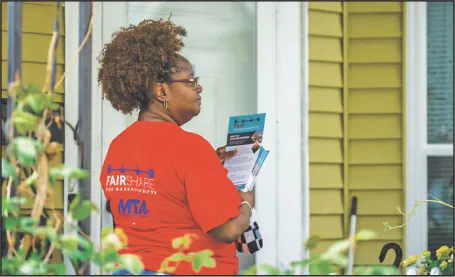
In recent weeks, groups of MTA Summer Member Organizers have fanned out across the Commonwealth, knocking on doors and speaking to taxpayers about the amendment. Other educators have made phone calls, answered questions, and talked to family members and friends about why the FSA would be good for the state’s future.
The challenge, they say, is not so much to change people’s minds as it is to introduce them to the proposal and help them understand its impact.
Question 1, whose fate will be decided on Nov. 8, asks voters to approve an additional tax of four percentage points on annual taxable income over $1 million. That means it will affect only the very rich, despite the fears being stoked by right-wing groups and other opponents. The vast majority of residents will not pay a penny more in taxes.
As things stand, Massachusetts has a sizable gap in the share of state and local taxes paid by the highest-income families and the lowest-income families — one that favors those with the greatest wealth. Families earning less than $22,500 a year pay 10 percent of their income in taxes, while the top-income families pay 6.8 percent, according to research by the Massachusetts Budget and Policy Center.
The Fair Share Amendment would help correct that imbalance.
Tracey Pratt, a 22-year educator, is among the MTA canvassers who have been visiting homes in Somerville this summer. Pratt, who teaches health and is a member of the Cambridge Education Association, said that passing the ballot question will make the tax system fairer for everyone.
In mid-May, Pratt spoke briefly at the campaign kickoff in front of a Somerville school.
"Schools need support," Pratt said. "We need new buildings. We need repairs to buildings. We need to make sure that every school and every building has proper ventilation and is safe for students. We need to make sure that the students have the proper staff. We need to give them what they need — and to give them what they need costs money."
Others point to the necessity of providing high-quality public colleges and universities without leaving students burdened by massive amounts of debt. Such arguments resonate among working families, the organizers note.
Cara Berg Powers worked in Worcester this summer as one of the MTA’s lead member organizers.
She and 15 fellow organizers have been committed and resourceful in spreading the word. They’re hitting the highest voter turnout areas of Worcester, as well as some surrounding communities.
"We have an awesome crew," Berg Powers said. "We are doing primarily doors, but also phones. We have teams going out every day Monday through Friday — and then weekend shifts if that makes sense for them."
As of late July, the Worcester contingent had reached more than 7,500 doorsteps, and organizers had held more than 1,000 in-person conversations with prospective voters.
The individual one-on-one contact, whether face-to-face or over the phone, makes a difference because organizers can respond to any questions that voters may have.
"The Fair Share Amendment is incredibly popular once people understand it," Berg Powers said. "The bigger issue is identifying folks and making sure enough people know this is coming up on the ballot: ‘Vote Yes on 1.’ It’s more of an information campaign."
Elected officials have joined the summer organizers in signing on to champion the amendment. They include U.S. Senators Elizabeth Warren and Edward Markey.
In mid-May, Markey spoke at the Somerville launch that Pratt also attended. The amendment represents "fundamental fairness" for Massachusetts, Markey said.
"We are one of the wealthiest states in the United States," he said. "All we’re asking for is for a millionaire who makes $20,000 a week to pay 4 cents more on what they make over $1 million. That is a small price to ask the wealthiest in Massachusetts to pay."
Why does Massachusetts need this?
"We can see all of the gaps that still exist, all the kids who still are getting left behind," Markey said. "We know there is a digital divide. We know the pandemic exposed how many kids did not have the internet at home. It made it very clear we already had a crisis in terms of brown, Black and immigrant kids in our state not getting access to the educational tools that they need."
Warren, who spoke at a campaign event in Malden in late June, said that explaining the amendment to voters is straightforward.
"We’re not going to win this through a multizillion-dollar campaign," she said. "We’re going to win this one face-to-face."
And how the new revenue will be spent is also startlingly simple, Warren told the crowd. "Two things: We’re going to put that money into educating our children and we’re going to put it into transportation. Because we understand in Massachusetts that to build a future for all of us, we have to have an education system that works for all of us. And understand this about transportation. Transportation is opportunity. It’s how you get to work. It’s how you get to a home that you can afford."
The amendment is a chance to end the austerity narrative — the "sorry, there’s just no money" argument — that has been offered again and again in Massachusetts, according to MTA President Max Page.
"This is one of the wealthiest states in the nation, a place where the wealthy have gotten much wealthier because of what makes Massachusetts a great place for business — a well-educated workforce," Page said.
"When we take away that false story of austerity, we can get what we need for public schools and colleges and win fair pay for adjunct faculty, debtfree public higher education, more counselors and behavioral specialists, living wages for Education Support Professionals, and sustainable, healthy buildings."
For more information on the campaign, please visit massteacher.org/fairshare.