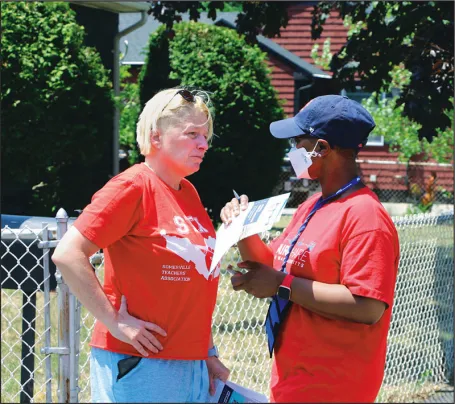
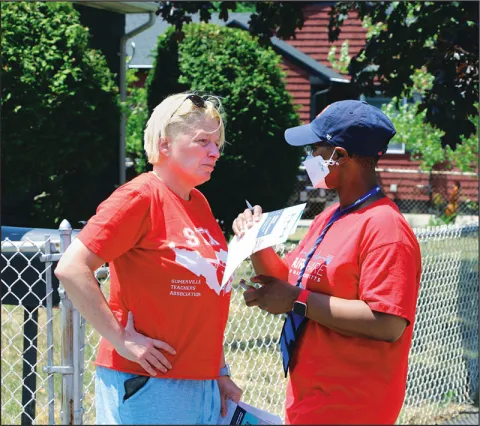
On long, sunny days this summer, MTA Education Support Professionals walked up to six miles, going door-to-door and sharing information with registered voters and answering their questions about the Fair Share Amendment.
But the work of the ESPs who canvassed in neighborhoods and telephoned voters as part of the Fair Share campaign never seemed to repeat itself. Every day brought something a little different. On hot days, people handed the MTA members bottles of cool water. Most everyone was attentive, according to those who have been canvassing week after week.
"A lot of the people were listening," said Anne Monopoli, an ESP who walked through neighborhoods in Worcester. "Most of them really wanted to know what it was. They’d say, ‘We never heard about this’"
The amendment, Question 1 on the Nov. 8 ballot, represents a generational opportunity for public education. It is a constitutional amendment that would create a 4 percent tax on the portion of a person’s annual income over $1 million. The money generated, estimated to exceed $2 billion annually, would be dedicated to public education and transportation.
Peggy Boyle, an ESP who worked as a Summer Member Organizer this year, canvassed in Plymouth and Wareham and on Cape Cod. Boyle noted that she and her campaign partner would work together to map out which way to go, and they usually reached 30 to 40 houses a day, "if not more."
Like Monopoli, Boyle spoke with many people who hadn’t heard about the ballot question, which gave her an opportunity to explain it. The amendment could allow schools to hire more educators; elevate the pay of ESPs to a living wage in many communities, a central tenet of the MTA PreK-12 ESP Bill of Rights; and help ensure that public colleges are affordable to all students.
When speaking to fellow educators, Boyle encouraged them to share the information with colleagues back in their buildings. Boyle, a member of the Easton Educators Association, encouraged everyone to vote on or before Nov. 8.
Only the very rich would pay the additional tax, a point that seemed to hit home with many of the people Monopoli spoke to. Some of them found humor in it.
"I would say: ‘This is not going to affect most of us. It’s taxed on your second million dollars,’" she said. "And they’d say: ‘Well, I’m still working on that first million dollars.’"
Monopoli, an ESP who has worked in Shrewsbury for 25 years, said she felt she made a difference. Working the doorsteps, she and a canvassing partner would hand out the campaign literature and explain that the amendment would only raise money for public education and transportation needs in Massachusetts.
As the campaign enters its final stages, ESPs are in a position to share their understanding of educational needs with the public at large and are doing their part to help educate voters on the amendment. Several hundred volunteers and staff worked over the summer as part of a broader coalition to pass the amendment, and the canvasses and phone banks are ongoing.
As an ESP, Monopoli said, she felt that people listened to her because they knew she worked closely with children in schools. "The last few years have been so tough on the school systems — and the kids and the parents," said Monopoli, a member of the Shrewsbury Paraprofessional Association. "We really need this extra support. There is so much need: for school counselors, for after-school programs, for all this stuff for the kids because the past two years have been so tough on them."
Susan Soares, an Education Support Professional who works in Arlington, has also canvassed. And she has covered the Fair Share Amendment at periodic meetings of her local. She also set up an information table at the high school’s open house, capturing the attention of curious parents as they passed by.
Soares doesn’t advocate for ESPs specifically when she talks with people about Question 1, although she hopes that living wages become a reality if it passes. The districts often cite lack of funds as a rationale for not increasing education salaries.
"When I talk about the Fair Share, I talk about school as a whole," Soares said. "I want kids to have all the things that they need. Whatever it is. Do they need reading support? Do we need to hire a reading person? Whatever it is, I want that for them."
For more information about Education Support Professionals and the MTA PreK-12 ESP Bill of Rights, visit massteacher.org/esp. To learn more about Question 1, go to massteacher.org/fairshare.