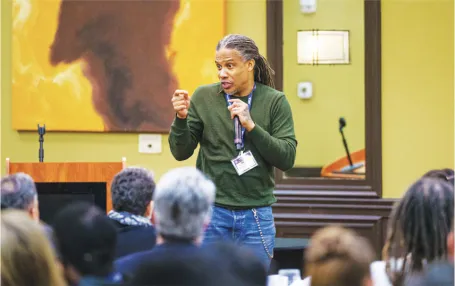
A commitment to racial justice requires people to talk openly about the way the world is, and to work actively to change it. That was one of the points made by David Stovall, Ph.D., a professor at the University of Illinois at Chicago, who was the keynote speaker at the MTA’s 2022 Ethnic Minority Affairs Committee Conference.
Held in December, the two-day conference was organized by the MTA EMAC Committee. It featured an opening night address by Stovall, who touched on subjects including forms of white supremacy, gentrification, and how politics and race are reflected in standardized tests and academic "standards" and "rigor."
Stovall, a professor in the departments of Black Studies and Criminology, Law & Justice, is a scholar who investigates areas including critical race theory, the relationship between housing and education, and the intersection of race, place and school.
In his address, "Race, Capitalism, and the Struggle for Justice in Teachers Unions: Working with Intent, Building Without Fear," Stovall said a commitment to racial justice requires people to make changes and be honest about the work. "We live in a land founded by slavery, genocide and wrongful land appropriation," he said. "That’s a historical fact. It is not conjecture."
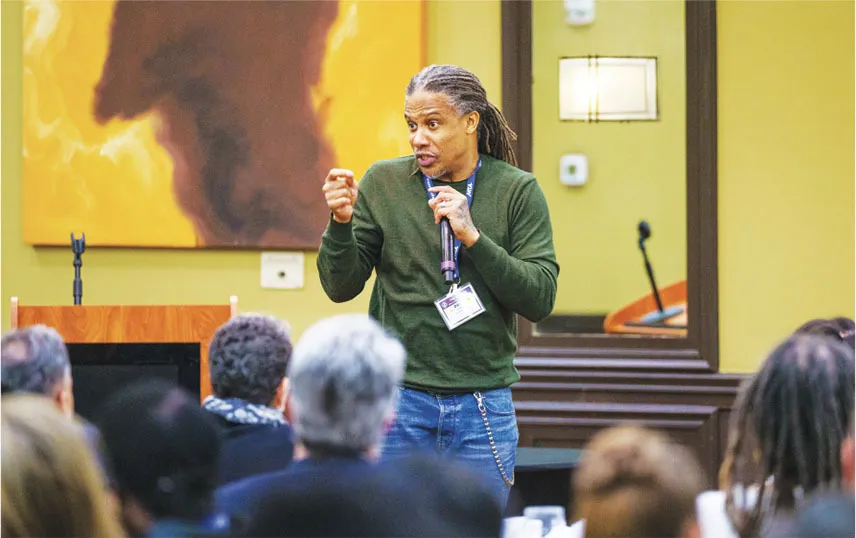
Labor unions that prioritize racial and social justice must prioritize the marginalized, he said, even if it means making some people uncomfortable. "The work that’s being done cannot be exclusionary of race because it makes some people uncomfortable," Stovall said.
For the first time in three years, the EMAC conference was held in-person, and it attracted more than 125 educators from across the state.
Individual sessions at the event included workshops on building union power, how to navigate difficult conversations with peers, building intergenerational, intersectional climate coalitions, and the harmful impact of standardized testing.
Commitment to racial justice
In comments to the members, MTA President Max Page said the union is committed to antiracism efforts and to promoting the voices and needs of its diverse membership. "We must continue to work for representation of people of color in our elected offices and in our staff, to continue to learn together about the destructive impacts of racism and capitalism on all of us, but particularly our members of color, and work for public policies that advance greater equity."
The MTA has fought for such policies – such as the preK-12 Student Opportunity Act, the higher education Cherish Act, Tomorrow’s Educators (to diversify the education workforce), and the Fair Share Amendment as building blocks of a more racially and economically just Commonwealth.
On the final day of the conference, EMAC Committee members participated in a moderated discussion of current issues, including how they balance their work and union lives, representation of diverse educators in schools and the comradery of belonging to groups with shared interests and backgrounds.
The panel was moderated by Christine Sampson-Clark, a member of the NEA Executive Committee, and a longtime special education teacher in Trenton, New Jersey. She began her career 30 years ago as an Education Support Professional.
Jennipher Burgess, an ESP who works in Lexington, serves as a Diversity, Equity and Inclusion facilitator for the school district. In the panel discussion, she said she doesn’t expect that ESPs should be paid the same amount as classroom teachers, who work longer hours outside the workday, but she does expect comparable benefits and respect. "I am asking that if they get 14 sick days; we should get 14 sick days," Burgess said.
She continued: "… what keeps me here, as a building rep, and all of those things, is we’re seeing that this conversation around diversity, equity and inclusion involves ESPs, and people other than teachers," Burgess said.
An opportunity to listen
Kip Fonsh, who is an MTA Retired member and also a member of the MTA Board, attended the EMAC conference as a white ally. He was there to listen and learn, said Fonsh. "I live in a community that’s incredibly diverse, but the diverse groups do not always engage with one another," he said. "This was an opportunity to listen."
The conference was held at the Verve Hotel in Natick and attracted Education Support Professionals, Retired members and educators from all grade levels and higher education.
Yemisi Oluwole, a member of the Cambridge Education Association, attended the EMAC Conference for the first time. Oluwole is an officer in the Cambridge local, serving as secretary, and has worked as an Education Support Professional for nine years. Oluwole wanted to attend to feel the engagement of other educators and to learn more about shared challenges.
In the course of daily work, educators do not have time to get together otherwise. "We don’t have an opportunity to do this," Oluwole said.
For more information about the EMAC Committee and its work, please visit massteacher.org/emac.

Office DEPOT® is now Business Solution Division
Your MTA Office Depot ® Member Benefits Program has been rebranded to ODP Business Solutions™.
This exciting evolution allows for the program to be more agile and innovative. Whether you’re looking for ink and toner, paper, cleaning products, or office or school supplies, count on ODP Business Solutions to be in your corner to help you succeed.
To register and access your savings, visit: bit.ly/MTA_OD
ODP and ODP Business Solutions are trademarks of The Office Club, Inc.
© 2022 ODP Business Solutions, LLC. All rights reserved.