Many educators throughout Massachusetts have had it with smart phone and digital distractions in schools.
Individual districts and schools have applied restrictions, hoping to refocus students on academics, but educators say a statewide law to require districts to adopt a so-called “bell-to-bell” ban could bring more uniform enforcement.
Legislation recently approved by the state Senate would require public districts to develop a policy that includes prohibiting access to cell phones and other personal electronic devices on school grounds during the school day by the start of the 2026-2027 school year.
Exceptions would be available for students who need devices as part of an individualized education plan. The state Department of Elementary and Secondary Education will provide guidance on a model policy. The proposal is now before the state’s House of Representatives.
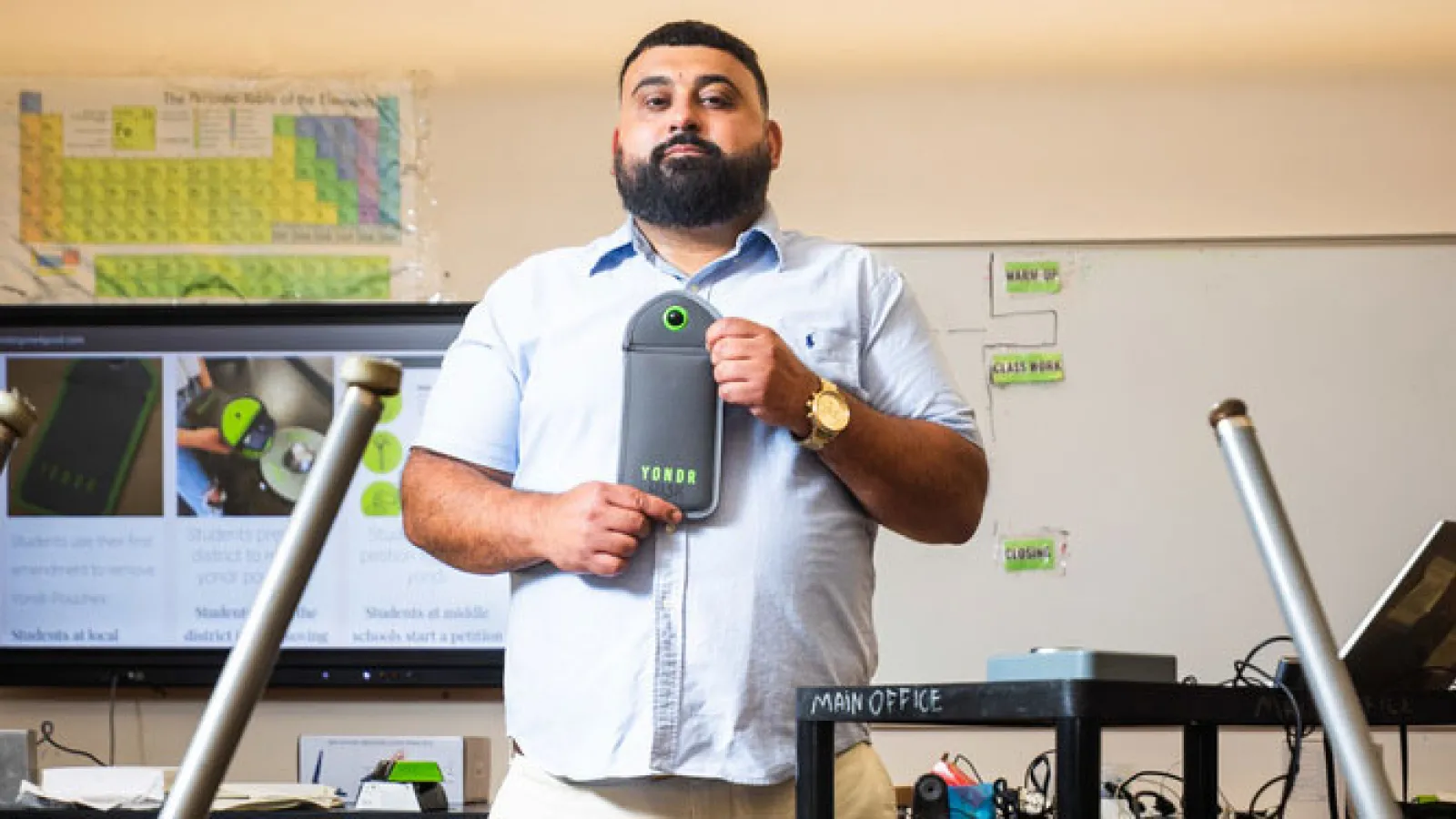
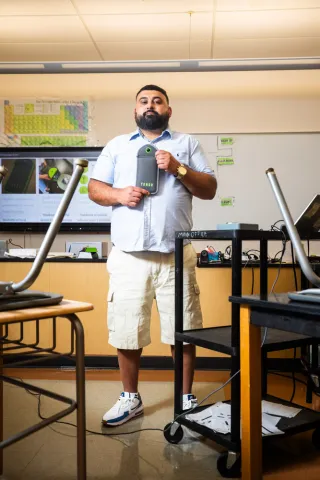
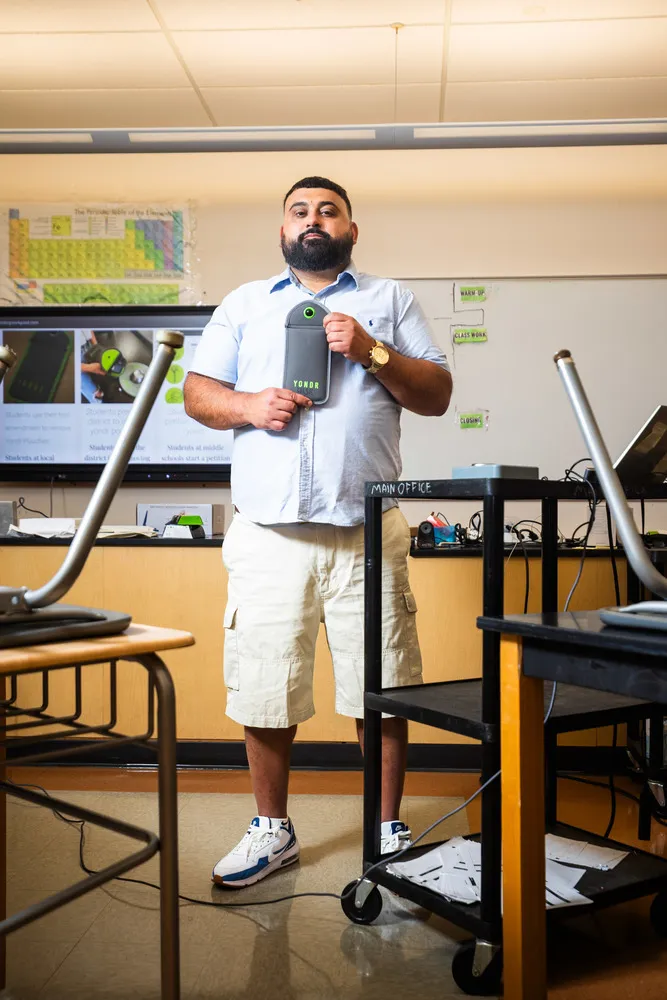
In Fall River, the public school district last year enacted its own ban on electronic devices in classrooms and common areas, requiring students to secure their devices in a locked Yondr pouch on entering the school. Educators say the relief was immediate.
Before the policy, because students still had access to their phones, they consistently used them and it was disruptive, said Joseph Michael, a Fall River Educators Association member, who teaches science at Kuss Middle School.
“In the 2023-24 school year, there was … I’m going to call it chaos,” he said. “Kids were on their phones in the hallways. Kids were TikToking, recording. It was a distraction schoolwide.”
Now, when he sees a student using a device – they sometimes sneak them in if they bring in a second phone – he can enforce the policy by pointing to the district’s rules. The discipline meted out for a first offense, second offense, etc. follows a matrix that all educators use. If a parent complains, he can refer them to administration.
“It’s up to the grade-level administration to create a vision for that school,” Michael said. “I feel Kuss did a really good job taking on a district initiative and then portraying that vision.”
Consistency in enforcement of any ban is one of the things that educators say they want. It’s difficult to be the one saying, put the phone away, if another professional is allowing them. That’s one of the reasons why many say they want state-level action.
Jenn Pompetti, a sixth-grade teacher at Henry Lord Community School in Fall River, said she considered leaving the district two years ago, when she taught at a different school. The distractions caused by the phones and other devices were constant, she said.
“[You] ask the kid to put the phone away. Two minutes later, you ask again,” Pompetti said. “Some would, others would swear at you, and now you’ve escalated the situation to a point where if you took the phone, forget it.”
Pompetti, now at a new school in Fall River and working under the new policy, said: “It’s a thousand-times better, let me tell you.”
Smart phones have been available since 2007, when the iPhone launched, but social media has grown in use since then, and particularly since the COVID-19 pandemic, educators say students seem more attached to their devices. The devices – which now include watches, earbuds and eyeglasses – also are being used by students at younger ages.
By 2023, when the first state adopted a ban on cell phone use in schools, a survey by the Pew Research Center found 72 percent of high school educators reported the devices were a “major problem” in classrooms. By this summer, 35 states had approved restrictions on access to cell phones in schools, according to the Associated Press.
The Massachusetts legislation passed the state Senate with a 38-2 vote in late July.
State Senator Jason Lewis, D-Winchester, who helped develop the legislation, cited research that’s shown myriad negative effects linked to the use of cell phone use in schools, including worsened mental health, academic performance, relationship building and social skills.
Over the past year, he worked with the MTA and other organizations including the Massachusetts Association of School Superintendents, the Massachusetts Phone Free School Coalition and Smartphone Free Childhood to fine tune the proposal.
“We heard from both parents and teachers that they would like a more uniform cell phone policy enacted statewide,” he wrote, in an email. “Large variations in policies and enforcement from school to school, and even classroom to classroom, have made things much more difficult for students and educators.”
Because parents expressed concern about not being able to remain in contact with their children, he said, a provision in the bill will require schools to have at least one method for parents or guardians to contact students during the school day. In most cases, this would be the main office.
Christine Mulroney, president of the Framingham Teachers Association, said Framingham High School adopted a no-cell-phones restriction in classrooms last year, which showed fast results. “There was some immediate improvement in students connecting with each other and with instruction.” The challenge, she said, was students still could use their phones and connect to social media in the hallways and during lunch.
A law, she said, would provide more consistency and backup in creating policies and follow-through for violations.
The MTA supports the legislation, and both President Max Page and Vice President Deb McCarthy have testified before a legislative subcommittee to support its passage. In a statement, they said: “Having a statewide framework for districts to use in creating policies to exclude students’ access to cell phones and social media during the school day will produce healthier, more supportive learning environments for all.”
Join the conversation on Facebook. What do you think of cell phone restrictions?