While students have largely taken the lead in calling for more sensible gun control laws, educators are now pushing for an end to "active shooter" and lockdown drills that simulate violent situations.
The National Education Association, the American Federation of Teachers and the advocacy group Everytown for Gun Safety jointly released a white paper in February explaining that there is no evidence to suggest that active shooter drills enhance school safety. In fact, such drills are more likely to be traumatic experiences for students.
The report, "The Impact of School Safety Drills for Active Shootings," cites research showing that most school shootings have involved current or former students of the schools that were targeted.
"Moreover," the report states, "despite a lack of research proving active shooter drill training’s effectiveness and the potential to inform potential shooters of protocols, many for-profit companies charge school districts tens of thousands of dollars to provide such training. These funds could be better spent on proven, effective measures, such as threat assessment programs, mental health professionals, physical security upgrades, and improving school climate."
While it is reasonable to provide preparedness training to school staff, the report continues, it is not necessary to subject students to shooter simulations and other violent reenactments. The paper also publicized guidelines aligned with those of the National Association of School Psychologists and the National Association of School Resource Officers for schools that ultimately choose to conduct such drills.
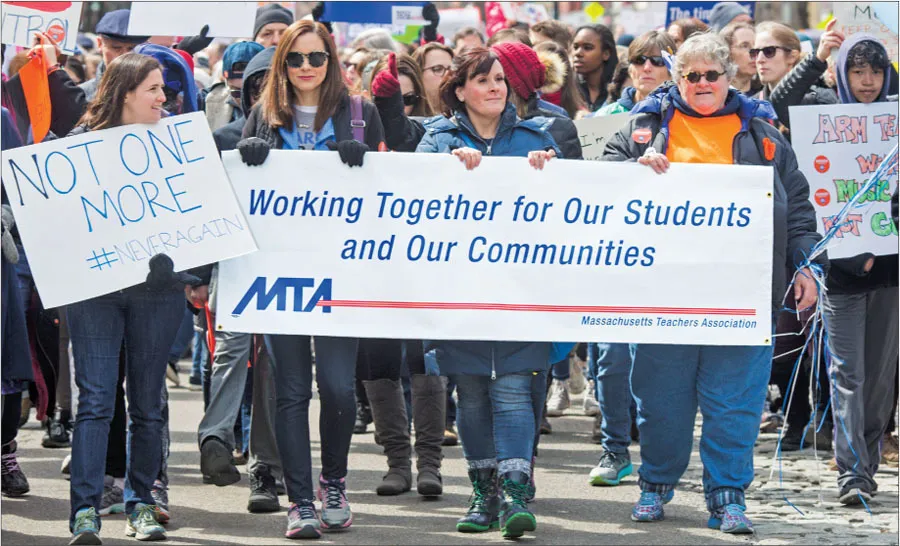
The MTA has called for an outright ban on lockdown and active shooter drills that involve students. There is no requirement that such drills be conducted, and the state does not keep track of schools and districts that employ the drills.
MTA President Merrie Najimy said the drills she has experienced have ranged from having children hiding in the dark to practicing throwing objects at an intruder.
"It is time to stop subjecting students and educators to classroom lockdowns and active shooter drills, which are narrow, fear-based responses to problems that run deep in our society and cannot be addressed by such exercises," Najimy said. "Simulating school shootings traumatizes both children and adults — and there is no evidence to suggest that the practice increases safety for our students or our communities."
The MTA instead urges districts to put in place personnel and programs dedicated to students’ emotional and mental well-being.
"To create truly safe learning environments, schools must have the necessary resources to hire sufficient numbers of counselors, maintain small class sizes, and take other steps that professional educators know are necessary," Najimy said. "We need to focus on detecting and addressing social and emotional concerns rather than fixating on active shooter drills and other extreme crisis responses."
Norton middle school teacher Joe Spremulli agreed. Spremulli said students and educators need to be prepared for emergencies but that such preparation does not need to be trauma-inducing. He added that while school shootings are galvanizing events, public schools are generally remarkably safe places.
Rather than involving students in active shooter or lockdown drills, schools should work to foster a culture and climate conducive to safe, healthy learning environments, he said.
"These drills are frightening children and providing no proven benefit," Spremulli said. "We should be focusing our energy on practices that we know make our schools better, safer places to teach and to learn."