As schools reopen to more in-person teaching and learning, exhausted MTA preK-12 members are holding it together while heading toward the finish line. They are focused on giving students the support they need as they hope for a better, safer and more satisfying year starting in the fall.
As educators, they have worked harder than ever to develop new modes of connecting with students through various phases of in-person, hybrid and remote learning. As unionists, they have pushed back against misguided state and district policies, winning important protections along the way.
"Member organizing and several rounds of bargaining have been key to winning adequate ventilation, surveillance testing and other health and safety accommodations," said MTA President Merrie Najimy.
While the MTA was unable to push back the state’s overall timetable for increasing in-person learning to after April vacation, member advocacy helped gain more time for the 64 districts that were granted waivers.
"That reprieve was badly needed to give staff more time to become vaccinated and to work out the complicated logistics of changing how, where and when students are taught," Najimy said.
Reactions to increasing in-person learning have run the gamut, from joy at finally being back with students in the classroom to frustration over challenging conditions. Resources and staffing levels make a big difference.
Take the case of two enthusiastic mid-career elementary teachers, Callie Walsh, a third-grade teacher in Malden, and Peggy Jeram, a fifth-grade teacher in Cambridge. Cambridge spends twice as much per pupil as Malden, and it shows in terms of how much staff the district has available to teach and support students in COVID-19 times.
Two days after Malden’s elementary schools were required to open more fully on April 5, Walsh said that 11 of her third-graders were still remote while nine were in the classroom, forcing her into the worst of both worlds — having to teach in person and remotely at the same time.
"I feel like I’m drowning," Walsh said as she was driving home to take care of her own 14-monthold child. "While I’m thrilled to see more students in person again, every day is a mental battle. I don’t know how I can continue to do this without more support and training on how to balance the needs of the kids in front of me with the needs of the kids at home."
Walsh described how difficult it is to be present for the students whose faces appear in little boxes on her computer screen while also addressing the ordinary needs and behaviors of those in front of her. Other MTA members also have described the simultaneous remote/in-person combination as the most difficult.
Jeram’s experience was different. She said it "felt like Christmas" to be back in her Cambridge classroom with students after more than a year of remote teaching.
"I was so excited to see them," she said. "It’s like riding a bicycle. You’re back in your classroom and you know what to do. I felt real joy."
She added that having been vaccinated made all the difference in her feeling that it was safe enough to be back.
Although some of Jeram’s students also had chosen to remain remote, her school had enough resources, or foresight, to divvy up assignments in a way that the fifth-grade teachers either taught in person or remotely — but not both at the same time.
Cambridge fourth-grade teacher Solana Herron-Smith had a similar experience, citing the benefit of having enough staff to focus on students in small breakout rooms during periods of remote instruction and not having to be responsible for both the children in front of her and those on screens at the same time. "Teamwork made the dream work," she said.
Walsh described how difficult it is to be present for the students whose faces appear in little boxes on her computer screen while also addressing the ordinary needs and behaviors of those in front of her. Other MTA members also have described the simultaneous remote/in-person combination as the most difficult.
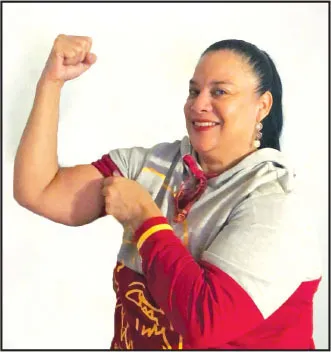

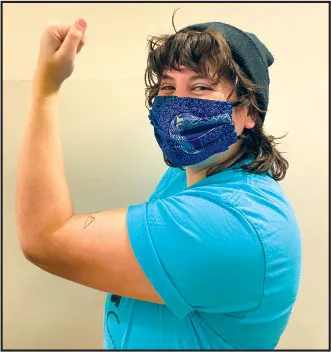
Dozens of MTA members rolled up their sleeves for a vaccination campaign on social media that was based on the World War II-era effort featuring Rosie the Riveter. From top to bottom are Worcester paraprofessional Elsa Trinidad, New Bedford teacher Takeru Nagayoshi and Revere teacher Chelsea Brandwein-Fryar.
All school employees faced the challenges of changing modalities this year. Sherry Bienvenue, a kindergarten aide in Chicopee, described the dizzying experience of being moved to different schools and classrooms, as well as shuttling between in-person and remote instruction.
All school employees faced the challenges of changing modalities this year. Sherry Bienvenue, a kindergarten aide in Chicopee, described the dizzying experience of being moved to different schools and classrooms, as well as shuttling between in-person and remote instruction.
These changes were driven by poor air quality in one building, a surge in coronavirus cases in November and, finally, the state’s reopening order.
While she described the building she is now assigned to as "clean and well run," on balance she believes the students and staff would have been better off with remote instruction all year. "I could see the stress in the students’ faces, even above their masks," she said. "They know something’s not right. We have stickers on the floor and they are told they have to stand on the dot. They are constantly washing their hands and being told to pull up their masks. When they went home in November and returned in January, some of them cried because they missed their mommies. There were too many changes."
Everyone interviewed for this article shared one common sentiment: resentment toward the state for usurping local decision-making and failing to confer with the affected educators.
Will Karvouniaris, president of the Wakefield Education Association, said his district already had been moving toward reopening more fully when Education Commissioner Jeffrey Riley’s in-person mandate was handed down.
"The precedent of them taking away control from school committees is almost nauseating," Karvouniaris told MTA Today. "We’ve worked so hard on communication within the district. The superintendent and I used to be on opposite sides of a lot of things. Now it seems like we call each other 44 times a day. The only thing the mandate has done is unify us at the local level even more."
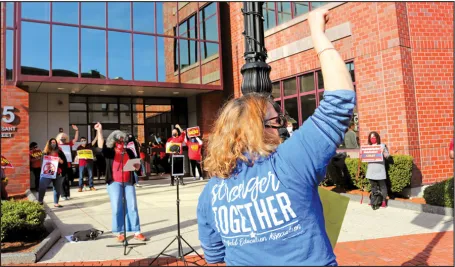
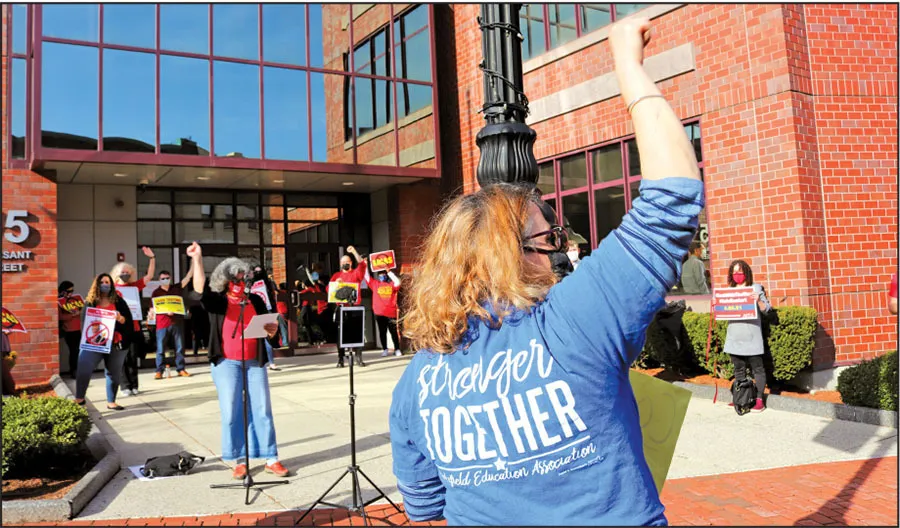
At a rally protesting the state’s overreach, Chelsea School Committee member Roberto Jimenez Rivera fired up the crowd when he strongly condemned the mandate as "an undemocratic power grab."
School district leaders were also uncharacteristically outspoken. Twelve Middlesex County superintendents wrote a strongly worded letter that concluded, "Your declaration without a thoughtful plan only exacerbates the challenges we face in schools and belies the current reality of the situation in which we find ourselves."
Some of the concerns about reopening would have been blunted if Governor Charlie Baker had prioritized vaccinating educators in Phase 1, as recommended by the Centers for Disease Control and Prevention. He also inexplicably refused to approve a union-backed plan to have firefighters and ambulance workers vaccinate school employees in their own districts.
Baker’s alternative was to set aside four weekend days for school employees at mass vaccination sites, with the last one scheduled for April 11 — more than a week after elementary schools were ordered to open. Many members did not wait that long, instead scrambling to get their first shots locally as soon as they became eligible on March 11.
Despite the tug-of-war with the Baker administration, the health risks and the challenges of educating students during the pandemic, MTA members have risen to the occasion. They advocated for vaccines through a social media campaign based on the World War II-era Rosie the Riveter poster showing a strong woman with her sleeves rolled up, ready to do her job. The slogan for this campaign was "I’m ready!" — meaning ready for the vaccine. But it easily could have been the slogan used in the original poster: "We can do it!"