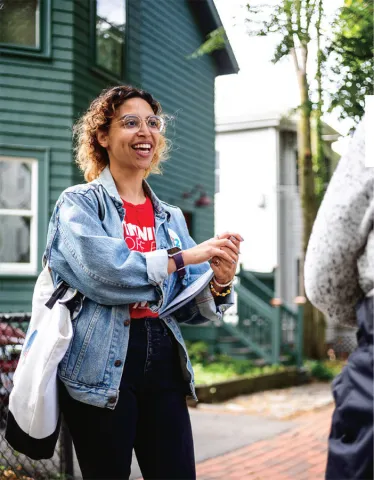
Katie Fontes walked down shaded sidewalks in Cambridge recently, carrying a shoulder bag filled with campaign pamphlets, ready to explain the impact of Question 2 on public schools and students in two minutes or less. On the doorsteps where she found residents home, Fontes chatted briefly about the fast-approaching election, and moved on.
Her turf covered several dozen homes, apartments and condos occupied by likely voters, one of the hundreds worked by educators volunteering this summer and fall for the ballot campaign. The question, which appears on the Nov. 5 statewide ballot, will replace the high-stakes MCAS high school graduation requirement. In its place, local districts will certify that students have met the already-high Massachusetts standards for graduation.
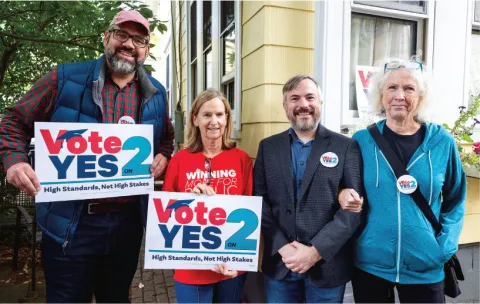
Campaign volunteers, including working and retired educators, their family members, parents, elected officials and supporters of public education, have fanned out throughout the state over the past several months, urging a YES vote on Question 2.
Fontes, who teaches ninth- and tenth-grade English as a Second Language in Revere, sees the impact of the high-stakes MCAS exam for high school graduation. Many of her students who already have plans after graduation have been tripped up by the standardized exam, which is taken in English in the tenth grade.
"As an ESL educator, I know the MCAS affects our most vulnerable learners the most, especially the special education and ESL learners," Fontes said.
Students who are learning to write and read English as a new language – a process that typically takes several years – have access to a dictionary as their sole accommodation on the test, Fontes said. Most of her students are newcomers, in their first year in the U.S.
"It’s unfair, especially for a lot of my students that already have jobs and who are already planning to go into vocational work, into plumbing or being an electrician," Fontes said. "They have a plan. They have skills that are valuable to our communities, and yet the MCAS is a barrier to them receiving a high school diploma."
Every year, the MCAS high school graduation test in Massachusetts prevents about 700 students from receiving a high school diploma, according to state data. These are students who have met all other requirements for their graduation, including passing all required courses. The actual number affected by the exam is much higher – because many students drop out after failing to pass the exam, and those students are not included in the graduation data.
The effort to change this started more than a year ago, when the MTA joined forces with a group of parents seeking to end the use of standardized MCAS exams as a graduation requirement. More than 170,000 state residents signed petitions across the state to put the issue on the November ballot.
Voting has already begun. Although the statewide election is Nov. 5, the early voting period began Oct. 19 and will continue through Nov. 1. Individual communities set early voting periods within that window.
Getting out the message for YES on 2 has been the work of several hundred volunteers. They’ve been writing letters to the editor in small publications throughout Massachusetts, speaking to parents at back-to-school nights, walking neighborhoods in canvasses and making phone calls to frequent voters.
In Methuen, retired member Deb Mousley has enjoyed walking around and talking with people about the ballot question. A former teacher and guidance counselor, she said many voters initially seemed confused about the question. She said after a conversation, several were more supportive. "People have no idea that students have been denied a diploma and only given a certificate of attendance," she said.
Many educators have found these one-on-one conversations easy, particularly with engaged parents of young students, who remember having to take the MCAS graduation test themselves. More than 70,000 contacts have been made over the last several months of the campaign, including more than 200,000 doors reached.
Joel Patterson, a high school math teacher and member of the Cambridge Education Association, organized one of the larger canvasses in September. He spent much of the late summer walking through the city neighborhoods, speaking with residents.
"The response from the people who we talk to is overwhelmingly positive," he said. "They’re learning about it for the first time from me and other canvassers."


In his job, Patterson sees the burdens placed by the test requirement on students with learning disabilities or those who don’t have English as their language at home. "These kids struggle a lot with standardized testing. To have their diploma vetoed, when they’ve passed all of their classes, because they can’t pass one standardized test, it’s not fair to these kids."
Cambridge Education Association President Dan Monahan was one of the canvassers in late September, pedaling off on a bike to his targeted neighborhood. Before starting off, he said he had found conversations with people about Question 2 fairly easy, particularly when they understand that it narrows the curriculum. "Tests don’t measure what we most want our kids to do when they’re out of high school," Monahan said. "There are so many things that are more important. There is so much time spent preparing students for the test. They can’t take elective classes."
Kathy Greeley, a retired member who recently wrote a book about MCAS and testing, has been among the frequent canvassers for the ballot question. A longtime former English teacher, she taught through the entire period of MCAS, which started in 1993. The high school graduation test became a requirement in 2003. "I saw that it hurt a lot of kids and it particularly hurt our most vulnerable kids," Greeley said.
Her canvassing has shown, she said, that people listen to and trust educators. "And I’m local. All of the campaigning I’ve done has been in my neighborhood. I can talk from experience."
For more information on the campaign for YES on 2, visit the campaign website at yesonquestion2ma.com or massteacher.org/testing. To join a canvassing or phone bank effort up through early November, please visit mobilize.us/massteacher.