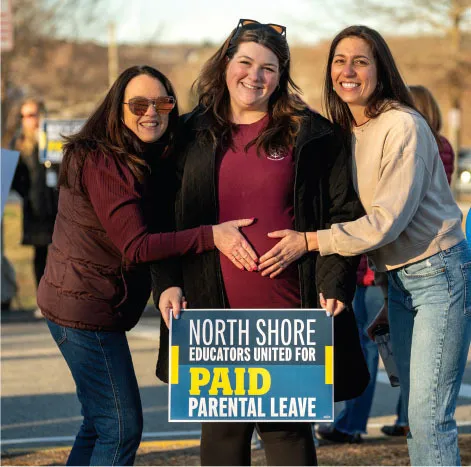
Kris Melanson remembers what parental leave looked like for him with his first son. Using his accumulated sick days, capped at three weeks, he tried to stretch out that last week by using half-days instead.
He found himself up all night with a newborn, while trying to create plans for substitutes and grade papers. "It was extremely difficult," he said. "We got through it, but it was hard."
Four years later, Melan son has a second leave with his second son. This time, he and other educators in Beverly are entitled to more modern parental leave – 12 weeks off, with six paid by the district and the remainder with sick days. This winter he’s at home, not worrying about his students, not grading middle school writing, and focused on his child.
It didn’t come without a fight. In Beverly, educators went out on strike as part of their bargaining campaign for parental leave and other benefits in a new contract. Across the state, locals are trying to negotiate for improved leave benefits that their members desperately want and need, including family leave that would allow educators to take time to care for sick spouses, parents or children. All the while, most private employees in Massachusetts are entitled, under state law, to generous paid leave.
Exempted from that state law, public educators are fighting for fairness at the local level as well as statewide.
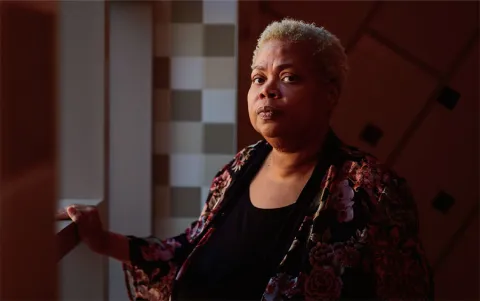
Rhonda Hall-Reynolds, a member of the Springfield Education Association, was a teacher of autistic children in 2020 when her husband suffered cardiac arrest. Initially hospitalized in Springfield, then transferred to Worcester, then to a rehabilitation hospital in Cambridge, her husband needed her help, but she couldn’t take leave from work without forgoing her salary.
She learned the city had not opted into the state’s Paid Family and Medical Leave only after emailing the district’s human resources office and inquiring about paid leave. The federal law of a similar name, which she’s entitled to take, is unpaid. "You’re doomed," Hall-Reynolds said. "You can’t take that and pay your bills."
She was left in an impossible position, having to drive between Springfield and Boston multiple times a week, while balancing her full-time job.
"While you’re in crisis," she said. "And your loved one is in crisis. And you’re trying your best to be there for your husband who is sick in a hospital, and for your students who need you."
Hall-Reynolds, whose husband died two years ago, is among those in Springfield now advocating for the city to join the state’s program for parental and family leave.
Parental leave, in particular, has become a driving issue in local campaigns in Massachusetts, in part because infant daycare has become so prohibitively expensive, said Melanson, who is on the bargaining committee for the Beverly Teachers Association.
The fact that preK-12 public education remains a female-dominated profession is factoring into the demand for strengthened parental leave. And supporters say it also informs the opposition. Would educators have to fight so hard for this if it wasn’t primarily a workforce of women?
"There is this fundamental disrespect for this profession that is historically and still largely female," said Julia Brotherton, co-president of the Beverly Teachers Association. "You have to be back and caring for the children. Even though you’re saying, ‘I’d like to be caring for my own child’. "
In its contract, Beverly secured six weeks of parental leave for educators who are birth parents, non-birth parents and adoptive parents. Teachers and paraprofessionals all got the same benefit, Brotherton said. Before the contract, birth parents could take up to eight weeks, using their own sick time, and their partners could use their sick leave for three weeks. None of that was paid by the district.
If the educator giving birth hadn’t accumulated eight weeks of sick leave, they could take that time with their baby, but it would be unpaid leave, which many couldn’t afford. "We had people who came back after a few weeks, really," Brotherton said. "People have said publicly, ‘I was still bleeding when I came back’. "
Brittany McGrail, who had her son, Henry, in early May, was lucky. After his birth, the Gloucester educator had enough sick and personal days accrued to last until the last two days of school, which she took off as unpaid leave. "I would have been going back at the five and-a-half-week mark, if not for [giving birth in] May," she said.
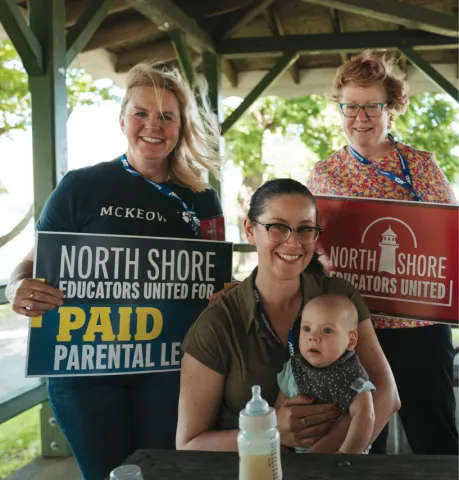
Gloucester educators went on strike in the fall. Their contract now provides more generous leave than what McGrail was afforded with Henry.
"It shouldn’t come down to luck," she said. Local districts need to think about how life with a newborn can impact educators, she said. "Teaching is hard. It is not an easy job. It requires a lot of mental strength to do what we do every single day, that you don’t have when you’re trying to recover from giving birth, when you’re trying to take care of a baby."
These personal stories are being shared and amplified in contract campaigns.
Over the past two years, 48 locals of the MTA have secured standalone, paid parental leave, according to data as of Jan. 18. Those gains include eight weeks, or 40 workdays, in Andover, Cambridge, Hingham and Stoughton, and at Masconomet Regional.
In January, the Fall River Educators Association reached a contract creating four weeks of paid parental leave for birth and non-birth parents. In the past, the district allowed birth parents to take 12 to 14 weeks off as paid days if they had the sick time. But the district paid for no parental leave.
The new contract, which was ratified by the local, is expected to be approved in February by the School Committee. Negotiations centered around issues of pay, not the leave, said Keith Michon, association president.
"The district was in agreement about the need for more modern parental leave," he said. "And they knew what was going on around the rest of the state."
The move for family leave, a more expansive definition that would allow educators to care for their elderly parents, or spouses, or older children, is a fight that is ongoing. As a statewide solution, the MTA has introduced legislation that would remove the exemption for public educators in the existing state Paid Family and Medical Leave law. Enacted in 2021, the law provides paid leave for private employees who need time off from work to care for family, or themselves.
Covered through a combination of employee and employer payroll deductions, it provides up to 20 weeks for an employee’s own serious health issue, and up to 12 weeks for parents caring for a newborn, or newly adopted child, or a family member with a serious health condition. It covers a maximum weekly amount, which varies based on one’s pay.
Public educators, as well as other municipal employees, are not included under the law unless the local community opts in. To date, none have. TECCA, a virtual public school, is the only district that has opted into the program.
Max Page, MTA’s president, said it’s long past time for public educators to be included under the law. The union was among the Raise Up Massachusetts coalition that advocated for the creation of the family leave law.
"This is a basic human right enjoyed by workers in most industrialized nations. Educators should not be penalized when they have a serious illness or need to recuperate at home, or to care for their family members and children."
For more information on paid family and medical leave, visit massteacher.org/pfml.
Join the conversation on our Facebook and Instagram channels. How important is paid family and medical leave to you as an educator? What would you be likely to use this for?