Should educators expect to have students yell at them routinely, or throw chairs or push or spit on them? Has endurance of assaults or threats become just another part of the job?
Educators increasingly are saying "no," and are organizing and calling on the state and local districts to provide more mental health resources for students, so educators can support them in their needs, and be assured of a safe and healthy workplace.
Donna Grady, president of the Franklin Education Association, said educators want the state Department of Elementary and Secondary Education to back them up. "As employees, I think they want DESE to say, ‘You have a right to be safe in your workplace’."
At the same time MTA members are organizing, a year-old task force is trying to define the problems, identify solutions and advocate for more support.
The Safe Schools for All Task Force was created in October 2024 by the MTA Board of Directors, after several New Business Items were introduced by delegates at the previous Annual Meeting. Its members represent educators working throughout the state, at all grade levels and in varying roles. One of its first decisions was to survey members statewide about their experiences.
In a three-week span, more than 1,500 members had responded to the April 2025 survey, representing 120 locals. Individual comments provided by more than 150 members shared incidents of verbal and physical assaults, as well as various types of threats and harassment. The numbers seemed to indicate that incidents are concentrated in the earliest grades, with 54 percent of respondents saying they worked with preK through fifth-grade students.
When asked whether they felt their school provided sufficient resources, staffing, financial support and wraparound services for students in need of mental, behavioral or physical health resources, most respondents said they either "somewhat" or "strongly" disagreed.
The task force is now creating a digital app that would allow educators to document physical injuries in a way that would be easier for the task force to analyze, and which would create more consistency in reporting. The task force is working alongside the Massachusetts Nurses Association, which is supporting our work in creating the app, said Melissa Alvarez, an adjustment counselor and task force member, who is helping to lead the effort.
"The overall goal is to be assured of a safe and healthy workplace where injuries are decreasing and educators are welcomed into a productive environment," said Alvarez, a member of the Revere Teachers Association.
"Our app is here to support educators by tracking injuries and data. Here is what is occurring in our schools across the Commonwealth. We need additional funding. We need educators back in the workforce. We need resources not only for our students but the caregivers who are searching for the support that they cannot find."
Through the fall of 2025, MTA members shared their stories and suggestions for safety improvements at a series of regional meetings. The task force is taking this information into account. It maintains a website, massteacher.org/safeschools, which provides resources for educators, including a guidebook and contract language for locals that are trying to strengthen safety through bargaining, including by obligating districts to provide a safe workplace.
Grady, a co-chair of the task force, said educators want support and a consistent process when something happens. "So there is a process not necessarily for getting a student out, but a process for addressing what has happened, not only with the student, but the students who have observed what is going on, with the educator who has been directly involved and with the educator who has been indirectly involved, either by being in the room or watching their colleague being hurt or having to evacuate the other children," she said. "Aggression or behavioral concerns have been treated like a ‘one and done’ and it only involves one person, generally the student. And it’s never the case."
In 2018, Massachusetts extended workplace protections under the Occupational Safety and Health Act to all public employees, including those who work in public schools. The state Department of Labor Standards has guidance on safe school environments, including a worksheet that evaluates whether a district is taking sufficient steps to protect its workers. This can be added to labor contracts. The Somerville Educators Union, for example, recently negotiated a requirement that its employer use the worksheet to inform the development of violence-prevention protocols.
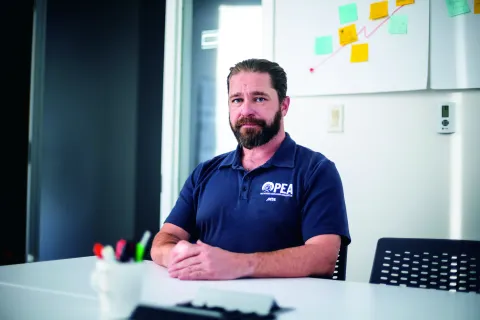
Eric Simard, a co-chair of the task force and interim vice president of the Pathfinder Education Association, said educators want real assistance for issues they’re facing, and want the state to come up with solutions for what districts can do. "If a student is dysregulated, teachers are many times chastised, ‘Well, why don’t you teach something more interesting?’ So, their classroom management skills are being called into question as the reason why a student is becoming dysregulated," he said. "That fosters a feeling of not being supported by your employer."
Local health and safety committees also are an option for increasing focus on the issue. Several locals throughout Massachusetts have established these committees, which allow educators to analyze and collect data and take steps to address ongoing safety issues.
This could include schedule changes that give students appropriate recess and lunch periods or bolstering staffing. The task force is supporting state legislation that would require at least 30 minutes a day of free-play recess for all K-8 students. It also supports legislation to establish a Whole Child Grant Program, which would provide per-pupil funding to districts to hire more school counselors, social workers, psychologists and ESPs.
Grady, who teaches kindergarten, said providing at least 30 minutes daily for unstructured recess is critical. "We need to take the devices out of the classroom, at least in preK, K and 1," Grady said. "They do not need to be tested. They need to have a meaningful social structure. They need to be able to interact with their materials. We need to be able to teach the way children learn."
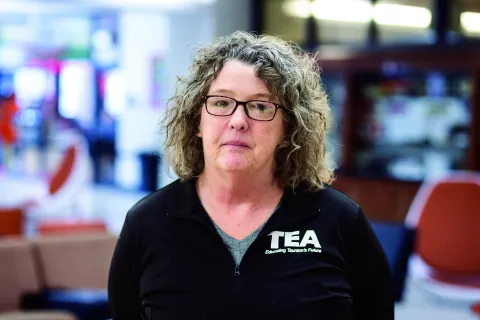
Educators in Taunton were among the first in the state to identify the problem of student dysregulation and launched a campaign several years ago, Support Our Students, to identify solutions. This included establishing health and safety committees in every school, said Denise McGuirk, president of the Taunton Education Association. Over time, however, structured programs in schools shifted due to staffing changes and resource constraints, she said.
Educators don’t want students to be blamed, she said. "What we are asking for is not harsher discipline or increased policing, but predictable safety, adequate staffing and systems designed to prevent crises rather than simply react to them," McGuirk said. "We need more mental health specialists and de-escalation professionals, ongoing professional development for educators that is supported and focused on de-escalation, smaller caseloads for special educators and specialists, and the resources necessary to make these supports effective."
Patti Donahue, a paraprofessional member of the Education Association of Plymouth and Carver, with 14 years of experience in the Plymouth schools, said her school has improved thanks to stronger leadership. But she said she often has to convince ESPs in other buildings that violence is not an expectation of the job.
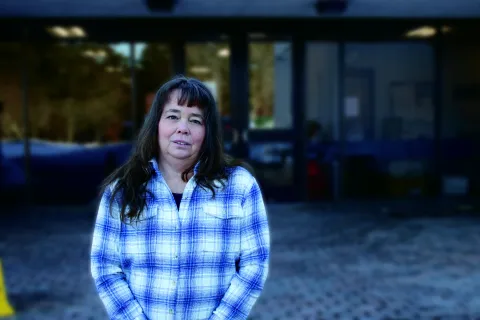
Often, educators don’t want to report or get the child in trouble, she said. The issues run the gamut, from hitting to biting to breaking eyeglasses. "I keep telling them, it’s not OK. That’s something we have to let administration know and know that it’s not OK," Donahue said.
The problem of educator safety goes well beyond Massachusetts.
The NEA in November 2025 released a report with the American Psychological Association based on two national surveys. It found violence and aggression toward educators were prevalent even before the COVID-19 pandemic. Fortythree percent of respondents to the APA survey said they wanted to quit the teaching profession based on their experiences.
The report contains several recommendations for promoting a safe work culture, including providing training and support for educators and school leaders that cover how to foster positive relationships with students and between students and their peers.
Massachusetts, meanwhile, recently announced $3 million in grants to expand mental health services in school, an amount that would provide funding for 58 school districts, according to a report in the Boston Globe. The governor, in her recent budget proposal, suggests $6 million for mental health support and wraparound services. But her budget also cuts minimum aid in the school funding formula from $150 to $75 per pupil.
The task force is trying to keep the pressure up, said Donahue, who is one of its members. It met with Education Secretary Patrick Tutwiler last spring and wants to follow up with another meeting. "What are we doing next?" Donahue said. "We’ve got to just keep applying the pressure and doing what we’re doing."
For more information on resources provided by the NEA.