The MTA celebrated its 175th anniversary in November 2020. The past four issues of MTA Today have featured stories about our history from 1845 to 1990. In this edition we focus on the pivotal decade from 1990 to 2000, a time when the locus of much decision-making about public schools shifted from local communities to the state with the passage of the Massachusetts Education Reform Act. This final installment in the series is based on coverage in MTA Today.
A decade after the anti-government organization Citizens for Limited Taxation won Proposition 2½ in a 1980 ballot vote, the group was back again with an equally threatening initiative to slash state taxes and budgets by billions of dollars. The risk to public schools and public higher education posed by Question 3 was enormous.
The early polls were not promising. This time, the MTA organized as never before, engaging in a massive "No on 3" campaign throughout 1990 with other unions and parent and community groups.
MTA members were the backbone of the local actions, passing out leaflets, holding signs and organizing public forums. As was the case in a much later fight against a ballot initiative to expand the number of charter schools, many analysts felt that educators — among the most trusted professionals in our society — had a huge impact on the outcome simply by telling their friends, relatives and neighbors about the harm the measure would cause. In the end, Question 3 was resoundingly defeated, 60 percent to 40 percent.
"We did it!" wrote then-MTA President Rosanne Bacon. "It is a triumph of reason over anger. The message for us is clear. When we work together, we can win!"
The celebration was short-lived, however. A recession had taken hold, and when Republican Governor William Weld took office in January 1991, he was intent on cutting spending rather than raising taxes to address the threat. The cuts came quickly.
The hit to public higher education was immediate and reverberated nationwide. In March 1991, the chair of the NEA’s National Council on Higher Education was quoted as saying, "It is a travesty and a disgrace for this indignity to be heaped upon such great public colleges and universities. It will set the worst possible precedent because Massachusetts is viewed as a national leader in higher education."
Furloughs were imposed on faculty and staff, and programs vital to students were slashed.
"Outraged faculty, librarians, staff, and students at the University of Massachusetts’ Amherst and Boston campuses conducted ‘No Business as Usual’ for two days in mid-April to protest the continuing savage budget cuts against the university and public higher education," an MTA Today article stated.
Public schools were also hit hard when the state slashed local aid, while municipalities were prevented from making up for the loss without a Proposition 2½ override. Low-income communities were impacted the most. In 1991, MTA Today reported that Holyoke’s elementary schools no longer offered music, art, physical education, foreign languages, guidance services, home economics or industrial arts.
According to that account, "Classes in Holyoke are jammed with up to 42 students," the result of the layoff of onethird of the teaching staff of 750. "Next to the crammed classrooms are empty ones. Teachers in two of the three middle schools have no preparation time."
Critics of public schools, burned by their loss on Question 3, were quick to blame educators. They clamored for "reform" and demanded salary givebacks to make up for the lost funding.
The MTA and the state affiliate of the American Federation of Teachers fought back, proposing funding increases and truly progressive plans for change. The MTA and others also aggressively pursued a lawsuit, first filed in 1978, to establish the state’s constitutional obligation to provide adequate funding to public schools in rich and poor communities alike.
These debates all came to a head in June of 1993.
On June 4, the House and Senate approved the massive Massachusetts Education Reform Act, which included an ambitious new funding system along with numerous policy changes.
"We did it!" wrote then-MTA President Rosanne Bacon. "It is a triumph of reason over anger. The message for us is clear. When we work together, we can win!"

On June 15, the Supreme Judicial Court ruled in favor of the MTA-backed plaintiffs in the case, McDuffy v. Robertson, determining that the state had failed to meet its constitutional duty to provide an adequate education to all students.
Three days later, Weld signed the education bill into law, to mixed reviews from the MTA. "This bill may be far from perfect," wrote MTA President Robert Murphy, "but it gives a strong impetus to improve student performance, to stabilize and increase school funding and to enhance our own opportunities for professional excellence, while still protecting the basic due process rights of all educators."
To this day, the 1993 law has shaped virtually all aspects of public education in Massachusetts. Key provisions are as follows:
Foundation budget. For the first time, the system set spending requirements for every district, specifying the minimum local contribution and how much the state must allocate to bring all districts to "foundation." This led to a doubling of state funding for public schools, from $1.3 billion in 1993 to $2.6 billion in 2000, with most of the new money going to low-income districts. The additional resources were a tremendous help in the early years, though eventually the formula failed to keep pace with rising costs. Last year, the foundation budget was substantially updated in the Student Opportunity Act.
Student standards. For the first time, the state had a mandate to establish learning standards by grade level, leading to the creation of the Massachusetts Curriculum Frameworks.
State assessment system. The law also required the creation of an "assessment system," though that system largely rests on a series of standardized tests: the MCAS. At first these tests were just administered in grades four, eight and 10, but more levels were added later. Among other problematic applications, MCAS results are used to identify "underperforming" schools and districts and to determine which students are qualified for diplomas.
Just cause dismissal. The law abolished the teacher tenure system and replaced it with a "just cause" dismissal standard for teachers who had attained Professional Teacher Status.
Certification. The act established a process for certification — now called licensure — that has undergone several modifications since 1993 but still retains some of the original features. It required aspiring teachers to pass qualifying exams, now called the Massachusetts Tests for Educator Licensure.
Recertification. For the first time, recertification was required. Teachers were — and still are — required to be recertified every five years by participating in mandated professional development.
Charters and school choice. The state’s interdistrict choice program was expanded. The act also allowed the creation of privately run but publicly funded charter schools, though it initially capped the number at 25 statewide. The expansion of charter schools has been hotly contested ever since, most recently with the defeat of Question 2 in 2016.
School councils. Principals in each building were required to establish school councils that include parents, teachers, community members and, at the high school level, students.
The MTA spent much of the rest of the 1990s implementing, challenging or modifying various portions of the law. Some of the changes were welcome, while others, including the MCAS requirements, are still controversial.
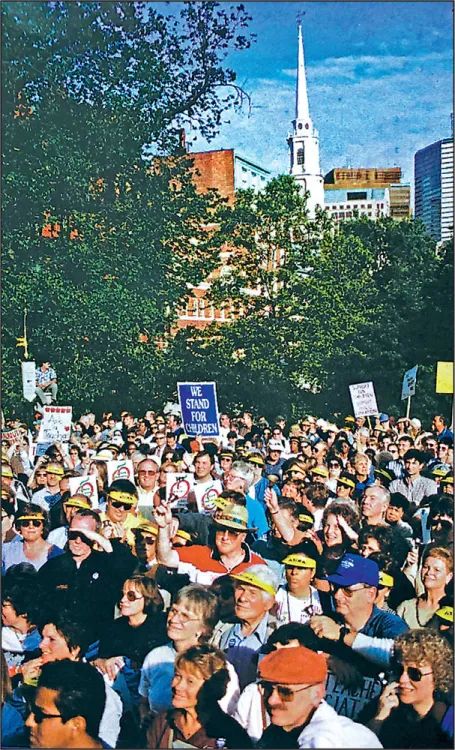
The MTA’s ability to mobilize members was also on display throughout the decade. A large rally in 1992 was topped by an even bigger one in 1999 — likely the largest in the MTA’s history. An estimated 15,000 to 20,000 educators shut down Beacon Hill on June 16, 1999, marching, chanting and ringing bells as they gathered at the State House.
Specific policy proposals catalyzed the rally, but the energy behind it was fueled by the demand that educators be heard on matters that affected them and their students. Their slogan was clear: "If you want to know how to make schools work better, ask a teacher."
This is the last article in our five-part series on the MTA’s history. Future writers will need time to put the last two decades into perspective. Given our state’s importance in establishing public schools and the MTA’s role in fighting for the rights and interests of educators, their students and the common good, we will always have a compelling story to share with future generations.