The last pay raise given to Shrewsbury Superintendent of Schools Joe Sawyer boosted his salary by $32,175.
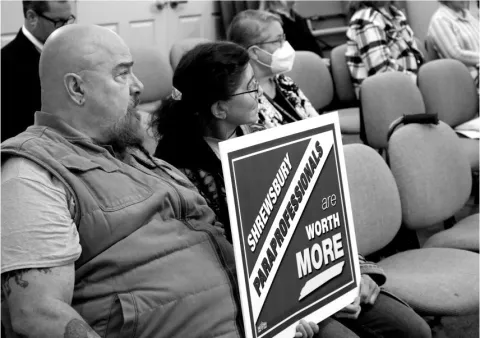
That’s more money than the lowest paid paraprofessional makes in a year, said Shrewsbury Paraprofessionals Association member Wesley Engvall, during a Shrewsbury School Committee meeting in September.
"Your priorities are skewed away from the most essential workers who work with the most vulnerable students, and that has an impact on us as human beings," Engvall said. "We are not numbers on a spreadsheet."
Engvall made the remarks at a meeting attended by several members of the SPA during its fight to secure a fair contract.
The SPA and School Committee did reach a tentative agreement on Oct. 21 and the union has scheduled a ratification vote for Nov. 6.
The Shrewsbury union’s concerns – and members’ stories – echo those heard in similar contract fights happening throughout the state.
Paraeducators – also known as Education Support Professionals – are typically paid far less than licensed teachers, yet over time the responsibilities handed over to these essential educators have grown.
In many cases, they work with students on legally mandated special education plans and contend daily with significant learning and behavioral needs. The position’s low pay and poor access to benefits are leading to staff shortages in many Massachusetts districts.
In Methuen, ESPs are furious over the district’s decision to contract with non-unionized workers and pay them higher hourly wages than the full-time staff.
ESPs who belong to the Methuen Education Association are trying to lift pay rates that are among the lowest in their region.
Michelle Hall has been a full-time ESP in Methuen for 15 years, and her pay is topped out at $24,900 – not much higher than the entry-level pay of $20,000. On the weeks when her health insurance costs are deducted, Hall’s paycheck is just $330 – for a two-week pay period.
"We have untrained 19-year-olds coming in making more than full-time staff," she said of contracted staff. "They get paid $150 per day. My pay works out to be $132 per day."
Methuen has more than 60 openings for ESP positions, and Hall said the MEA is fighting to lift starting salaries above $30,000 over a new, three-year contract. ESPs, she maintained, should not be expected to work multiple jobs to make ends meet.
"The district did offer us $1,000 more per year, but also wanted us to extend our workday by an hour," Hall said. "We are willing to negotiate, but we are no longer willing to work for free."
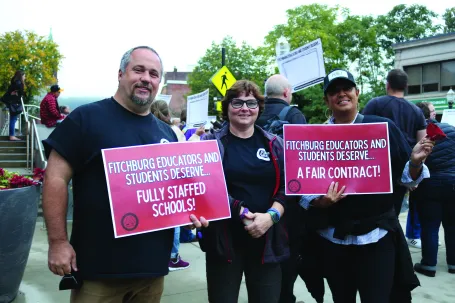
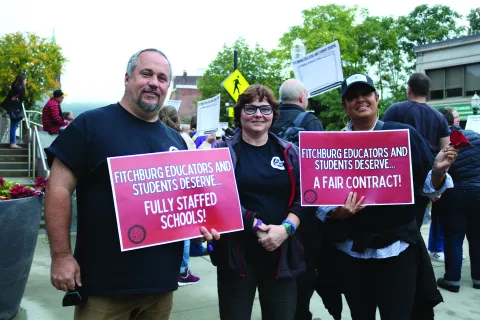
In Fitchburg, paraeducators are fighting to create a starting salary of $40,000. The current top salary for the job is about $30,000.
"I’ve been working with special education students for 22 years, and can’t live off of this one job," said Jennifer LeBlanc, a Fitchburg Education Association member who holds a second job.
The FEA paraeducators are bargaining alongside union members who are classroom teachers, and the solidarity between the units is driving a push for worker equity.
"We are trying to get 10 paid holidays, like other workers have. Right now, we have none," said Scott Gammel, a leader of the paraeducators.
The Fitchburg School Committee got the message that all educators deserve fair pay and benefits when the FEA recently delivered a petition signed by the membership demanding equitable treatment for all members.
Likewise in Shrewsbury, when ESPs took their fight to the School Committee, the president of the Shrewsbury Education Association — a separate union from the SPA — spoke up for them.
"I’m going to speak from the heart as an educator with 36 years of teaching experience," said SEA President Kelly Finneran. "I could not imagine doing my job of educating my fourth graders without the support of these paras."
For more information on ESPs and contract actions, visit massteacher.org/esp.