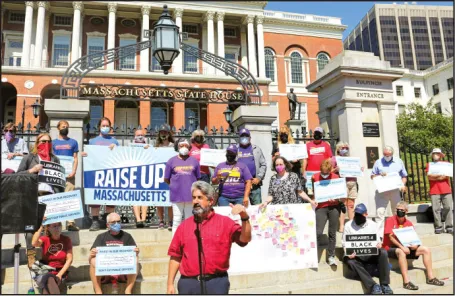
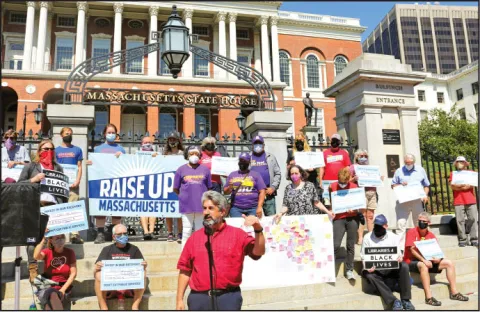
Educators are playing a key role in the Raise Up Massachusetts coalition’s effort to address the economic crisis brought on by the COVID-19 pandemic in a way that protects families, students and communities.
The MTA is a partner in the coalition’s Invest in Our Recovery campaign, which seeks swift state action to generate the revenue necessary for public health and public education, as well as aid to people affected by job losses.
Events in recent weeks have focused on promoting progressive tax initiatives, with coalition members taking part in virtual forums and holding remote meetings with legislators to seek solid commitments on three issues:
▪ Rolling back the tax cut on corporate profits to restore the 9.5 percent rate. Focusing on corporate profits would spare independently owned small businesses in the state and generate $450 million to $525 million in revenue.
▪ Tightening the loophole that allows corporations to shift their profits overseas to avoid state taxes. The coalition is pushing the Legislature to increase the state tax rate on so-called Global Intangible Low-Taxed Income — GILTI — as happens in other states that mirror federal policy, generating $200 million to $400 million.
▪ Increasing the tax rate on unearned income — including dividends and interest from investments and assets such as stocks and bonds — by 2 percent. Every percentage point above the current rate of 5 percent could generate more than $400 million while protecting working families from higher taxes on wages and making investors pay their fair share.
The Legislature could implement these measures even as work continues to place the Fair Share Amendment on the Massachusetts ballot in 2022. The amendment would add a 4 percentage point surtax on the portion of a person’s annual income over $1 million.
"Massachusetts is still a very wealthy place for those at the top," said MTA Vice President Max Page.
During a Labor Day rally highlighting the reinvestment plan, Page pointed out that the 19 billionaires who live in Massachusetts have seen their collective wealth grow by more than $17 billion during the pandemic.
"More than 9,000 people have died, 120,000 have gotten sick and one million have lost jobs. We demand a robust and just recovery that allows workers to rise," Page said during the State House event.
A poll of 600 voters shows strong backing for the Raise Up revenue initiatives, with each one garnering between 70 percent and 85 percent support.
Before the pandemic hit, Massachusetts was on track for its first major reinvestment in public education in more than 20 years as a result of the signing in 2019 of the Student Opportunity Act. There was also a high-energy effort to ensure greater state funding for public higher education through the Cherish Act.
Now, many school districts are scrambling to cover the costs of making buildings safe and addressing the academic, social and emotional needs of students engaged in both in-person and remote learning. Public colleges and universities have cut staff and programs, and many are worried that the losses may be permanent.
MTA President Merrie Najimy said that passing progressive revenue initiatives will also improve public health programs.
On Sept. 29, Najimy joined fellow activists in the Massachusetts Health Equity Alliance, a coalition of doctors and community advocates, in calling on Governor Charlie Baker to do more to control the spread of COVID-19 in Massachusetts.
Najimy said the state has an obligation to make sure there is high-quality child care in communities; to ensure that students have access to the technology they need to work remotely; to prevent a wave of evictions; and to cover the costs of unemployment insurance so that families can avoid additional trauma from the pandemic.
"Now is the time to take a progressive approach to generating revenue and to raise taxes on wealthy individuals and corporations so we can finally have the massive investment in the public good that is long overdue," she said.
For more information on the campaign, please visit raiseupma.org and massteacher.org and watch the MTA’s social media pages.