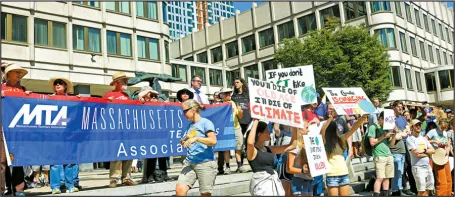
The COVID-19 pandemic has forced the cancellation of large gatherings that had been planned around the 50th anniversary of Earth Day to address climate change and promote environmental activism. But the work itself continues — and the MTA’s Climate Action Network is in the thick of it.
There are now more than 160 MTA members participating in the network, including a core group of about two dozen educators that has been organizing fellow MTA members to take action on climate change.
Because of the network’s advocacy, the MTA supported last year’s youth climate strikes and signed on as a sponsor of Earth Day 2020 Boston.
Michael Kozuch, a high school history teacher in Newton, played a leading role in developing plans for Earth Day events in Boston. Kozuch, who also offers a course on sustainability, reduced his teaching load to focus on organizing rallies and teach-ins to span a week of action that was to have started on April 18.
But by the end of March, when it became clear that large public events would not be possible as a result of the coronavirus crisis, Kozuch had pulled together an online meeting of student activists and members of environmental groups who had been involved in the planning for Earth Day.
Although the meeting began with a tone of disappointment, it ultimately blossomed into an enthusiastic brainstorming session about ways to use social media platforms to promote the Earth Day message of activism to protect the environment.
"I was surprised and then encouraged by the level of support people voiced to keep going despite the incredible disruption in everyone’s lives," Kozuch said.
He was not surprised that students took the lead in designing the new digital format. As MTA Today went to press, the organizers were planning a Facebook Live event on April 18 and an ongoing campaign to post nature photos with the hashtags #earthday2020boston, #earthrise and #strikewithus on social media sites.
Kozuch, who was born the day after the first Earth Day, which was held in 1970, has been teaching a course on sustainability for a dozen years. Upon noticing his students’ eyes opening wider and wider with each class, he concluded that more social action was needed.
"Part of my teaching the course is empowering students and letting them know that their voices matter," Kozuch said.
He likened the organizing surrounding climate action today to the activism that grew around other movements, such as opposition to the Vietnam War, the environmental awareness campaigns of the 1970s, and fights for the civil rights of people discriminated against based on race, gender and sexual orientation.
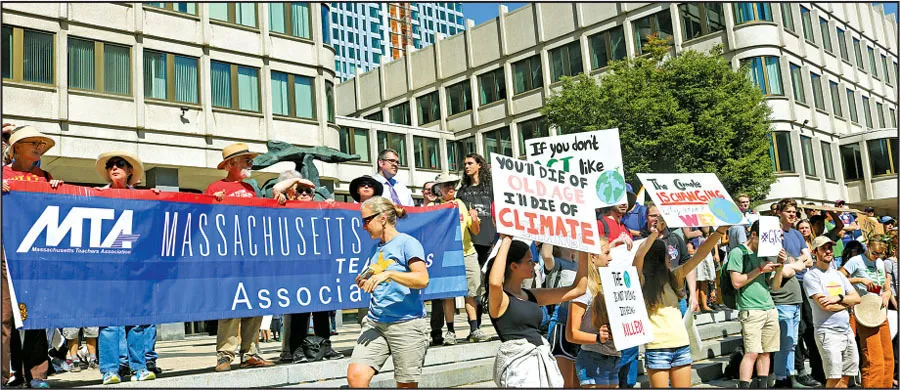

"Young people have always had to push the adults to listen," Kozuch said. "Once again, we are seeing young people make a difference."
Simone Klein is a senior in Kozuch’s sustainability course. She said that at first, she was disappointed when the plans for in-person Earth Day events had to be canceled.
"Planning a big event, though, I’ve been learning how to be flexible," Klein said. "We are making an active choice to keep going. If climate justice is important, we just need to decide what we can do."
Part of her motivation to keep working on a virtual Earth Day program involves the fact that so many of her peers — not just her fellow students in the sustainability course — see climate action as a crucial issue. More people are recognizing climate change as a universal problem, Klein said.
She said that in addition to posting photos on social media that promote environmental awareness, she was most looking forward to creating Earth Day chalk murals, especially at her high school — while employing all of the necessary social distancing, of course.
"It will be great to bring back life to the school," she said.
Likewise, the Climate Action Network is keeping alive its ambitious plan to deepen environmental awareness and activism within the MTA.
The network has four areas of focus:
- Supporting student actions such as climate strikes.
- Developing "green" contract language to bring to the bargaining table.
- Creating a broad array of curricular materials not only to educate students at all levels, but also to educate fellow educators on climate change.
- Forming coalitions across environmental and labor groups.
Climate Action Network member Craig Slatin, a retired UMass Lowell professor, said that one priority is building consensus among coalition partners for a unified position on cohesive legislative action that moves the country toward a Green New Deal.
There already has been some success, Slatin noted, in crafting contract language that encourages sustainability, including moving toward more energy-efficient workplaces.
As public funds are diverted to address the damage wrought by climate change, that will have an impact on how public education is funded in the future, Slatin said. That is another reason educators should be actively working to mitigate the problems arising from global warming and pollution, he added.
"The coronavirus crisis is showing us in the short term the impact of a global crisis," Slatin said. "The climate crisis — slowly over time — will have an even deeper impact, which is why we need to convince people to act now."
Kozuch said he believes the pandemic will inspire people to behave differently.
"In every tragedy, there are opportunities to rethink how we move forward," he said. "The current crisis is getting us to rethink how we organize as a society and should be getting us to think how to make our society more sustainable."