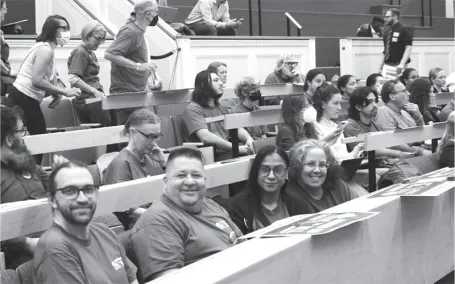
Despite recent upticks in state funding for public colleges and universities, the Massachusetts public higher education system still suffers from the impact of shrinking state investment over the past 20 years. The ripple effect of inadequate state funding for public higher education has impacted students, faculty and staff, as described during a wealth of testimony delivered before the Legislature’s Joint Committee on Higher Education.
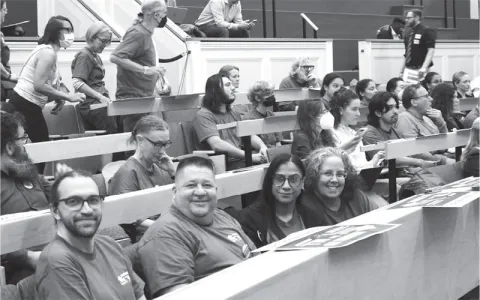
The committee held a hearing on the Cherish Act in September. The Cherish Act, supported by the MTA and its allies in the Higher Ed for All coalition, is a multi-pronged effort to improve working conditions at public colleges and universities, increase financial support for students, restore state responsibility for campus buildings and their maintenance, and position public colleges and universities to be leaders in creating climate-friendly spaces for working and learning.
Establishing debt-free access to high-quality public colleges and universities is among the goals of the legislation.
Students who spoke at the Sept. 18 hearing addressed the significant cost barrier of attending a public college or university. A UMass Amherst student described how a sudden change in his family’s financial situation could force him to withdraw from school or delay completion of his degree.
Celine Voyard, a recent UMass Boston graduate, pointed out that tuition at the university has increased by 135 percent over the last 20 years, and that important resources have been cut, such as the early learning center used by students who need child care.
"You are pricing out the very students our institution was meant to protect," she said.
The prohibitive cost of higher education is not just a problem for those already in college. Malden educator Jessica Gold Boots told how the high school students she works with — many of them English learners — have the grades and accomplishments to get accepted into a public university, yet learn that they cannot afford to attend once they determine the difference between the cost and their aid package.
"I saw students’ faces fall in late May after receiving a negligible financial award letter," Gold Boots said. "Still more students would accept and enroll, only to drop out a semester or two later – when they realized they didn’t have a viable financial path to graduation – laden with student loans. This wasn’t just a one-off experience. Year after year, my colleagues and I sadly witness students and their families do everything they are encouraged to do – work hard, be inquisitive, advocate – only to furlough their own dreams when facing the immense cost of college."
Faculty and staff working at community colleges, state universities and UMass campuses also are advocating for the Cherish Act to help address increasing workloads and establish equitable pay and access to benefits for part-time workers.
Adjunct faculty, in particular, have pointed out that their working conditions are becoming untenable. The pay for adjunct faculty is considerably lower in comparison to their full-time and tenured colleagues, and adjunct faculty have limited access to benefits even when taking on the equivalent of full courseloads.
Eric Parkison, an adjunct professor, said the funding that the Cherish Act seeks would provide dignified working conditions.
"Even after more than a decade as an adjunct teaching at one or two, or three or even four, schools a semester, I have never been considered full time in any position I’ve held in academia. I haven’t accrued much for retirement. I don’t have employer-sponsored health care. I feel desperate much of the time and ashamed. Even after a good semester I feel ashamed for what little has come from my investment in my education," said Parkison, who teaches at institutions including Bunker Hill Community College.
"You are pricing out the very students our institution was meant to protect."
CELINE VOYARD UMass Boston graduate
Dozens of state legislators are cosponsoring the Cherish Act, and several spoke in favor of the bill. The committee will decide whether to move the bill forward for consideration by the full Legislature.
Massachusetts is trending in the right direction with public higher education. Using funds from the Fair Share Amendment, which raised money for public education through a 4 percent tax on taxable annual income above $1 million, the state launched MassReconnect, which allows anyone age 25 and older without post-secondary education to attend a community college at no cost.
But clearly more needs to be done to improve access to public colleges and universities.
A recent report by the Hildreth Institute found that despite increasing high school graduation rates, enrollment is down at public colleges and universities, even as employers are looking for more collegeeducated workers.
The drop in enrollment was steepest among students of color and low-income students, the report found.
Michael Ash, a UMass Amherst economics professor, and Colin Jones, an analyst with the Massachusetts Budget & Policy Center, both highlighted the societal benefit of implementing debt-free, high-quality public higher education.
Jones estimated the total cost of the Cherish Act at $750 million but said much of what the bill aims to do can be phased in over several years.
"The Cherish Act renews and expands the two-century-old social contract of shared responsibility for public education and the intergenerational compact in which citizens pay forward the returns of the trust and investment of the previous generation." Ash said. "The Cherish Act is a recipe for growth, social solidarity and broadly shared prosperity."
To take action on the Cherish Act, please visit mahigheredforall.org.