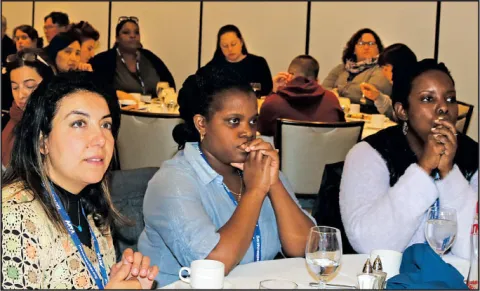
The 2019 MTA Ethnic Minority Affairs Committee Conference focused both on the past and the years ahead as participants honored EMAC’s 40th anniversary and looked to a future in which love — of teaching and of public education — will play a central role in the fight for economic, racial and social justice.
The conference was held on Friday, Dec. 6, and Saturday, Dec. 7, at the Four Points Sheraton Hotel in Norwood.
A video tribute honored those who built EMAC in its first four decades to make ethnic minority members’ empowerment central to the work of the MTA. The conference also featured a keynote speech by Dr. Durryle Brooks titled "Bringing Love Back into the Social Justice Conversation," along with a panel discussion on keeping love at the center of conversations about education and justice and a day of workshops on the same theme.
EMAC Co-Chair Yan Yii, a fifthgrade teacher in Canton, welcomed the crowd on Friday evening, saying that a steady stream of hate, racism and fearmongering in the public sphere was the impetus for this year’s theme.
"We needed to put the conversation about education and social justice back where it belongs," she said. By refocusing on educators’ love for their profession, their students and their communities, she said, "we can stop leading with hate and anger."
Co-Chair Sharmese Gunn, a senior resource specialist and adjunct professor at Mount Wachusett Community College, thanked those "who paved the way for us to be sitting here today, celebrating 40 years of EMAC."
Gunn reminded the audience to follow the lead of EMAC’s founders and former chairs, a number of whom were highlighted in the video. She advised attendees to get to know their union, self-nominate as ethnic minority delegates to the MTA Annual Meeting or the NEA Representative Assembly, and be sure to vote in the next presidential election.
"Whether voting or attending a ‘White Fragility’ book club," she said, members should pass along what they feel and find out. She added: "Tell a friend, tell a friend, tell a friend!"
Lincoln educator Claudia Fox Tree, who is descended from the Arawak Nation, addressed the crowd in Taino, one of the many Arawak language groups.
She told the audience that the land on which the hotel sits was once the home of the Massachusett people and that they still survive on the land to this day.
She urged those present to "think about all the places you have lived and traveled" and remember that they have often been on ground once stewarded by indigenous people "who were often enslaved, who survived genocidal movements, and who had their land taken away from them."
MTA Vice President Max Page said he was proud to be present at EMAC’s 40th anniversary event and praised the committee’s work. The crowd erupted in applause as Page called the recent enactment of the Student Opportunity Act "a major victory for racial justice in Massachusetts."
"We are antiracist by fighting for $2 billion in increased funding and insisting that the money go to communities with the greatest need and that have experienced the greatest oppression," he said. "We are antiracist when we fight for safe communities for all students and for our families, no matter how they came to be our students and our neighbors."
MTA President Merrie Najimy urged the educators who filled the room to fight for racial and social justice for the sake of their students. She said that Paulo Freire, an education scholar of the last century who was a leading advocate of critical pedagogy, "challenges us to understand that education is intended to liberate the human being from conditions of injustice and oppression."
"How do we transform education to be liberatory? We take a pedagogy and we put it into practice," Najimy said. "Our job is to create classrooms as liberatory spaces." Educators can also achieve education as liberation through their unions, she noted. "We do that by acting on the lessons of Freire."
Yii then introduced Brooks, an interdisciplinary scholar and social justice practitioner whose work centers on dismantling systems of oppression by examining the everyday ways that power, privilege and oppression function together.
Keynote speaker talks about ‘what it takes to build up’
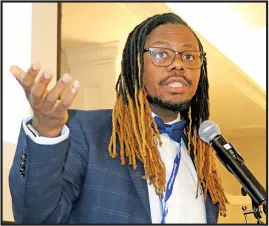
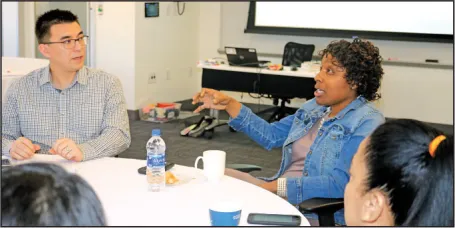
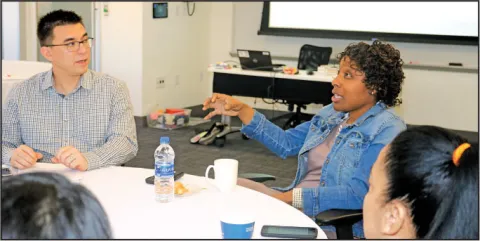
During his childhood in Baltimore, Dr. Durryle Brooks told the audience at the EMAC Conference, he was given little support — economic or emotional. He asked rhetorically, "What is love to a little gay black boy in Baltimore City who never had a chance?"
During his childhood in Baltimore, Brooks said, he was given little support — economic or emotional. He asked rhetorically, "What is love to a little gay black boy in Baltimore City who never had a chance?"
Brooks said that as he became interested in social justice work, he went looking for a definition of love. He found it not in "an anemic, romantic notion" but in a definition that had power.
"That’s the way I entered this work," he told the crowd. "I needed the kind of love that Dr. Martin Luther King Jr. talked about when he said, ‘We need a love that does justice.’"
So rather than "cutting and destroying, tearing down" those with differing views, Brooks eventually decided to focus on "what it takes to build up."
He said that what he didn’t know growing up in poverty in Baltimore "was that I would become a character assassin" for a time.
"I thought I needed to point out others’ flaws," he continued. "But I needed to learn that the person right next to me was just as important to the development of my own spirit as I was. That’s the work that we need to do.
"That’s the work that will take a lifetime," Brooks said. "But you have to start it, because at the end of the day, without it we’ll be ill-equipped to create social change."
To close out the evening on Friday, participants were treated to spoken-word poetry, a musical number by fellow MTA members, and dance by young performers from the Afro Dance Group based at the Lt. Peter Hansen Elementary School in Canton.
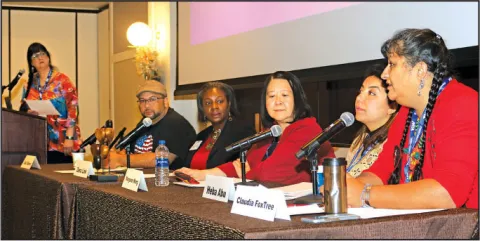
On Saturday, conference participants attended a panel discussion moderated by EMAC member Shauna Manning that expanded on the theme of the conference. Participants then attended workshop sessions, viewed the video tribute, enjoyed a celebratory cake, and attended more workshops.
MTA Benefits provided prizes that were awarded throughout the conference.
Marilyn Madden Walsh, a special educator who was attending her first EMAC conference, said the event helped her with the work that she and her colleagues are doing at the Fletcher Maynard Academy in Cambridge as they read Zaretta Hammond’s "Culturally Responsive Teaching and the Brain."
"The keynote speech gave us a lens through which to look at our work with our students," she said. "We do a lot of connecting and relationshipbuilding with families, and this all ties in. Knowing yourself and your own story helps you to connect to other people and their story."
Open advertisement in lightbox 
Let Cambridge help you live debt-free
Debt Consolidation - Without a Loan!
- Consolidate your credit card payments into one simple monthly payment
- Our clients’ credit card interest rates are reduced by an average of 64% (from 22% down to 8%)
- Our clients save an average of 25% on their monthly credit card payments
Student Loan Counseling
- Public Service Loan Forgiveness: Learn about loan eligibility repayment plans and appropriate strategies
- Teacher Loan Forgiveness: Learn all the options available for teachers and find the best solution for you
Don’t let debt get you down
888.948.4639 www.cambridge-credit.org/MTA
Visit www.cambridge-credit.org/disclosures.htmt for full licensing Information and required disclosures
To view the video celebrating the Ethnic Minority Affairs Committee’s 40th anniversary, please visit massteacher.org/EMAC40years.