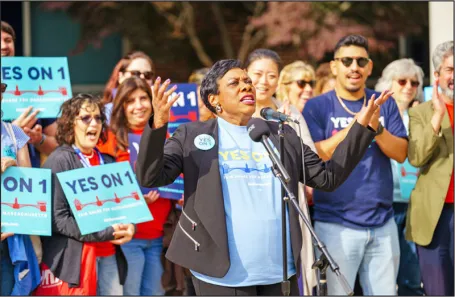
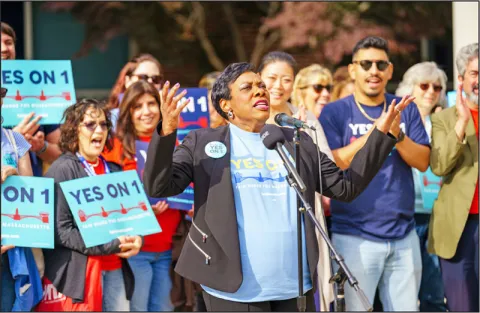
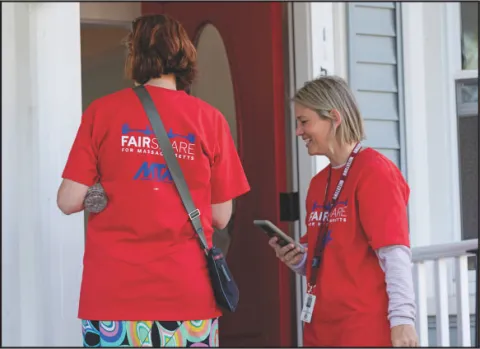
The path to winning the Fair Share Amendment can start in the parking lot of a Cape Cod supermarket or on a doorstep in Newburyport, Newton, Worcester or Springfield. MTA members know that — and they have spent the past several months canvassing the state to spread the word about the benefits that passing Question 1 will provide.
Now, with just days left before the Nov. 8 election, many educators say they are hopeful that the people they’ve been talking to will vote yes. But their advocacy will not stop until the polls close.
MTA members who have worked on phone banks, gone door to door in neighborhoods and spoken to family members and others about the FSA say they feel boosted by their actions. Every conversation is an opportunity to inform a voter. Every interaction in the community is a chance to explain how the amendment would work to help public schools and colleges, as well as address the deterioration of the state’s roads, bridges and transit systems.
Question 1, which is on the statewide general election ballot, would create an additional tax of four percentage points only on annual taxable income over $1 million. The money raised — an estimated $2 billion a year — would be dedicated under the state Constitution to public education and transportation.
MTA President Max Page noted that educators are a crucial factor in the campaign because they are the most trusted and respected people in their communities on issues related to students, schools and colleges.
"Passing the Fair Share amendment is the focus of intensifying MTA grassroots efforts that are drawing support from our 115,000 members across the state," Page said. "It’s a visionary and urgent proposal, and educators are continuing to have those crucial one-on-one conversations with their colleagues, neighbors, friends and family members about how a ‘yes’ vote will mean a reliable source of funds for our public schools, colleges, and transportation systems."
Only the richest Massachusetts residents would pay more under the FSA. Making sure voters understand that is crucial — as is spreading the word about what it will do for public education.
Kelly Henderson, a Newton South High School English teacher, canvassed in late September alongside Page. Their territory brought them into neighborhoods filled with households that send children to her school. And yes, it made a difference when she explained who she was.
"It really helps get the conversation going, and they know that the city wouldn’t be what it is without the schools," Henderson said.
Despite that relationship, Henderson said, every time her local union, the Newton Teachers Association, bargains for a new contract, educators hear the same line: "There isn’t enough money." Henderson said the Fair Share Amendment could help change that.
"We hear this in every district, even the ones chock full of millionaires," Henderson said. "This ballot question puts that gaslighting on notice: There is money, and it should go to the things that are most critical to our society, not another hedge fund."
On Cape Cod, canvassing took alternate forms. Door-to-door walking often didn’t make sense given the number of vacation homes and summer properties. So Cheri Armstrong, a teacher at Monomoy Regional High School, joined other supporters in taking the cause to places with more foot traffic.
By setting up tables outside grocery stores, for example, she and other FSA supporters were able to find people who live in their communities all year.
"We’ve been at Stop & Shop for the last two weeks, and we found that to be very successful in being able to reach our neighbors and encourage them to vote yes on Question 1," Armstrong said. "It’s the people who live here year-round, those who come on Saturday mornings to shop for their groceries."
Karen Suttle was nervous at first about door knocking. But Suttle, an elementary school social worker in Revere, gained confidence as she went along, initially talking with fellow educators and then expanding her efforts to others.
"We all have a share to give," Suttle said during a recent meeting of MTA local presidents where inspiring educators to get involved was a key theme. "If I sit and wait for the next person, that’s not going to happen, so I might as well start with me and make the change now."
With each voter, she explained that only annual income of more than $1 million would be affected.
In Newburyport, Suttle connected with a man who said his mother had been an educator. He told her that the community does not need additional money as much as other areas in Massachusetts do — highlighting an equity argument in favor of the amendment.
"I asked him what he would like to see the money used for in his town," Suttle recalled. "He said, ‘You know what, Newburyport has a lot of resources. A lot of communities don’t have that. So I would really like to see the money go to those towns.’ That’s what we’re working for."
An aspect of the amendment that has been mischaracterized by opponents is that it will punish owners when they sell their houses or a small business. Unless someone makes a profit of more than $1 million they won’t be taxed.
Many towns and cities have responded with support.
As of early October, endorsements had been received from school committees, selectboards and city councils representing more than 50 communities.
They include the state’s three largest cities — Worcester, Springfield and Boston — as well as small towns and large suburbs. Newton, which is home to many of the highest-value homes in eastern Massachusetts, endorsed the amendment through its City Council.
In Salem, a resolution to support the question was approved by the School Committee after it was introduced by Vice Chairman Manny Cruz.
He explained in a statement shared by the Fair Share campaign: "With the dollars raised, we can uplift our school communities through providing the smaller class sizes, social-emotional supports, extra tutoring and additional counselors, nurses and social workers that our students deserve."
If the amendment is approved, it will address many of public education’s needs.
As a start, every classroom in every school should have desks and chairs that fit the students and are appropriate for the lessons, said Tracy Little-Sasanecki, president of the Springfield Education Association. If that seems like it should already be happening, it isn’t, she explained.
Framingham Teachers Association President Christine Mulroney said educators in her 1,250-member local seemed more optimistic about the year as schools reopened.
The Fair Share Amendment’s potential to provide a stable source of revenue for public education was part of the reason, she said. After feeling exhausted for the past few years as a result of the COVID-19 pandemic, many FTA members took the summer off to reboot.
Now they’re advocating strongly for voters to approve Question 1.
"And coincidentally, we just settled our contracts for a measly 2 percent, which does inspire educators," Mulroney said. "It inspires them to fight for more — to understand we have this opportunity now to add this money."
National Education Association President Becky Pringle joined MTA members and staff for lunch in Quincy on Oct. 16 and then spoke at an FSA rally in Dorchester, along with U.S. Representative Ayanna Pressley.
"We all agree that every student deserves a well-resourced public school where their potential isn’t limited by strained budgets or a shortage of teachers," Pringle told MTA Today. "But while working Bay Staters struggle to make ends meet, the rich are getting richer and multimillionaires aren’t paying their fair share to ensure Massachusetts students realize their dreams. I enthusiastically support ‘Yes on Question 1’ because it’s time for Massachusetts multimillionaires to support the future of this Commonwealth."
For more information about the Fair Share Amendment, please visit massteacher.org/fairshare or fairsharema.com.