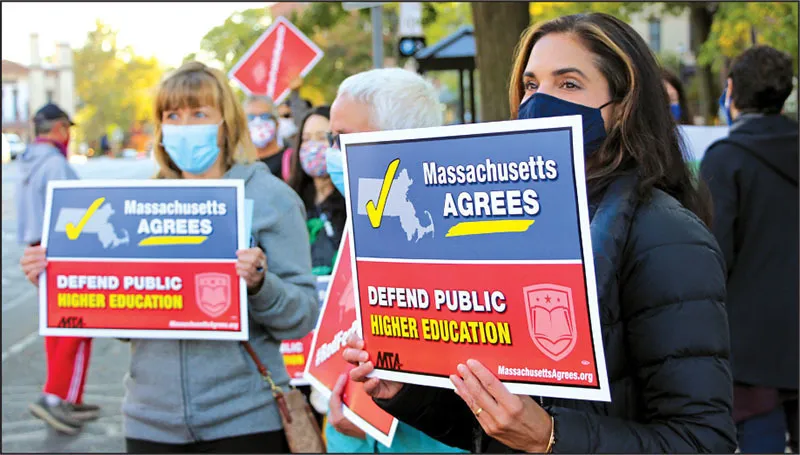
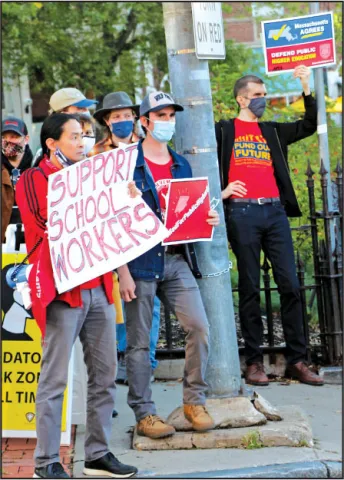
The MTA’s higher education members continue to lead the fight for sufficient state funding for public colleges and universities — and the effort to stave off deep, long-lasting cuts affecting students, workers and programs on campuses across the Commonwealth.
As the coronavirus pandemic continues to cause colleges and universities to adjust operations, MTA members have taken strong action to oppose decisions made by some administrators to reduce staff through layoffs and furloughs while eliminating course offerings and support services for students.
MTA Vice President Max Page recently addressed these issues during a hearing held by the Legislature’s Joint Committee on Higher Education.
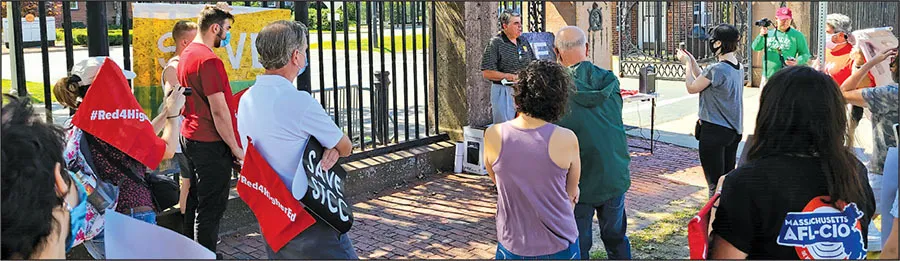
"Campus executives are rushing to cut invaluable programs," Page told the committee on Oct. 6. "For example, we are waging a battle right now to get Springfield Technical Community College to reverse its president’s decision to close seven programs — programs that produce nearly 100 percent job placement among their graduates.
"We are turning to fight against the relentless drive of Salem State University’s president to shrink the faculty and downsize or potentially close departments that are deemed ‘cost inefficient,’" he continued. "Fields such as art, sociology, economics, math and philosophy are being affected. I fear we are witnessing the sacking of Salem State."
MTA members in the UMass system have similarly taken aim at President Marty Meehan’s budget directives, which are based on an assumed revenue shortfall. Faculty and staff point out that the Legislature has so far committed to ongoing level funding for public higher education and that federal support is expected in whatever COVID-19 relief package is ultimately passed by Congress. Meehan’s budget projections don’t add up, they note, given the many unknowns about state and federal revenue.
MTA leaders also note that enrollment in the UMass system has not dipped as significantly as Meehan projected.
Through protests, rallies, car caravans, testimony and other forms of action, union members have been able to slow job losses. In addition, they got STCC to put the brakes — at least for now — on plans to drop programs.
Just weeks ago, a coalition of staff unions at UMass Amherst stopped the campus from immediately laying off about 450 workers in exchange for most of those employees taking two-week furloughs, among other steps. A joint labor-management committee has been created to explore other cost-saving measures.
The unions maintain that plenty of work remains to be done on the campus and that administrators have not thought creatively about job assignments during the pandemic. Workers are also demanding that UMass and other public higher education institutions use reserve funds to save jobs during the current economic crisis.
But even with the stopgap measures, the cuts are still going deep, displacing workers and taking away vital student services.
Tyler Bradley, a residence director who is a member of the Professional Staff Union at UMass Amherst, was placed on long-term furlough because the dorms are largely empty. Yet Bradley pointed out that his job also included an important advisory role, something he sees as essential to keeping students who are learning remotely connected to the campus.
"I was specifically hired to help LGBTQ students, and now that I’m on furlough, I can’t do that work," said Bradley, who participated in a recent Defend Public Higher Education standout in Northampton.
That demonstration was one of several designed to bring together union members from the different sectors of public higher education and to advocate for across-the-board support for community colleges, state universities and the UMass system.
Actions scheduled for the region north of Boston brought together union members and students from Middlesex and North Shore community colleges, UMass Lowell and Salem State. Among other issues, they highlighted health concerns on their campuses because of the state’s high COVID-19 infection rates and the fact that funding and staff cuts compromise safety.
The Massachusetts Agrees campaign likewise pulls together all of public higher education, directing messages at the Legislature about the need for adequate funding. The campaign recently launched its second video ad, focusing on the impact of cuts that have been made at UMass Boston, Quinsigamond Community College and Salem State.
And the campaign emphasizes that the immediate harm to workers, students and families is far from the whole story. It illustrates that slashing funding today will undermine public higher education’s vital role in the state’s economic recovery from the coronavirus pandemic.
"We all need to remember that for those with fewer skills and from low-income communities, this is not a recession — it is closer to the Great Depression," Page said during the higher education hearing. "These members of our Commonwealth need access to college, to a degree, to a certificate, more than anyone.
"With unemployment still in double digits, this is precisely the moment when the state should be dramatically expanding access to public higher education," Page added. "State Higher Education Commissioner Carlos Santiago speaks about demographic changes that are leading to fewer college-age students. What he fails to say is that fully 40 percent of the Commonwealth’s residents don’t have a college degree. In other words, there is a huge group of potential students out there, the very students he hopes to reach in the Department of Higher Education’s Equity Project."
For updates and further information, please visit massteacher.org and follow the MTA on social media. To view the videos and other material from the Massachusetts Agrees campaign, go to massachusettsagrees.org.