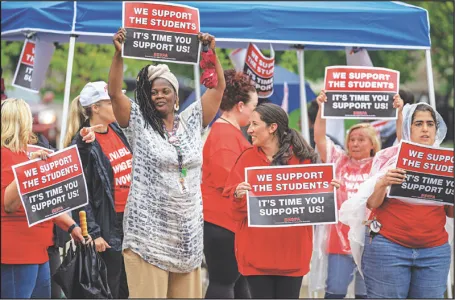
A years-long effort to increase salaries and benefits for Education Support Professionals paid off in several communities this spring and summer thanks to stepped-up action by MTA members.
The gains came in small and large locals across the state, as unions built on previous contracts and reached out to engage their communities.
In Somerville, the local secured a $35,000 minimum salary for paraprofessionals, an increase of almost 32 percent in the first year. The new contract also includes 12 weeks of paid parental leave for all educators, including for non-birthing parents.
In its last contract, the Somerville Educators Union secured a $25,000 starting salary for paraprofessionals and job security after four years, according to President Rami Bridge. This time, the priority was to move from a nominal percentage gain to a larger salary. The union followed an open process for negotiations that allowed members to follow what was happening.
And members were unafraid to take direct action — at one point in 2020 occupying a School Committee meeting to push for what the local was demanding. The SEU also distributed flyers when committee members who had said they would support union priorities later failed to follow through.
Bridge’s best advice for other locals? "To know your worth and not back off of it," he said. "These educators are worth this."
The Wakefield Education Association also stuck to its priorities. The 400-member union, which represents about 100 paraprofessionals, secured a 20 percent raise for all members over a threeyear period, including 15.5 percent this year, said association President Erin Chrisos.
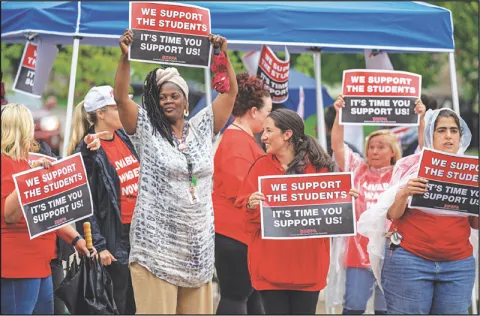
The new contract also includes a tripling of longevity pay, which starts after eight years, and input into professional development choices for ESPs.
Brockton paraprofessionals are continuing to bargain this month for a living wage, having made a strong stance earlier in the summer to reach out to the community and gather support for their goals.
In recent months, the Brockton Education Support Professionals Association has held a standout, coordinated an email blast of 3,200 messages to School Committee members and distributed flyers, in English and Portuguese, at the Cape Verdean Day Festival.
The 400-member local is seeking a $25-anhour minimum rate. That’s the same wage that the Brockton district paid one-year "community allies" who acted as hall monitors, according to local President Stacy MacDonald.
At the time, her union had a starting wage of just $16.90 an hour and the district couldn’t fill the ESP positions. "That opened our eyes," MacDonald said.
In Northampton, the local worked over three contracts to improve the status of ESPs, taking an active role in supporting and voting for unionfriendly candidates for School Committee. The Northampton Association of School Employees also simultaneously bargained all six of its unit contracts, which made the district see it was unified.
"Our strength comes in our numbers," said NASE President Andrea Egitto.
The local added bus monitors to its ranks this year and successfully negotiated a three-year contract that includes a $2-an-hour increase, yearly, for all paraprofessionals. By the end of the contract, ratified in June, the lowest-paid paraprofessional will earn $22.97 an hour, a 40 percent increase.
Paula Rigano-Murray, co-coordinator of the paraprofessional unit, described the contract as "phenomenal."
A paraeducator at Northampton High School, she attributed the gains in part to a decision by the local to "work to rule" in previous years, which demonstrated how much effort beyond the contract terms the ESPs had been putting in.
During bargaining, she prepared a slideshow of the MTA PreK-12 ESP Bill of Rights principles, and the accompanying living wage calculator, to demonstrate why ESPs needed to be paid more.
"I made it hard for them to say no," Rigano-Murray said.
Cambridge paraprofessionals, part of the 1,400-member Cambridge Education Association, also participated in actions this year.
The new CEA contract for paraprofessionals includes stronger terms for professional development and growth — including $1,000 a year in tuition reimbursement — and a requirement that all paraeducators be paid for the 6.5 hours they work, a 30-minute increase.
In addition, the unit got a 2 percent raise this year, to be followed by annual increases of 2.5 percent for the final two years of the contract, according to Bobby Travers, a 27-year paraprofessional who serves as CEA treasurer.
Travers said he sees growing respect for ESPs as educators — one of the tenets of the PreK-12 Bill of Rights — but there is still work to do on that.
"People think a paraprofessional is there to babysit kids — and we’re not. We’re there to educate kids. Overall, in public education, it has improved. But it’s still not where it should be."
In Andover, which also secured an improved contract this year, Special Town Meeting voters in mid-May approved a stipend of $800 for ESPs. Approval of the funds, to come from the town’s federal COVID-19 relief allotment, is being contested by the town administration.
But the support shown by residents was heartening, said Susan Greco, an Andover ESP and a member of Andover Citizens for Transparency, the group that organized the Town Meeting article.
"It is encouraging when we think about it. It shows the public does care about ESPs," she said.
For more information on Education Support Professionals and the PreK-12 ESP Bill of Rights campaign, please visit massteacher.org/ESP.