The MTA celebrated its 175th anniversary in November. The past three issues of MTA Today have featured stories from our history between 1845 and 1965, the year that the MTA won collective bargaining rights for teachers. In this edition we explore the period from 1965 to 1990, when the MTA became both a union and a professional association. It was a time of activism and strife that included the dawn of teacher strikes in the state, strong support for social change, and the devastating impact of Proposition 2½. All quotations in italics are from The Faces and Voices of the Massachusetts Teachers Association: Celebrating 150 Years of History, written in 1995 by now-retired MTA Communications Specialist Jerry Spindel. Other information is from MTA publications during the period and an interview with former MTA Executive Director-Treasurer Edward Sullivan, who worked for the MTA in several different capacities from 1971 to 2008.
The late 1960s through the 1970s was a period of powerful social change, including the rise of public-sector labor activism, the growth of the Civil Rights Movement, and the drive for women’s liberation.
In 1966, the American Teachers Association, a national African-American teachers’ group with 60,000 members, voted overwhelmingly to merge with the NEA. The ratification vote, which took place at the NEA Representative Assembly, was described by a witness:
"Every state association demanded the privilege of seconding the motion for merger. The Unification Certificate was signed by the presidents and executive secretaries of both organizations while delegates sang ‘Glory, Glory, Hallelujah.’"
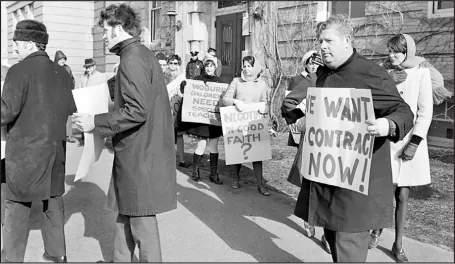
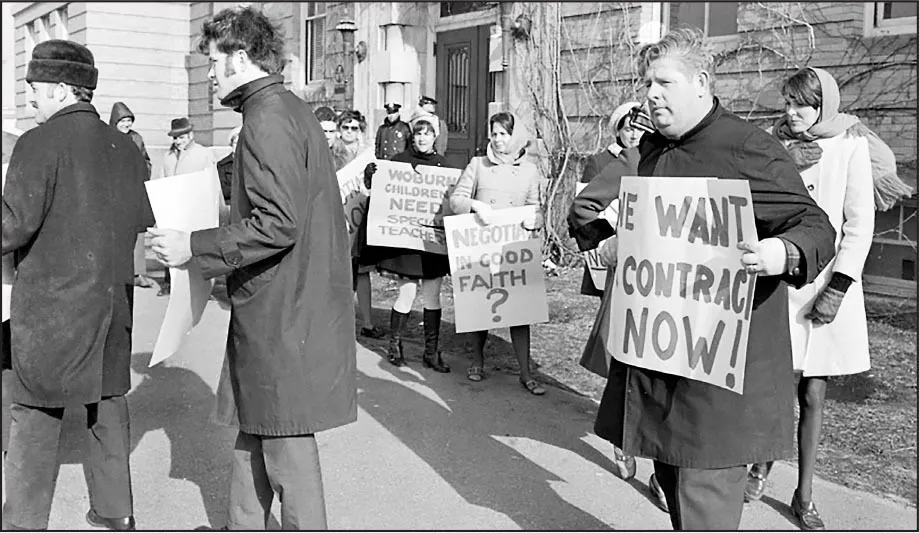
In 1968, the MTA opened its Boston headquarters, and a few years later it added regional offices and hired more staff. A strike for economic justice by the New Bedford Educators Association in 1969 was quickly followed by teacher strikes in Woburn, Brockton, Somerville, Burlington, Fall River, Grafton and Franklin.
During the two-week Franklin strike, in 1977, Superior Court Judge John M. Greaney jailed more than 80 teachers and fined the association $350,000.
One Franklin teacher who went to jail described her ordeal to MTA:
"We explained to the kids that their mother was going to jail. But try telling that to an eight-year-old. The first thing he wanted to know was, ‘How long? For a year?’
"I couldn’t even answer him. And then there are the fines and lost salary … I don’t know what it will mean. But we’ll manage. I did something I believe in very strongly, and I’d do it again — no matter what it cost."
Another jailed teacher shared his memories: "I was settling down to sleep when another inmate yelled up from a lower tier: ‘Hey, Teach, is this what you call collective bargaining?’"
Sullivan, then an MTA attorney, recalled those heady days.
"You could feel the electricity," he said. "A new type of activist leader was emerging. It was still a professional association, but we were on the move."
Speaking of the Franklin strike, he said, "Teachers from other locals came out in droves to support them."
The MTA, whose members were then and still are predominantly women, also fought against continued discriminatory practices.
In 1973, the MTA established the Committee on the Advancement of Women in Education. Six years later it celebrated a major victory when the state Supreme Judicial Court ruled that it was unlawful sex discrimination to exclude pregnancy from sick-leave coverage.
The fight for ethnic minority rights gained new momentum in the 1970s, first at the NEA and then in state affiliates.
In 1979, the MTA established its Minority Affairs Committee. Today, the MTA Ethnic Minority Affairs Committee is one of several association groups fighting for racial justice.
Louise Gaskins, a leading spokesperson for minority affairs at the MTA and the NEA, said that Black educators had struggled for equal treatment for years. She concluded, "Until you let people in power know that you are interested in changing how things are, things will remain the same. Our goal is simple: We intend to catch up."
The MTA also expanded its membership base to include public higher education.
In 1974, with the passage of collective bargaining legislation, employees of public higher education were finally able to enjoy the same rights as their K-12 colleagues. One campus activist told MTA:
"What existed [before] was basically a weak system of reaction — some faculty member would get fired, and the others would get together and hire a lawyer to defend him. Or a committee would be elected to handle the problem. But this is changing today. Faculties are winning genuine authority in matters which affect them. The agent for this change is collective bargaining."
The MTA also helped pass important legislation to improve public education for students, including:
- Chapter 622, which assured students access to all programs without regard to sex, race, religion or national origin.
- The Transitional Bilingual Education Act, guaranteeing bilingual education to students from myriad language backgrounds.
- Chapter 766, guaranteeing appropriate services to the state’s more than 100,000 special needs students.
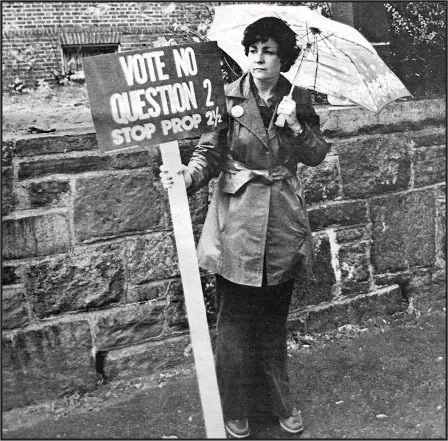
The promise of the 1970s gave way to despair in 1980 with passage of Proposition 2½, a statewide ballot question that strictly limited local property tax collections and eliminated fiscal autonomy for school committees. The MTA had fought the ballot measure and even put a competing, more moderate question on the ballot — but those efforts did not prevail.
The impact was devastating. It was many years before increases in state aid began to replace lost local property tax funds. In 1981, the MTA reported:
"These are among the signs of our times: The City of Cambridge proposes to cut 439 school employees. … The School Committee in Watertown approves a recommendation that could result in the loss of a third of the town’s 310 teachers. … The Quincy School Committee votes to close five schools and lay off 226 teachers. … The Boston Globe reports that large numbers of parents are considering enrolling their children in private schools because of the effects of Proposition 2½."
One 25-year veteran from the Berkshires wrote: "Like an invisible thief, Proposition 2½ has stolen one of my irreplaceable possessions: my career. It might have stolen my car; I could have replaced it. It might have taken my wallet; I could have found compensation. But it has taken that which I have nurtured and loved for a quarter century. I have not burned out. My zest for teaching holds energy enough for countless more years. I was put out."
New teachers were laid off in droves and positions were left unfilled. Years later the impact could still be felt, as many schools had large cohorts of older and younger teachers, but few in the middle.
The challenges to public education were not only financial. In 1983, "A Nation at Risk" was published. The report contributed to growing claims that public schools were failing.
A year later, almost 700 MTA members gathered at a special delegate assembly at Burlington High School to hammer out reform proposals based on their own experiences. Member voices informed the MTA’s advocacy in the debate over Chapter 188, the education reform law signed by Governor Michael Dukakis in 1985. The MTA praised the new law for funding equal opportunity grants and early childhood learning incentives but faulted it for not doing enough to limit class sizes or raise teacher salaries.
Also in the 1980s, wall-to-wall organizing opened the union to participation by every member of the family of Massachusetts public education, including school secretaries, custodians, bus drivers, teacher aides, food service personnel, library aides, laboratory technicians, telephone operators, medical records personnel, accountants, book-keepers, mail room clerks, computer programmers, library and reference assistants, audio-visual technicians, and others.
What didn’t change was the MTA’s struggle for members’ rights, benefits and professional dignity, leading to strikes in nearly two dozen locals in the 1980s.
When asked about teacher strikes by reporters, MTA President Nancy Finkelstein explained:
"Teachers are frustrated because in the midst of the Massachusetts Miracle, they have been left behind. If it is true that a rising tide lifts all ships, too many teachers are still waiting at the dock."
In future issues of MTA Today, we will write about highlights of the periods following the one covered here and leading up to the present day.